13Inorganic Chemistry Lecture Notes: Halogens and Thermodynamics
Recap of Previous Lecture Content
Reaction Orders:
First-order reactions ().
Second-order reactions ().
Zero-order reactions ().
Arrhenius Equation:
Chemical Equilibrium for Hydrogen Iodide Synthesis:
Chapter 9: Group 17, Halogens ()
9.1 Overview and 9.4 Electronegativity/Oxidation State
Terminology and Polarity:
The formula describes a covalent bond but doesn't explicitly state the polarity of the electron pair bond.
Polarity: Indicates whether one of the two atoms involved pulls the bonding electron pair more towards itself (Measured via the dipole moment).
Definition of Electronegativity ():
A measure of the ability of an atom in a covalent bond to attract the bonding electron pair to itself.
Ein Maß für die Fähigkeit eines Atoms, in einer Atombindung das bindende Elektro-
nenpaar an sich zu ziehen, ist die Elektronegativität x.
Die erste Elektronegativitätsskala wurde von Pauling aus Bindungsenergien abge-
leitet. Die polare Bindung eines Moleküls AB kann durch die Mesomerie einer kova-
lenten und einer ionischen Grenzstruktur beschrieben werden.
Electronegativity Scales
Pauling Scale:
Based on the difference in electronegativity between two atoms and .
Utilizes experimentally determined bond dissociation energies of molecules , , and .
Reference Value: Fluorine () is set to (formerly ).
Periodic Trends (Pauling Values):
Mulliken Scale:
Calculated as the mean of the ionization energy () and electron affinity ().
Energy expressed in electronvolts ().
Formula:
Eine andere Elektronegativitätsskala stammt von Mulliken. Er fand, dass die
Elektronegativität eines Atoms der Differenz seiner Ionisierungsenergie und Elekt-
ronenaffinität proportional ist. Dies bedeutet anschaulich, dass die Tendenz eines
gebundenen Atoms, die Bindungselektronen an sich zu ziehen, umso größer ist, je
größer die Fähigkeit des Atoms ist, sein eigenes Elektron festzuhalten und ein zu-
sätzliches Elektron aufzunehmen
Die Elektronegativitäten nach Mulliken beziehen sich aber nicht auf den Grundzu-
stand des Atoms, sondern auf seinen Valenzzustand (vgl. Abschn. 2.2.6). Mulliken-
Elektronegativitäten sind Orbital-Elektronegativitäten. Man muss daher zu ihrer Be-
rechnung die Ionisierungsenergie und Elektronenaffinität dieser Orbitale kennen.
Als Beispiel seien die Elektronegativitäten für die Orbitale der verschiedenen Va-
lenzzustände des C-Atoms angegeben.
Die Mulliken-Elektronegativität folgt aus der Überlegung, dass zwei Teilchen A
und B die gleiche Elektronegativität haben müssen, wenn die Energieänderungen
der Reaktion
Mulliken-
Elektronegativitäten sind Orbital-Elektronegativitäten. Man muss daher zu ihrer Be-
rechnung die Ionisierungsenergie und Elektronenaffinität dieser Orbitale kenne
Allred-Rochow Scale:
Electronegativity is proportional to the electrostatic attraction force () exerted by the nuclear charge () on the bonding electrons.
Formula:
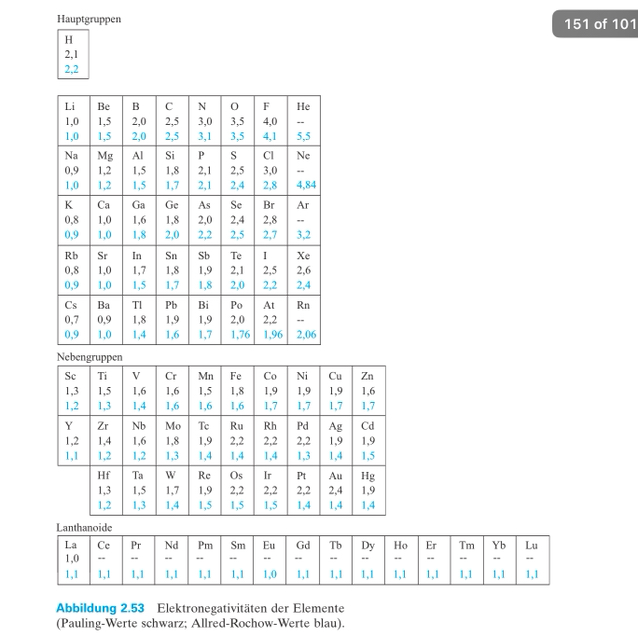
Oxidation States (OZ)
Definition: The formal charge of an atom within a chemical compound (salts or molecules). Bonding electron pairs are mentally assigned to the more electronegative partner.
Bonding between identical elements: The electrons are shared equally.
Nature of the value: It is a formal size/quantity that often does not represent the "real" charge; it is a crucial formalism for the stoichiometry of redox reactions.
Standard Rules for Oxidation States:
Maximum positive OZ: Corresponds to the main group number () (except Group 1 transition metals).
Fluorine (): Always (as the most electronegative element).
Oxygen (): Almost always (Exception: peroxides).
Alkali Metals: .
Alkaline Earth Metals: .
Hydrogen (): Usually (Exception: metal hydrides like , where exists as ions with an OZ of ).
Pure Elements: Always .
Ions: The OZ equals the ion's charge. For complex ions, the sum of OZs equals the total charge.
Ionic Compounds: The OZ is equal to the ionic charge.
9.5 Thermodynamics of Chemical Reactions
General Principle: Chemical reactions involve not just matter changes but also energy conversion ().
Unit of Energy: Joule (). (Historical: ).
The SI System: International System of Units ().
9.5.1 Reaction Enthalpy ()
Defined as the reaction heat of a chemical reaction occurring at constant pressure.
Standard Conditions: ; . Symbol: .
Molar Reaction Enthalpy (): Expressed in , referring to 1 mole of product formed.
Thermicity:
: Exothermic (energy is released).
: Endothermic (energy is required).
Die Größe der Reaktionsenthalpie ΔH hängt von der Temperatur und dem Druck
ab, bei denen die Reaktion abläuft. Man gibt daher die Reaktionsenthalpie für einen
definierten Anfangs- und Endzustand der Reaktionsteilnehmer, den so genannten
Standardzustand, an. Als Standardzustände wählt man bei Gasen den idealen Zu-
stand, bei festen und flüssigen Stoffen den stabilen Zustand der reinen Phase, jeweils
bei 1 bar Druck und der gegebenen Temperatur. Der Standardzustand kann für eine
beliebige Temperatur definiert werden, d. h. der Standardzustand enthält nicht die
Temperatu
9.5.1 Hess's Law
Theorem: For identical initial and final states, different reaction paths yield the same reaction enthalpy, regardless of whether the reaction occurs in one step or several partial steps.
State Quantities (): Variables like that depend only on the state reached, not the path taken.
Nach dem Satz von Heß hängt die Reaktionsenthalpie nicht davon ab, auf welchem
Weg CO2 entsteht. Bei gleichem Anfangs- und Endzustand der Reaktion ist die
Reaktionsenthalpie für jeden Reaktionsweg gleich groß und unabhängig davon, ob
die Reaktion direkt oder in verschiedenen, getrennten Schritten durchgeführt wird.
Calculation: It allows calculating the reaction enthalpy of a total reaction from the enthalpies of its (theoretical) partial steps.
9.5.2 Standard Molar Enthalpy of Formation ()
Index "f" stands for formatio (formation); index "0" stands for standard conditions.
Definition: The reaction enthalpy occurring during the formation of 1 mole of the compound in its standard state from its elements in their standard states at .
Arbitrary Baseline: For elements in their stable standard state (e.g., gas, gas, Carbon as graphite), .
Formula for Reaction Enthalpy: .
Für die Standardreaktionsenthalpie wird das Symbol ΔHº (oder ΔrHº)
verwendet. Die jeweilige Reaktionstemperatur wird als Index angegeben. ΔH(
2 93 be-
deutet also die Standardreaktionsenthalpie bei 293 K.
Standardbildungsenthalpie
Da ΔH unabhängig vom Weg ist, können wir die Reaktionsenthalpien von chemi-
schen Reaktionen berechnen, wenn wir die Enthalpien der Endstoffe und Ausgangs-
stoffe kennen.
Die Standardbildungsenthalpie ΔHB
( einer Verbindung ist die Reaktionsenthalpie,
die bei der Bildung von 1 mol der Verbindung im Standardzustand aus den Elementen
im Standardzustand-vorzugsweise bei der Reaktionstemperatur 25º C-auftritt.
Examples of Standard Formation Enthalpies ( in )
Inorganic Compounds:
Organic Compounds:
Stability: High negative formation enthalpies are markers for chemically stable compounds.
Example Calculation (Synthesis Gas from and )
Target Reaction:
Step 1:
Step 2:
Calculation: . The reaction is endothermic.
9.5.3 Thermodynamics Laws and Gibbs-Helmholtz
First Law of Thermodynamics: Energy can be converted from one form to another but can neither be created nor destroyed (Energy Conservation Law).
Second Law of Thermodynamics: In an isolated reaction space (energetically and materially), only processes where entropy () increases can occur. Systems strive for maximum disorder.
Mit dem Begriff System wird ein Reaktionsraum definiert, der von seiner Umgebung
durch physikalische oder nur gedachte Wände abgegrenzt ist und bei dem nur kontrol-
lierte Einflüsse der Umgebung zugelassen sind (Abb. 3.13). Man unterscheidet:
Isolierte oder abgeschlossene Systeme. Es findet weder ein Stoffaustausch noch
ein Energieaustausch mit der Umgebung statt.
Geschlossene Systeme. Es wird zwar Energie, aber keine Materie mit der Umge-
bung ausgetauscht.
Offene Systeme. Sowohl Energie- als auch Stoffaustausch ist möglich.
Der jeweilige Zustand eines Systems kann mit Zustandsgrößen beschrieben
werden.
Zustandsgrößen sind z. B. Druck, Temperatur, Volumen, Konzentration. Sie hän-
gen nicht davon ab, auf welchem Wege der Zustand erreicht wurde.
1. Hauptsatz der Thermodynamik: Die von einem geschlossenen System mit der
Umgebung ausgetauschte Summe von Arbeit und Wärme ist gleich der Änderung
der inneren Energie des System
Energie kann nicht vernichtet werden oder neu entstehen (Energieerhaltungssatz).
Ändert sich das Volumen eines Systems bei konstantem Druck, so wird die Volu-
menarbeitgeleistet (Ist ΔV positiv, erfolgt Volumenzunahme, ist ΔV negativ, Volumen-
abnahme) (Abb. 3.14). Volumenarbeit ist bei solchen chemischen Reaktionen von
Bedeutung, bei denen der Druck konstant bleibt.
Die Reaktionswärme einer chemischen Reaktion, die bei konstantem Druck abläuft,
bezeichnet man als Reaktionsenthalpie.
Total Entropy: .
Gibbs-Helmholtz Equation:
(Free Enthalpy):
: Spontaneous reaction (Exergonic).
: Equipment is in equilibrium.
: Non-spontaneous reaction (Endergonic).
Bei einer chemischen Reaktion findet eine Umverteilung von Atomen statt. Dabei
erfolgt nicht nur eine stoffliche Veränderung, sondern damit verbunden ist gleichzei-
tig ein Energieumsatz. Mit den energetischen Effekten chemischer Reaktionen be-
fasst sich die Chemische Thermodynamik
Reaktionen, bei denen ΔH negativ ist, nennt man exotherm, Reaktionen, bei denen
ΔH positiv ist, endotherm
Thermodynamics of Salt Dissolution
Example: in water: It dissolves despite the reaction being slightly endothermic () because the term () is large and positive, making negative ().
The is positive because the ordered crystal lattice is destroyed, and ions move freely in solution.
Comparison of values ():
9.6 Hydrogen Halide Compounds ()
Synthesis/Preparation
From Elements: Formation under normal conditions via a Radical Chain Mechanism.
Chlorine/Hydrogen example: Requires short-wave light ().
Initiation:
Propagation: ;
Termination: ; ;
Laboratory Methods (Displacement reactions):
HF:
HCl:
HBr/HI: Formed via reaction with Phosphorus and Water.
General Rule: A stronger acid displaces a weaker acid from its salt.
Properties of Hydrogen Halides ()
Polarity vs. Acid Strength:
Polarity (electron-drawing ability) grows with increasing electronegativity from to .
Säurestärke (Acid Strength): Increases with greater dissociation capability: .
Physical Properties:
They are highly hygroscopic and dissolve readily in water to form monoprotic Brønsted acids.
Boiling Points (Anomalies):
has an exceptionally high boiling point () compared to other compounds due to Hydrogen Bonding ().
The trend for follows a typical increase based on van der Waals forces, but is the outlier.
Chemical Stability/Reactivity:
attacks glass through the reaction with Silicon Dioxide: .
is a medium-strong acid ().
dissolves extremely well in water (507 parts by volume in 1 part water at ).
9.7 Halogen-Oxygen Compounds
Oxoacids of Chlorine
Formula | Oxidation State | Name | Salt Name |
|---|---|---|---|
Hypochlorous acid | Hypochlorites | ||
Chlorous acid | Chlorites | ||
Chloric acid | Chlorates | ||
Perchloric acid | Perchlorates |
Trends: Acid strength increases as the oxidation state of the central halogen atom increases.
Perchloric Acid ():
The most stable and only oxoacid of chlorine that can be produced in pure form.
Decomposes explosively when heated.
Explosive reaction when in contact with combustible substances.
Stable in aqueous solution.
Halogen Oxides
Binary Chlorine Oxides: include .
State changes: exists as Chlorylperchlorate in the solid state.
Primary Oxides: The most important ones are (Dichlorine monoxide) and (Chlorine dioxide).
9.8 Interhalogen Compounds
Nature of Bonding: Covalent compounds.
Composition:
Most are fluorides, with the exception of (which exists as the dimer ).
The more electropositive element occupies the positive oxidation state ().
Only , and serve as central atoms; is primarily the substituent.
Types:
Diatomic (): All combinations are known.
Tetratomic ().
Hexa- and Octatomic ( and ).