Neural Circuits
Patterns of neuronal connections in CNS circuits
Diverging
Converging
Reverberating
Parallel-after-discharge
**NOTE: Focus on diverging/converging only
Simple Spinal Motor Reflexes
Myotatic reflex ~ knee-jerk response
Stimulation of peripheral sensors: muscle stretch receptor
Initiates receptor potentials → triggers action potentials (travel along afferent axons of sensory neurons)
Information stimulates spinal motor nerons thru synaptic contacts
Action potential from the spinal motor neurons travel peripherally in efferent axons
Causes muscle contraction and behaviral response
1 purpose of this reflex: help maintain an upright posture in the face of unexpected changes
What is the role of interneurons?
Why is the flexor showing no/little activity?
Golgi tendon organ reflex (opp. of myotatic reflex)
contraction of quadricepts → relaxes muscle + contraction of antagonist
axon synapse on both inhibitory + excitatory interneurons in the spinal cord
inhibitory neurons - innervate a motor neurons to the quadricepts (relaxes the muscle)
excitatory interneurons - innervate a motor neurons to the antagonistic semitendinosus muscle (contracts muscle)
Spatial Organization in the Spinal Cord
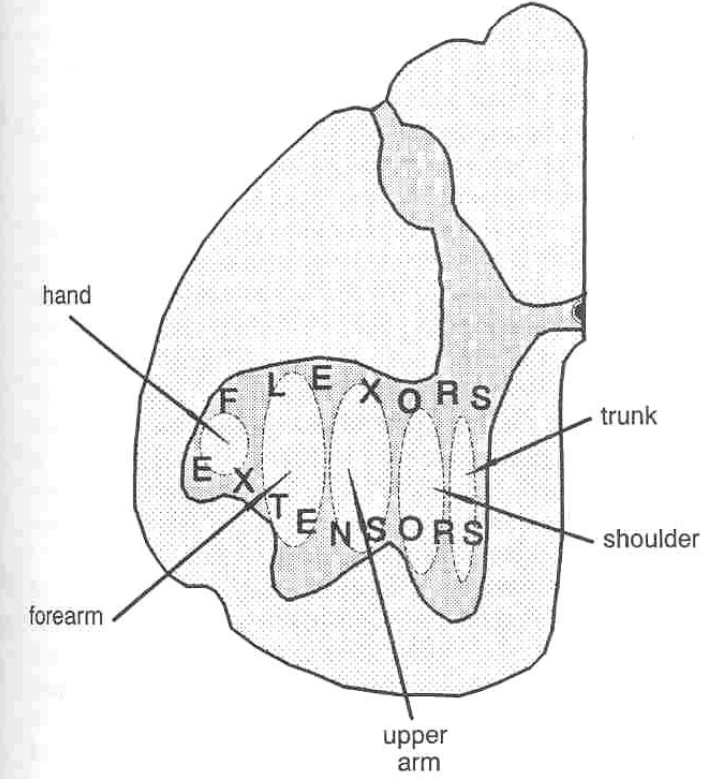
Spatial Motor Pattern Generators
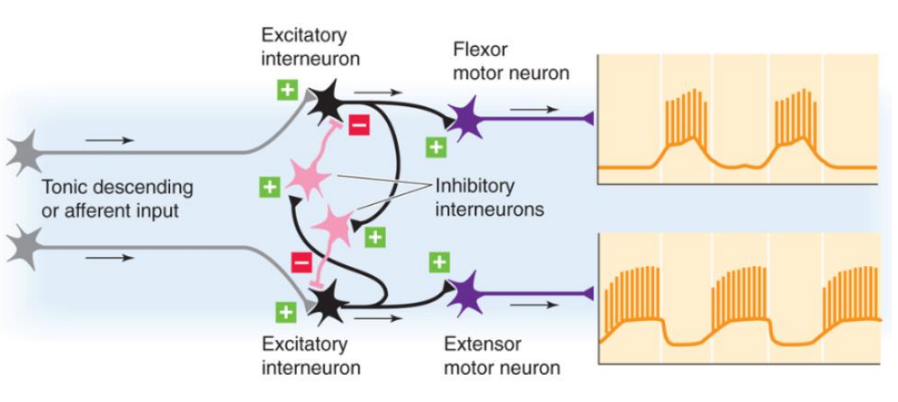
Stimulation of the upper excitatory interneurons has 2 effects
stimulated excitatory interneuron → excites motor neuron to the flexor muscle
stimulates excitatory interneuron → exites an inhibitory interneuron → inhibits lower pathway
Stimulation of the lower excitatory intereneuron has the opposite effects
when one motor neuron is active, the opposite one is inhibited
Cerebral Circuitry - Layers Lamination
Columnar processing circuits~
Basic local circuit in the neocortex consists of:
Inputs
Excitatory and inhibitory interneurons
Output neurons
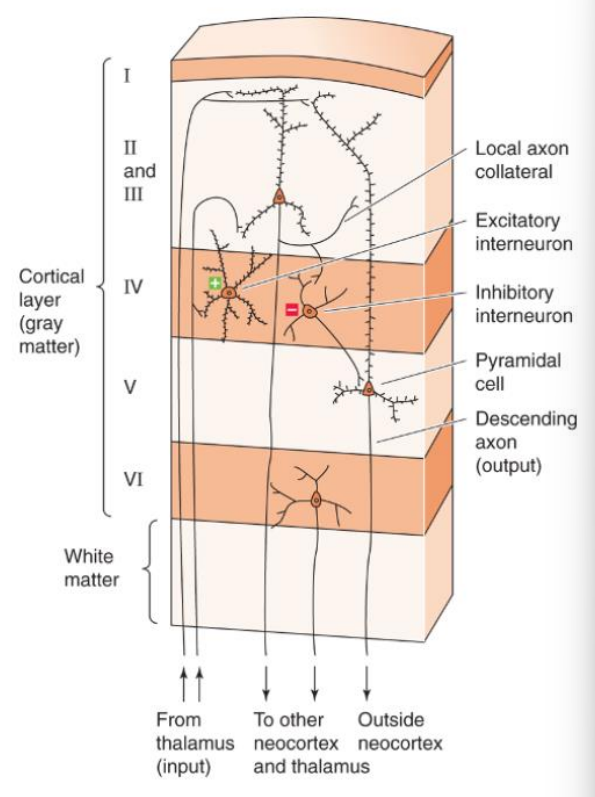
Connections Among Areas ~
Organization of Movement
Descending systems (upper motor neurons)
Motor cortex (planning, initiating, and directing voluntary movements)
Basal Ganglia - gating proper initiation of movement
Brainstem centers (basic movements and postural control)
Cerebellum - Sensory motor coordination
Spinal cord and brainstem circuits
Signal from brainstem centers towards:
Local circuit nurons - reflex coordination
AND
Motor neuron pools - lower motor neurons
sends signals to skeletal muscle
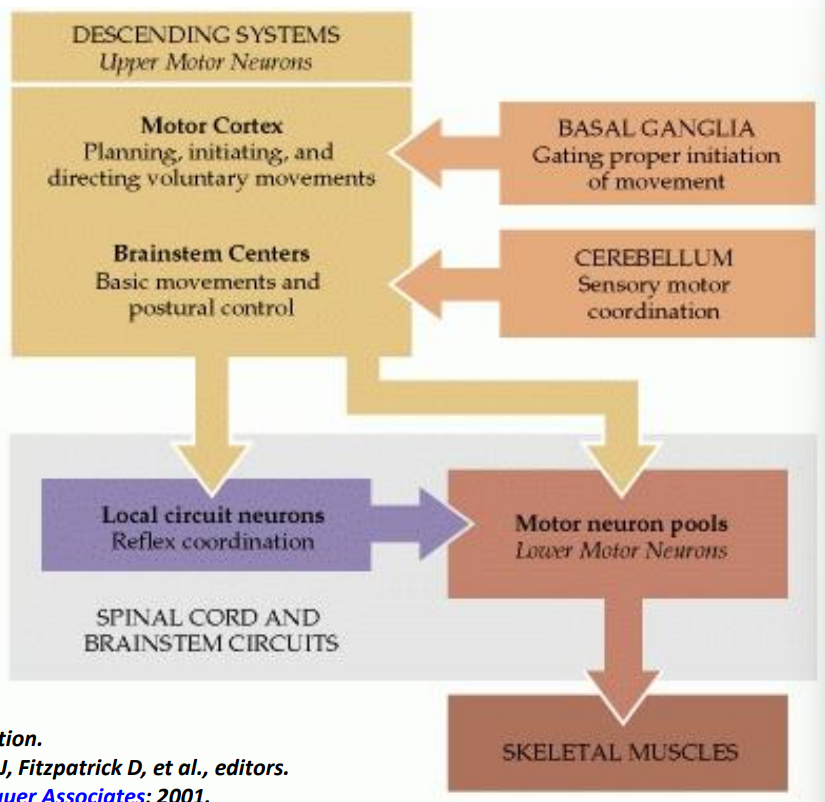
Movement: Connections Among Areas
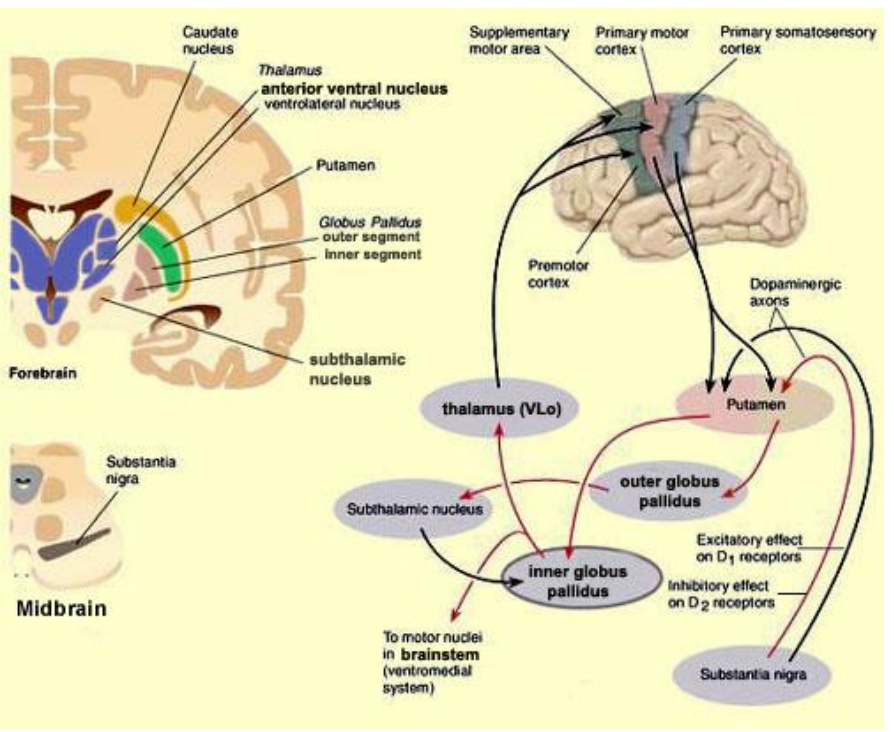
Striatum:
Is composed of:
Caudate nucleus (orange)
Putamen (green)
Major target for cortical afferents of the basal ganglia
Globus Pallidus:
Gives rise to efferents from the basal ganglia to the thalamus
Pars Oralis~
Part of ventrolateral nucleus of thalamus
projects to area 6
Usually designated by the symbol VLo
Other structures of the basal ganglia:
Form various internal loops → modulate the activity of the main loop
in which info passes thru the following brain structures in succession:
Cortex - straitum - globus pallidus - VLo - cortex (supplementary motor area, or SMA)
Which of the connections in this main loop are excitatory and which ones are inhibitory?
Excitatory influence of the substantia nigra and the subthalamic nucleus on various parts of circuit?