Pigments and Chromatography Video
How does wavelength relate to the color of light?
Electromagnetic Spectrum: wavelengths of light admitted from the sun
visible light is a part of the EM spectrum —> R.O.Y.G.B.I.V.
includes wavelengths 400-750 nm (range that human eyes can detect)
Violet has shorter wavelengths —> Red has longer wavelengths
Pigments: molecules that absorb light
Describe how absorption and reflection are related:
wavelengths that are NOT absorbed are reflected —> those are the colors we perceive
3 Pigments:
Chlorophyll: major photosynthetic pigment of the three
Xanthopyll —> accessory pigment
Carotenoids —> accessory pigment
Identify which colors of light chlorophyll absorbs and which colors of light it reflects?
Two types of Chlorophyll: a/b
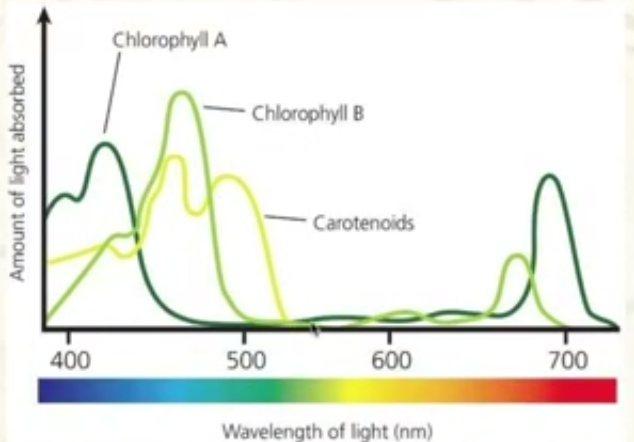
reflects green light & absorbs most other colors of light (wavelengths)
causes chloroplasts/leaves to appear green & absorbed lights to photosynthesize
main pigment in plants
Absorption Spectrum: shows the different wavelengths of light absorbed by a particular pigment/substance
peaks: high absorption
each line represents ONE TYPE of pigment
How does light absorption relate to the rate of photosynthesis:
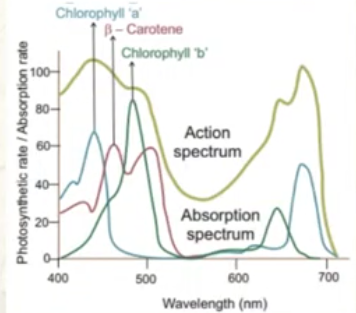
plants have several different types of pigments, so the overall rate of photosynthesis is a result of a combination of ALL the pigments absorbing light
more light absorption by pigments = higher rate of photosynthesis
Describe how the absorption spectrum differs from the action spectrum:
Absorption spectrum graphs are only ONE pigment, but the Action spectrum takes into account ALL the pigments present w/in the chloroplasts
Paper Chromatography: lab technique used to separate mixtures of substances as they move up the paper
substances: pigments extracted from plants
AKA thin paper chromatography
Outline how pigments are separated during paper chromatography:
pigments are dissolved in a solvent & will separate based on their solubility
the more soluble the pigment, the further it will travel up the paper
as the solvent travels, the pigments travel w/ it
Retention Factor (Rf): ratio of the distance moved by a pigment to the distance moved by the solvent
unique to each pigment in each solvent
Rf = distance traveled by sample/distance traveled by solvent
does not have units bc mm/mm cancels out
measure between the middle of the band
Plants in plant houses that use colored light must use a color besides green bc chlorophyll reflects green, color/light needs to be absorbed to perform photosynthesis