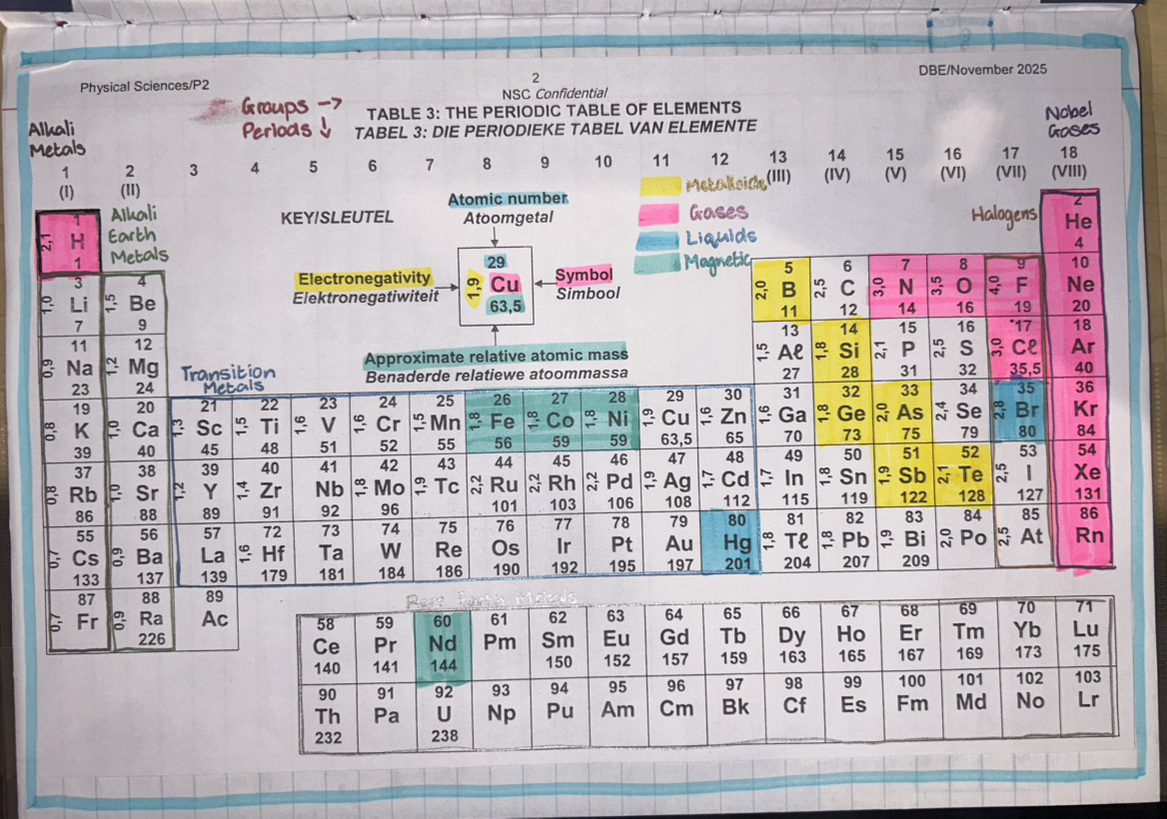
Periodic Table
Keywords:
Atoms
Smallest units that elements are made of (ten millions of a millimeter).
Molecule
When two or more non-metal atoms are chemically bonded together.
eg. H2, O2 and Cl2.
Compound eg. HO2 and CO2.
Salts
When a metal bonds with a non-metal.
eg. NaCl (sodium chloride) or Fe2O3 (iron oxide/rust).
Element
Pure substance.
Made up of only one type of atom that cannot be split up into simpler substances by chemical reactions.
There are 100 listed on the Periodic Table.
Compound
Is when two or more elements are chemically bonded together.
Their properties are nothing like the original elements.
The can be decomposed into their elements.
They can be molecules or salts.
Sub-Atomic Particles and Atomic Structure:
Atoms are made up of smaller particles called sub-atomic particles.
The nucleus is made of protons (p+) which are positively charged and neutrons (n0) which are neutral (ie. have no charge).
The mass number = p+ + n0
The nucleus is very tiny compared to the rest of the atom yet it contains more than 99% of the mass of the atom.
Electrons (e-) are negatively charged. They are arranged in energy levels around the nucleus like the layers of an onion. The first layer can contain 2 electrons, the next few can contain 8. These layers correspond with the periods on the Periodic Table.
Atoms are neutral therefore have an equal number of p+ and e- .
The atomic number is equal to the number of p+ (and e- in a neutral atom) which gives it its position on the periodic table.
Steps for Naming Compounds:
Steps:
Step 1:
Identify the elements in the compound.
Step 2:
Write down the name of the metal first.
Step 3:
If the compound contains only 2 elements, name the 2nd element and make it end in ‘-ide’.
Step 4:
If the compound contains 3 elements, one of which is oxygen, name 1st and 2nd elements and end in “-ate”.
Exceptions:
OH is called hydroxide.
When a metal is bonded with OH the compound’s name will end in
‘-ide’.
eg. NaOH = sodium hydroxide.
Prefixes:
Non-metal bonded to a non-metal.
1 - mono.
2 - di.
3 - tri.
4 - tetra.
eg.
CO - Carbon monoxide.
CO2 - Carbon dioxide.
CCl4 - Carbon tetrachloride.
Valence Electrons and Valency:
Valence Electrons:
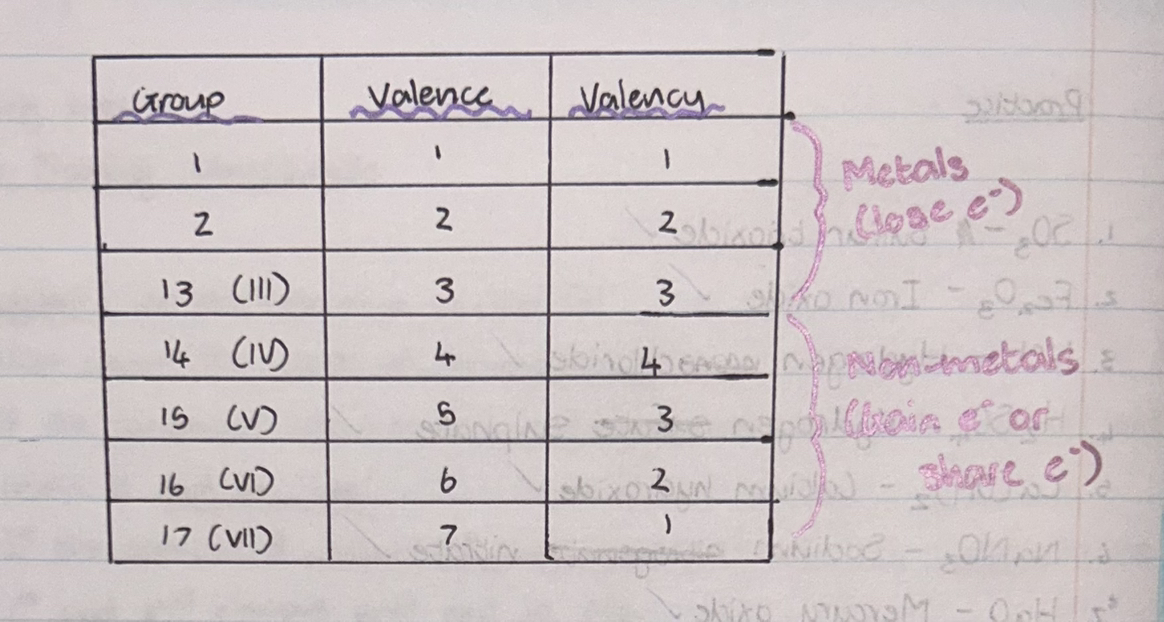
The ratio which atoms bond depends on the valence of different elements.
Valence electrons: are number of electrons in the outermost shell that are involved in forming chemical bonds.
When bonding the element with more valence electrons takes the valence electrons from the element with less.
Binding Possibility (Valency):
Definition: The number of electrons an atom needs to gain, lose or share to be in a stable state (octet → 8 valence e-)
Transition Metals:
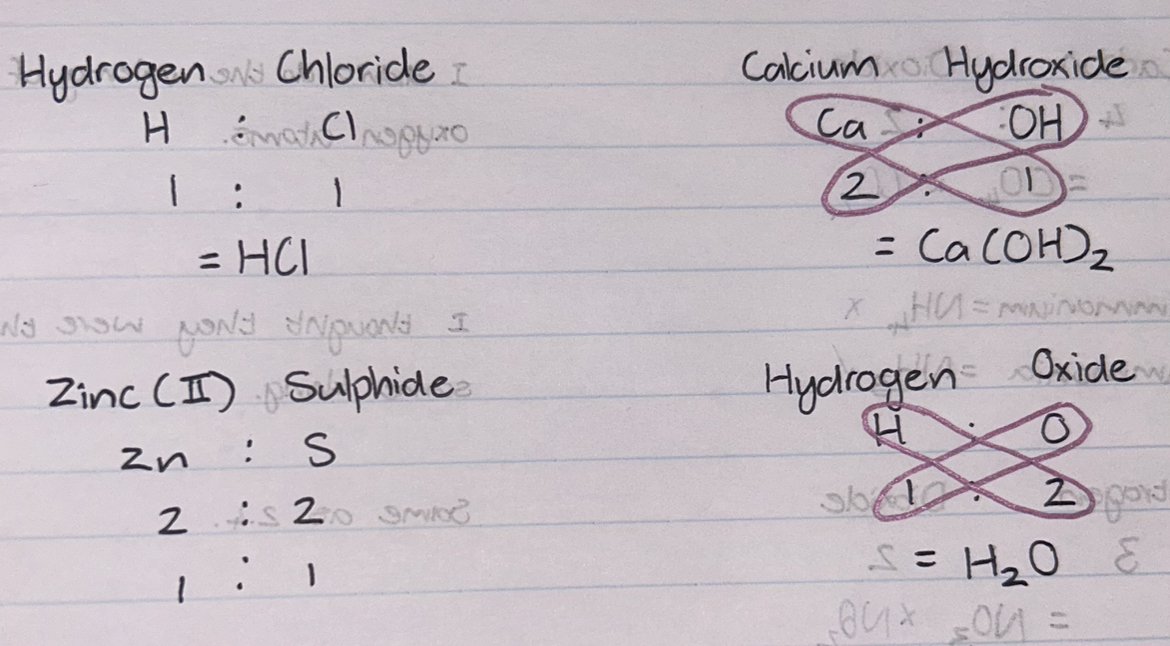
We use Roman numerals to indicate the valency of elements.
eg.
Zinc(II) Sulphide.
Iron(IV) Oxide.
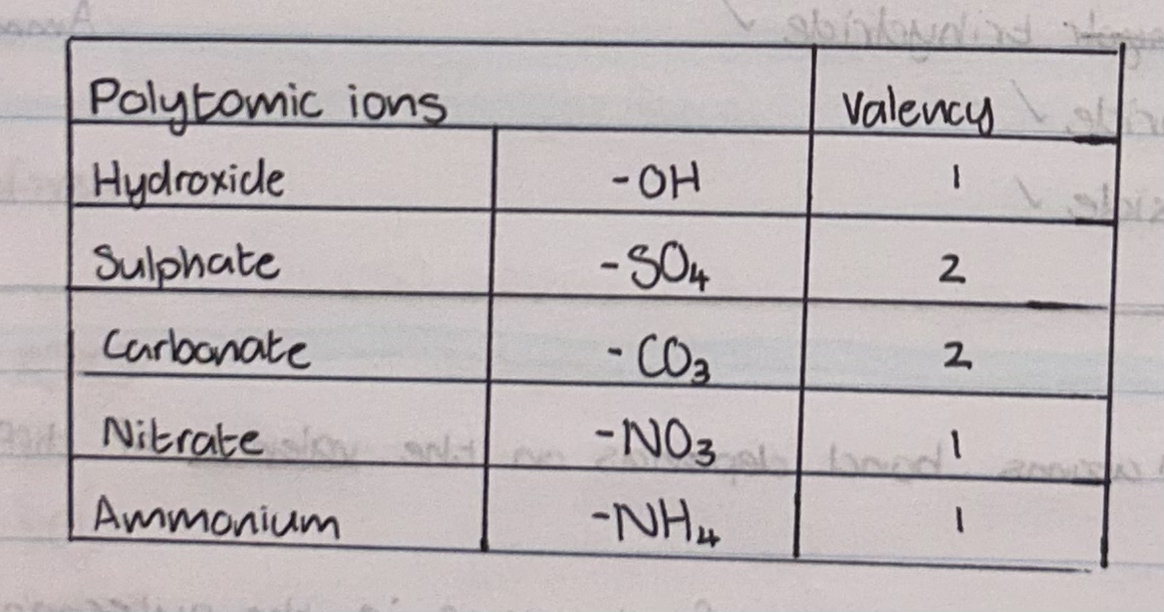
Polytomic Ions:
Writing Symbols From Names:
Prefix Rule:
If it has a prefix, take it literally.
Carbon Dioxide ≠ CO4.
Carbon Dioxide = CO2.
Roman Numerals:
Roman numerals state the valency for transition metals.
Method:
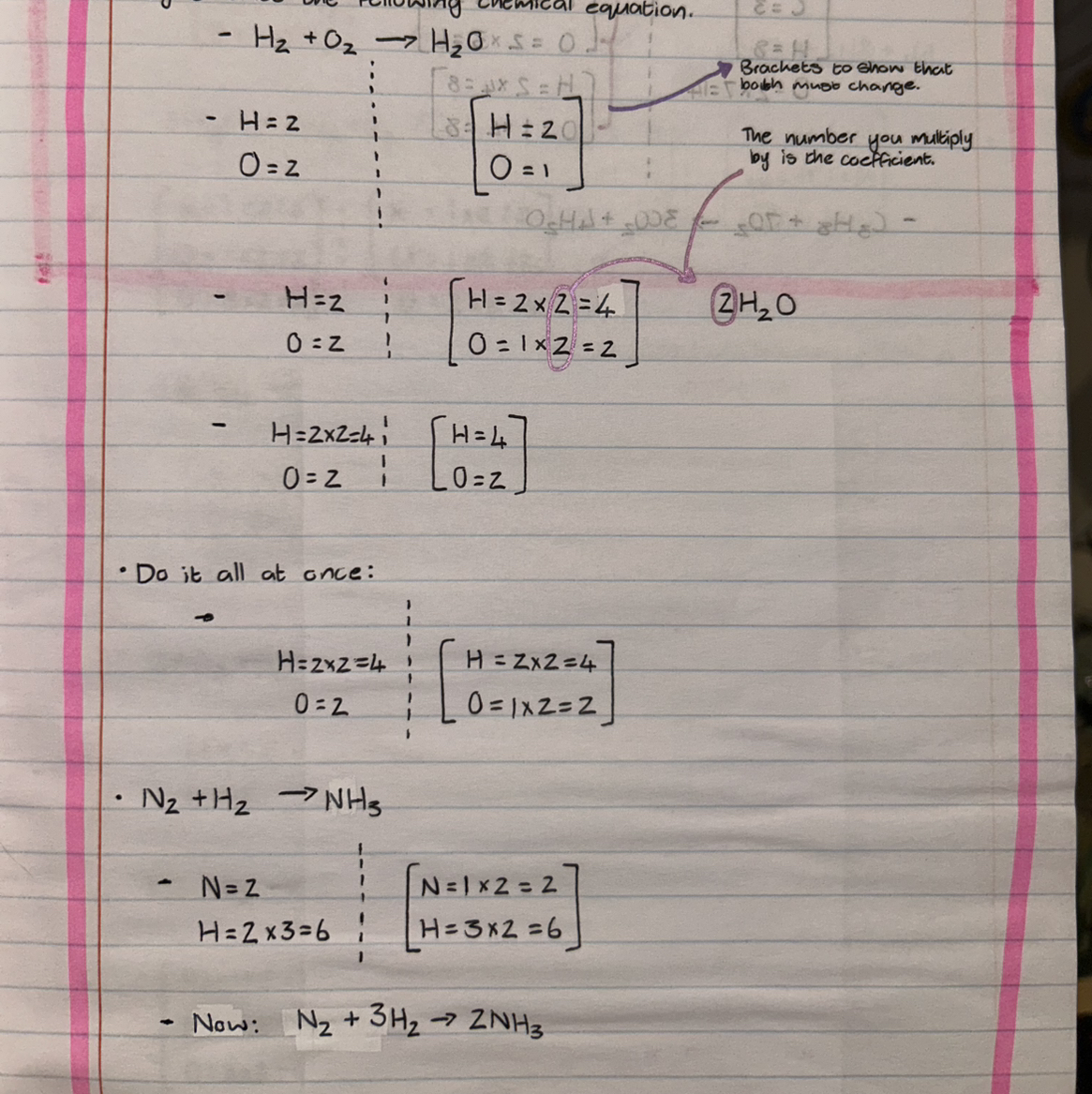
Balancing Chemical Equations: