Chapter 12: Equity Financing and Securities Markets
Equity in For-Profit Businesses
For-profit businesses are usually organized as:
Sole Proprietors.
Partnerships.
Corporations.
Hybrid forms.
Stockholders’ Rights and Privileges
Stockholders have a claim on the residual earnings (net income) of the business:
Net income “belongs” to shareholders.
Some portion may be paid out as dividends or used for stock repurchases.
Control of the firm.
Preemptive right.
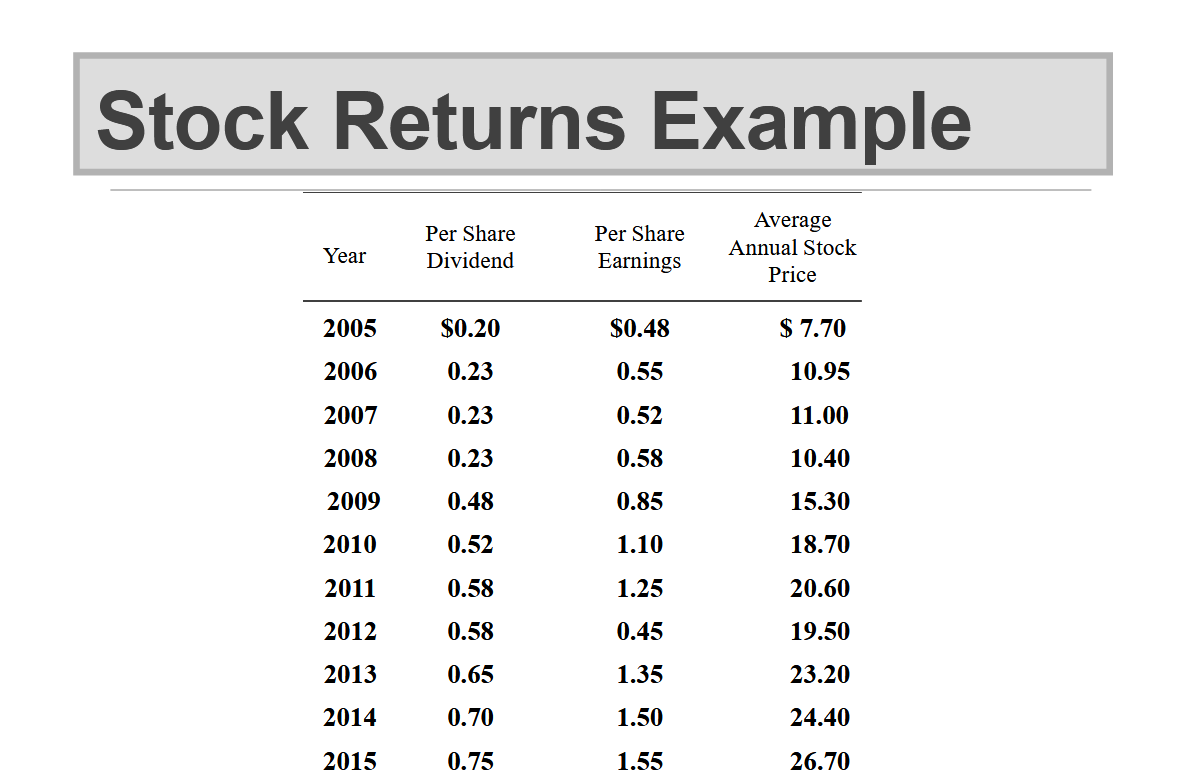
Stock Returns Example
For dividend-paying corporations, stockholder returns consist of both dividends (all years) and capital gains (2005 to 2006) or losses (2007 to 2008).
Generally, the amount of dividend paid is constrained by the amount of earnings.
Occasionally, however, dividends may exceed earnings, because cash flow is more important than earnings in setting dividend payments.
Methods Used by Corporations to Sell New Shares of Common Stock
Rights offering.
Public offering.
Private placement.
Employee stock purchase plan.
Dividend reinvestment plan (DRIP).
Direct purchase plan.
Equity in Not-for-Profit Businesses
NFP businesses must have “equity” capital, but it is not supplied by stockholders.
Start-up equity comes from:
Religious organizations.
Governmental entities.
Contributions.
Ongoing equity comes from:
Profits.
Contributions.
Grants.
Common Stock Valuation
For valuation, for-profit companies can be classified into three categories:
Start-up businesses, which can be valued (roughly) by option pricing models.
Young businesses, which can be valued on the basis of their expected operating cash flows.
Mature businesses, which can be valued on the basis of their expected dividend stream.
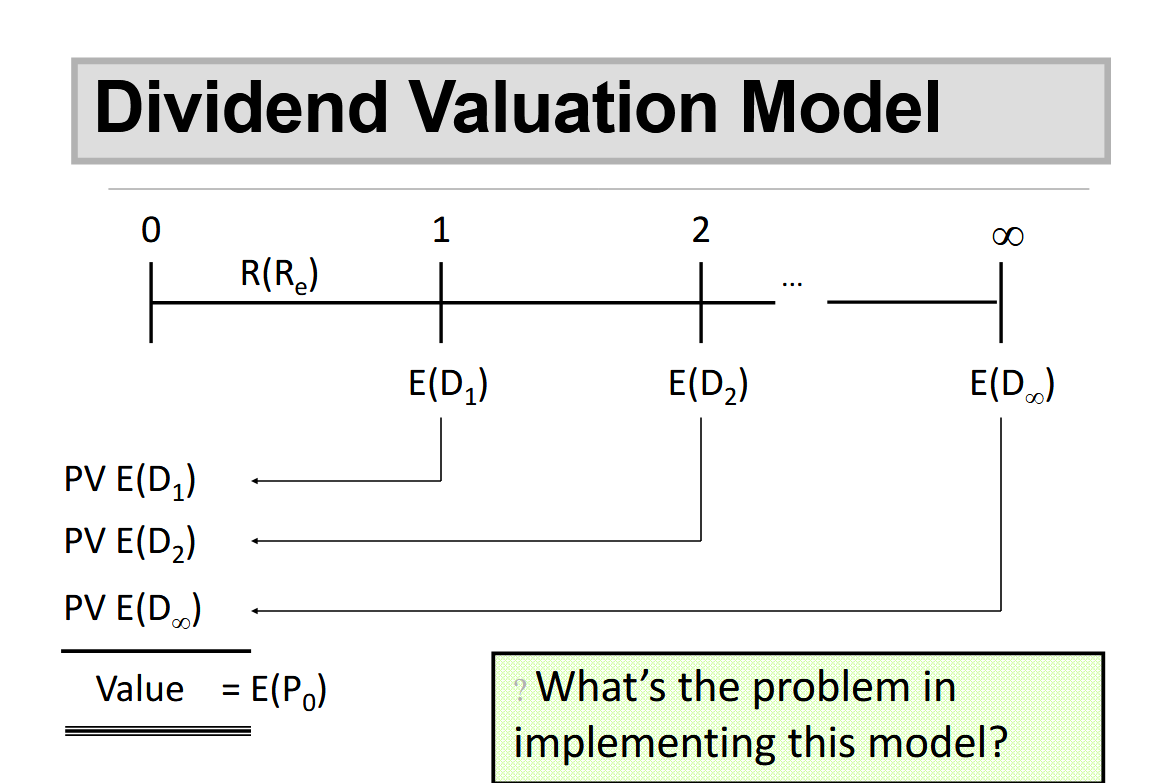
In the dividend valuation model, the value of a share of stock is the present value of the expected cash flow stream to shareholders.
In general, this stream consists of dividends and a future selling price.
Regardless of the holding period, a share of stock can be valued solely on the basis of its future dividend stream.
Constant Growth Model
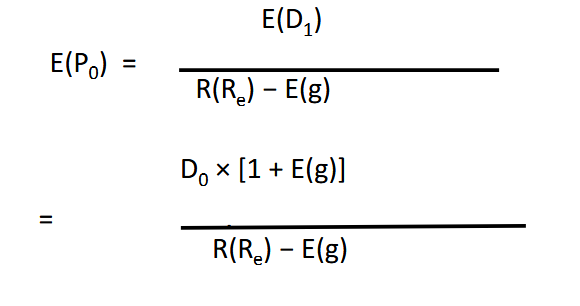
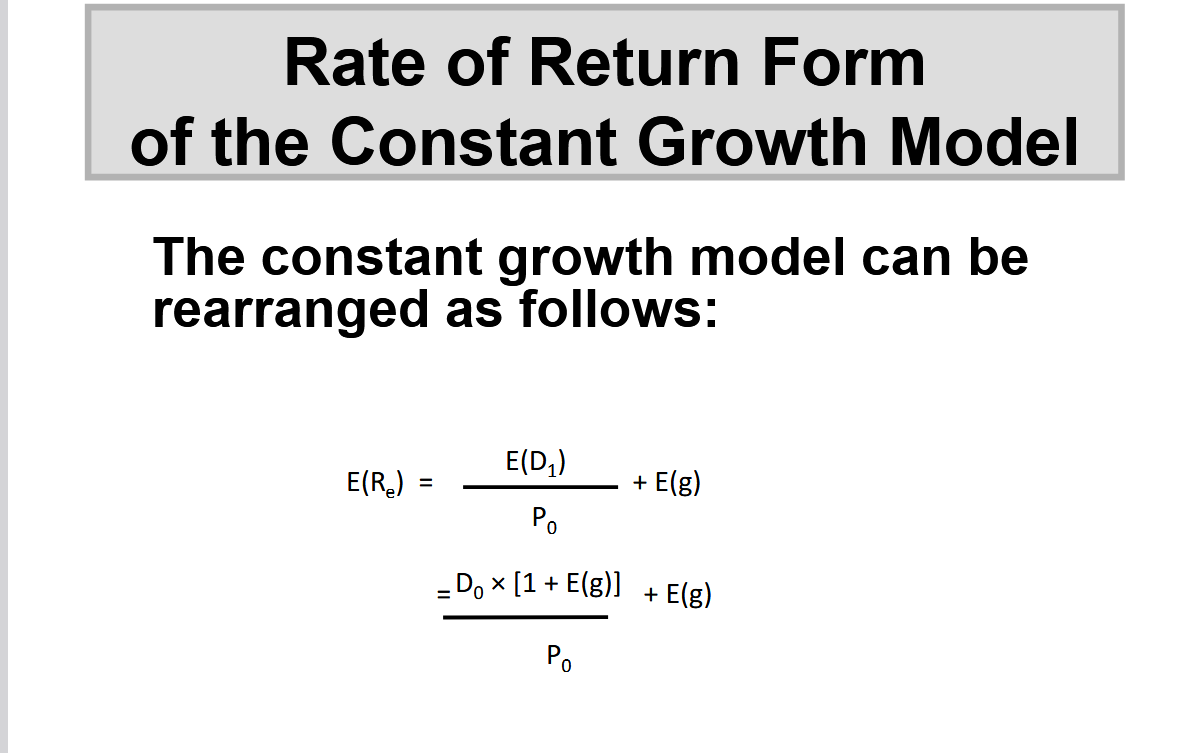
If dividends are expected to grow at a constant rate forever, then the general
stock valuation model can be simplified to this form:
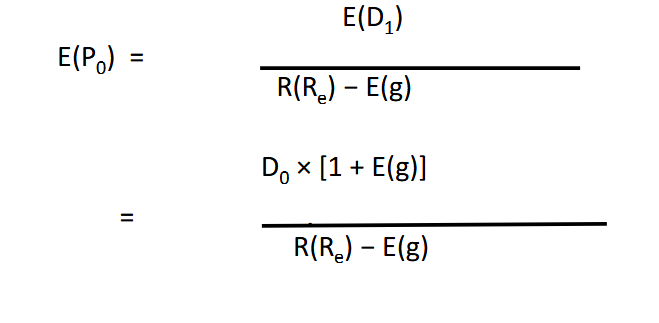
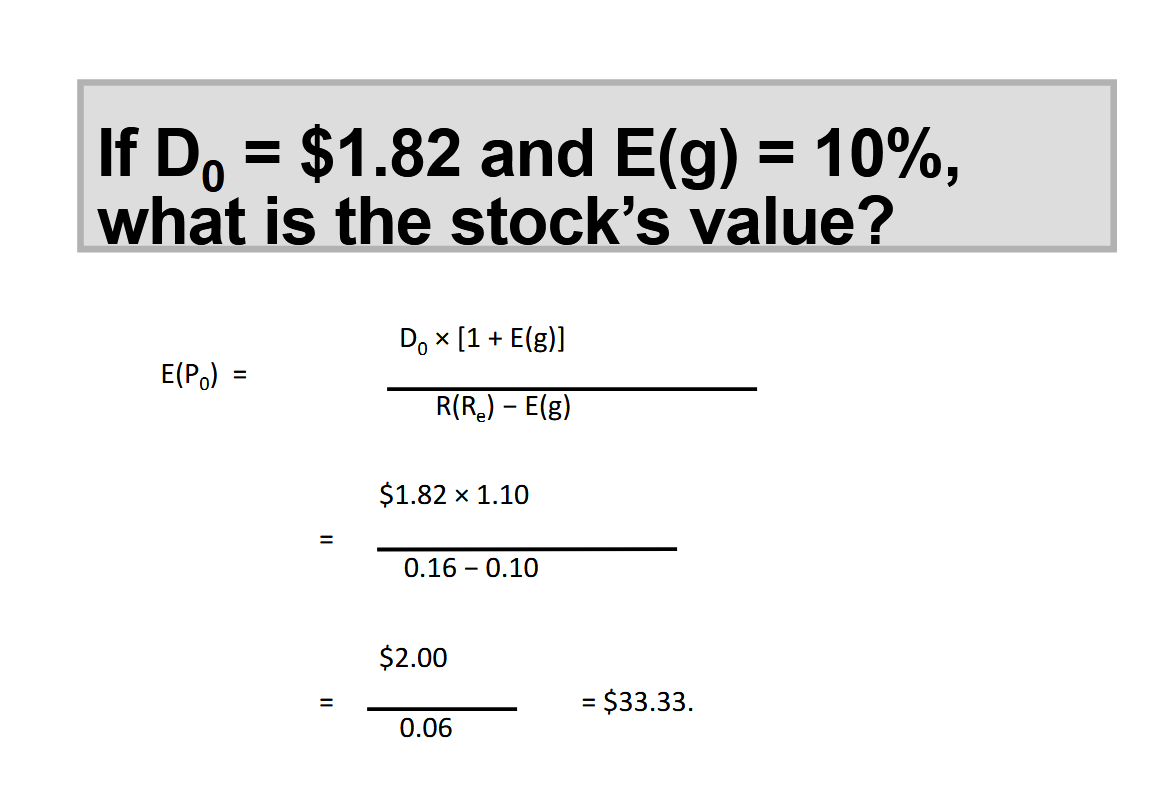
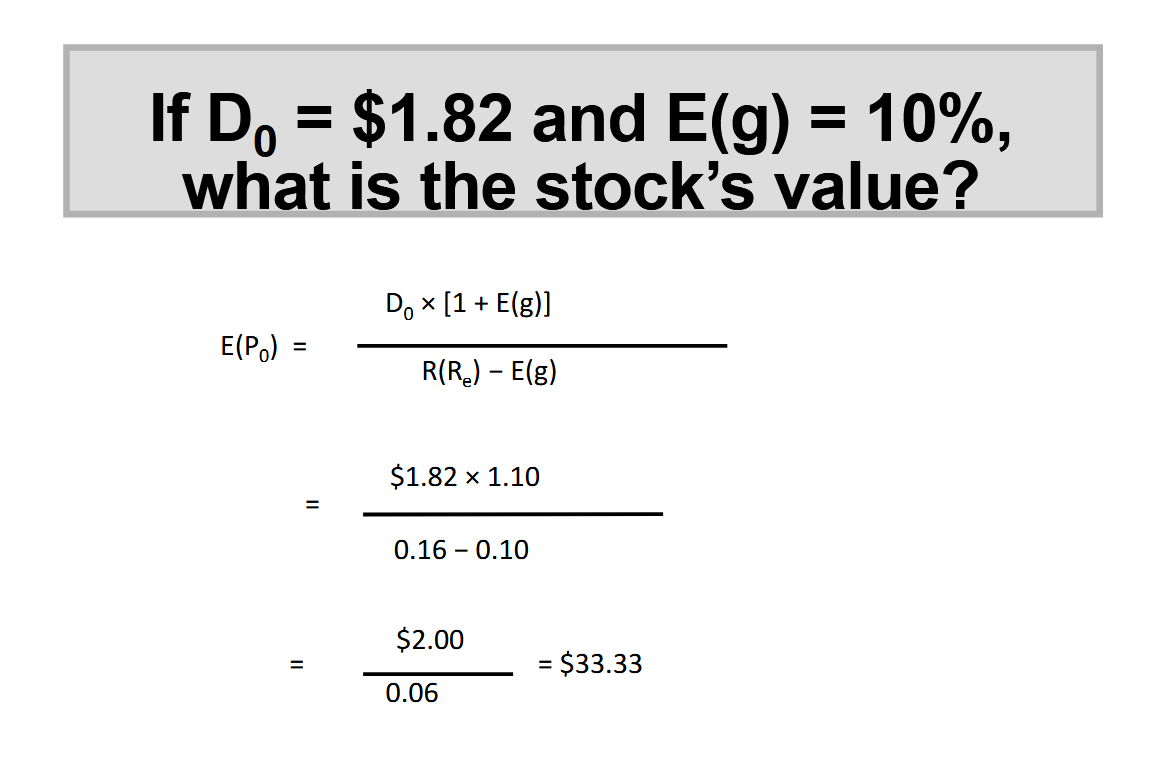
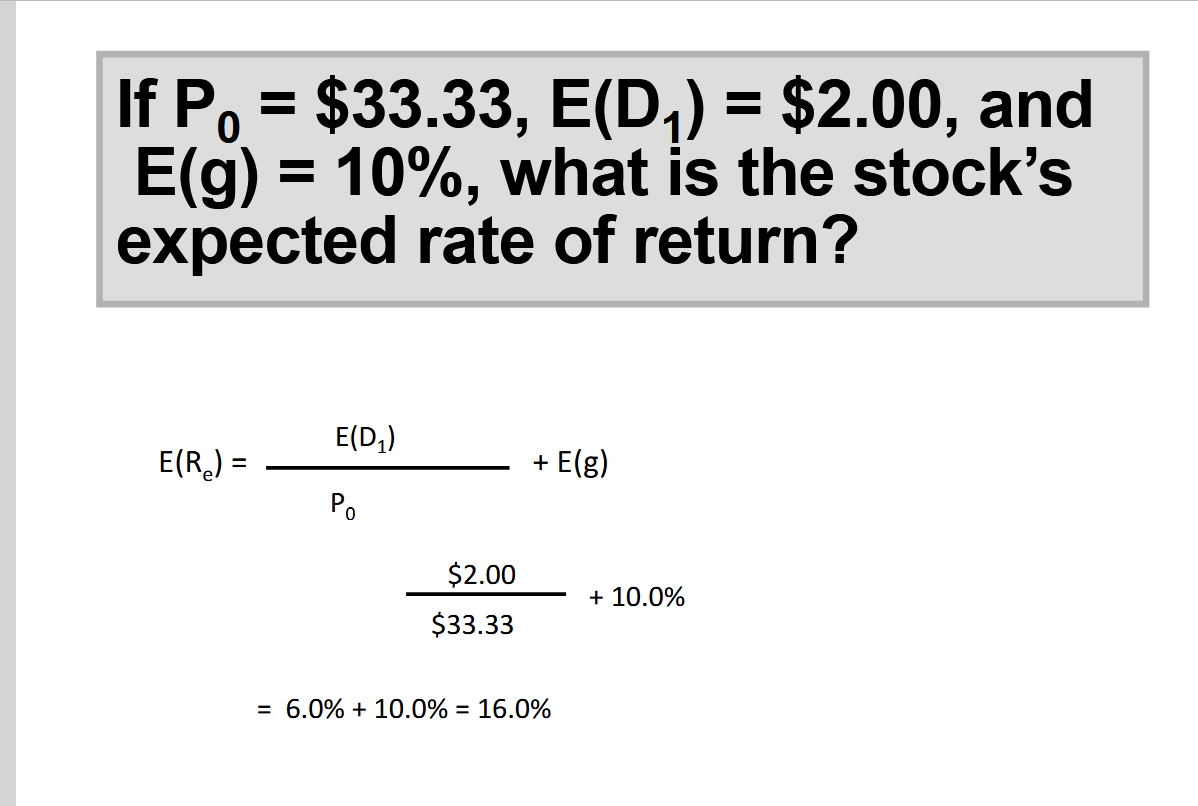
E(P0) is the value of the stock. (P0 is the current price).
E(g) is the expected constant dividend growth rate.
R(Re) is the stock’s required rate of return.
D0 is the last dividend paid (assumed to be paid yesterday).
E(D1) is the next expected dividend (assumed to be received in one year).
The most uncertain input variables are the most subjective.
Four assumptions are necessary for this constant growth model:
E(g1) = E(g2) = E(gN) = E(g)
R(Re) > E(g)
The last dividend was paid recently.
Dividends are paid annually.
Dividend growth is caused primarily by:
Inflation.
Earnings retention.
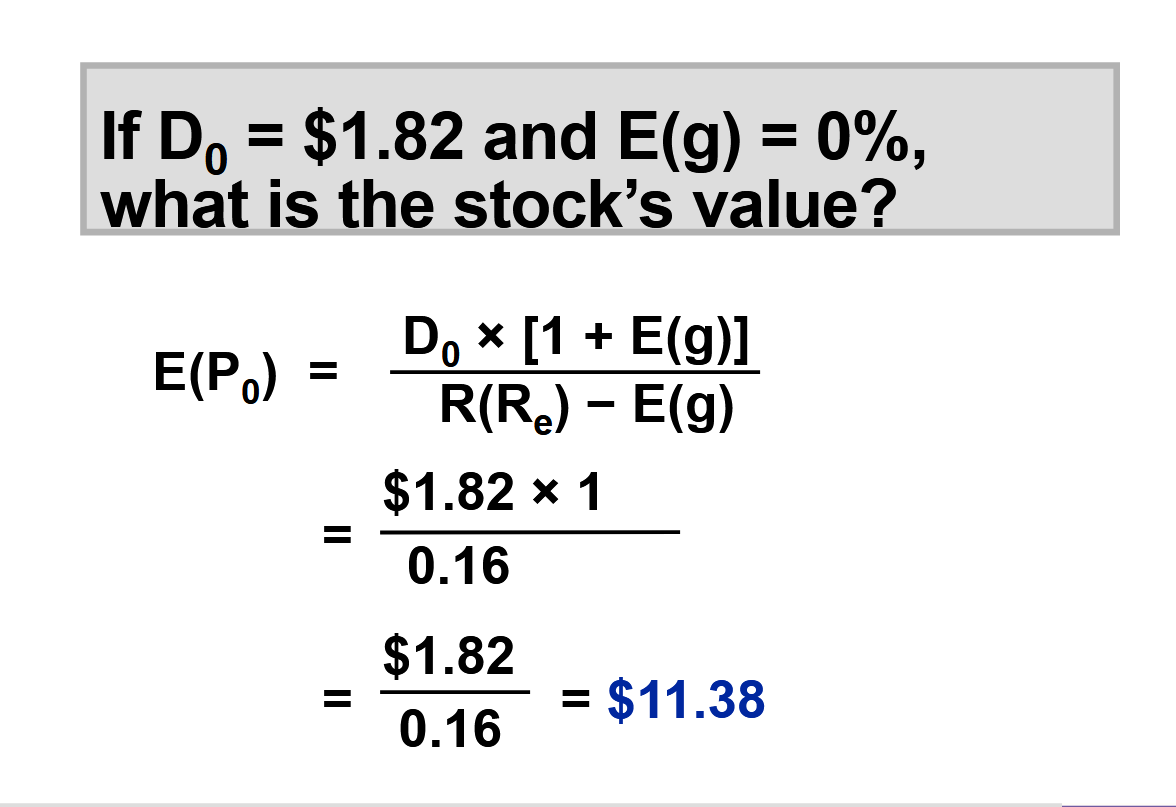
Note that the model can be used when E(g)= 0 (zero growth) or when growth is negative.
Constant Growth Model
If dividends are expected to grow at a constant rate forever, then the general stock valuation model can be simplified to this form:
Constant Growth Stock Conditions
The dividend is expected to grow at a constant rate forever.
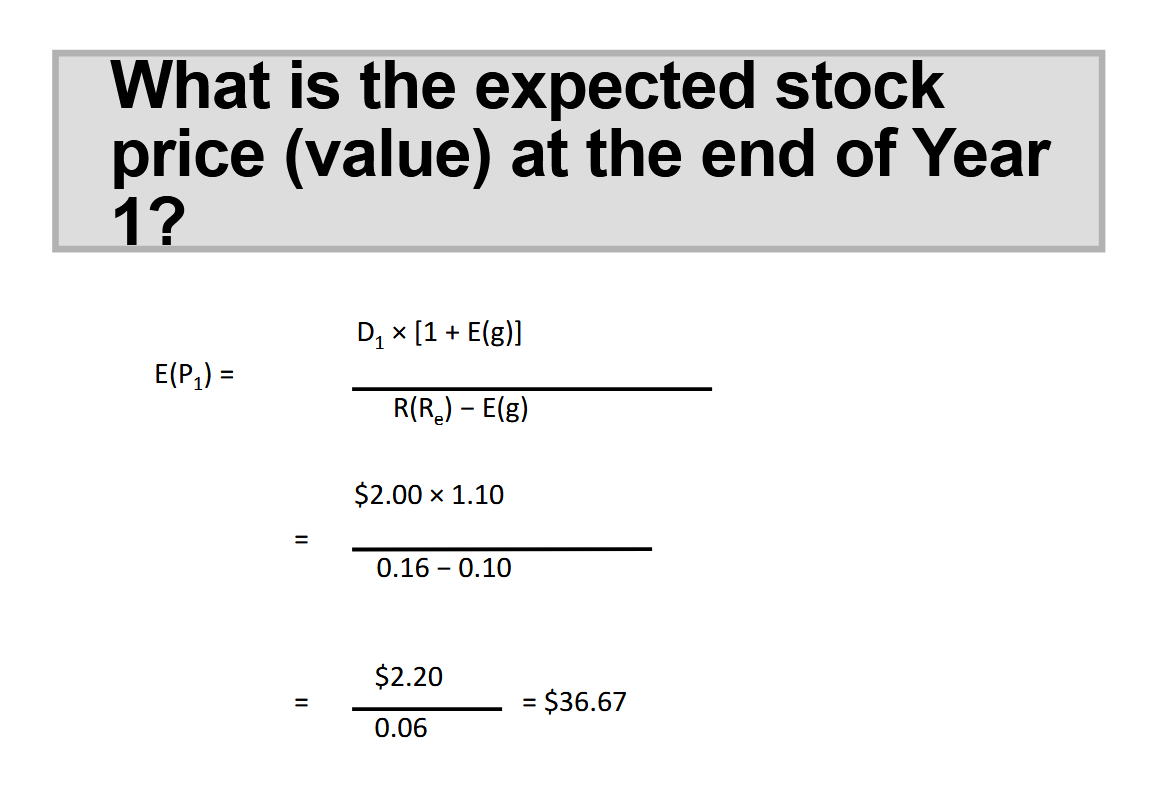
The stock price is expected to grow at the same rate.
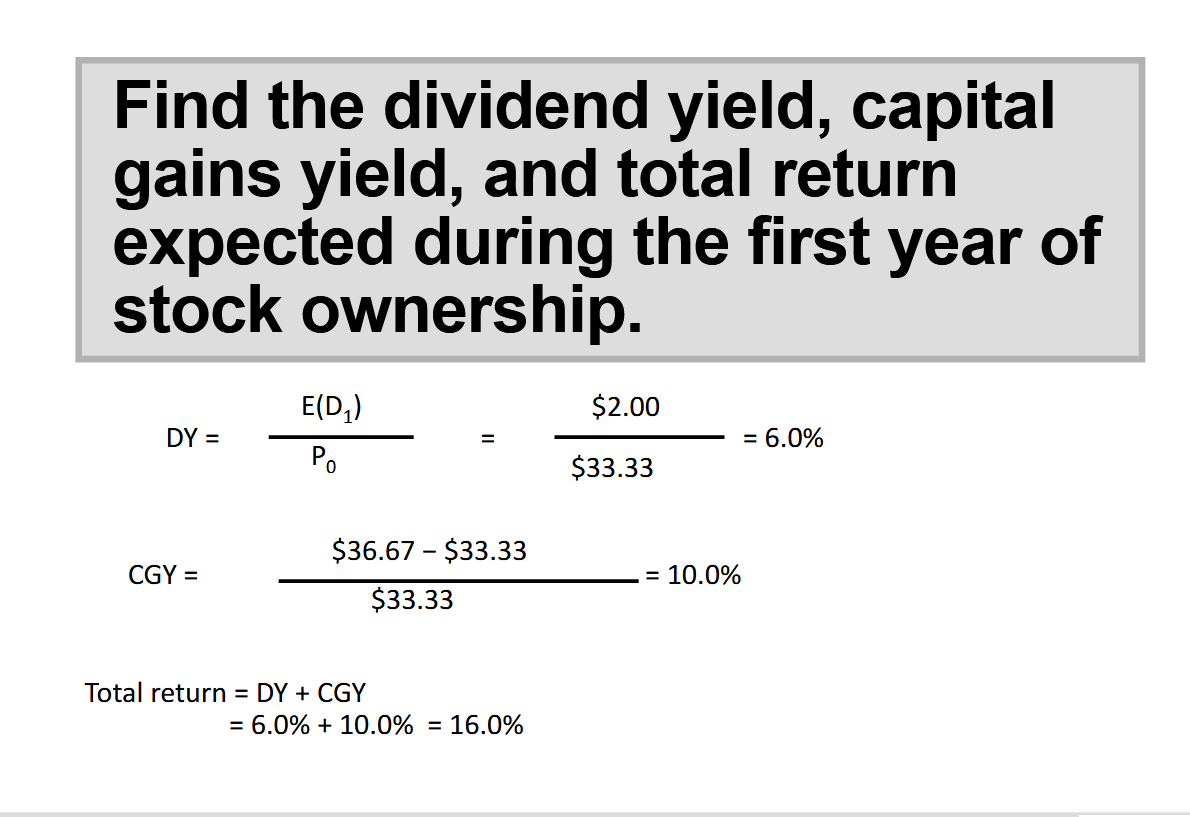
The expected dividend yield is constant over time.
The expected capital gains yield is a constant equal to the growth rate.
Nonconstant Growth Model
Clearly, most “real world” dividend-paying stocks do not exhibit constant growth.
A somewhat more complicated model is required to value such stocks.
However, because of the uncertainties in the inputs required for stock valuation, the constant growth model is useful for many mature firms.
Security Market Equilibrium
Investors will buy a security when its:
Expected rate of return exceeds the required rate of return.
Expected value exceeds the current price.
In market equilibrium:
E(Re) = R(Re)
P0 = E(P0)
Efficient Markets - Buying and selling actions continuously move security prices towards equilibrium
Informational Efficiency
A market is informationally efficient if:
Relevant information about asset values can be easily obtained at low cost.
The market contains many buyers and sellers who act on the information.
Implications of Market Efficiency
Prices reflect all publicly available information.
Investors should not expect to “beat the market”:
In the short run, expect to earn average returns for the risk assumed.
In the long run, expect to earn returns that are commensurate with the risk assumed.
Why might the major stock and bond markets be efficient?
Major financial firms, such as Merrill Lynch, Fidelity Investments, and Prudential Insurance, have thousands of well-qualified analysts with immediate access to information along with billions of dollars to invest
Thus, new information is almost instantaneously reflected in current prices.
What markets are efficient?
In general, the markets for the stocks and bonds of large companies and for Treasury securities are efficient
However, there is evidence that “pockets of inefficiency” exist and that “emotional excesses” can distort values.
The markets for real assets (real estate, MRIs, and so on) are not efficient.
Risk/Return Trade-Off
In efficient markets, the only way to obtain a higher return is to assume more risk
Consider the following investment alternatives:
⚫The stock of Kindred Healthcare, the United States’ largest provider of post-acute services.
⚫Kindred’s bonds