BIO122 WK1 Pathology
Pathology studies the changes in cells, tissues, and organs that underlie disease. It is the bridge between science and medicine.
- Pathology examines the changes that diseases like cancer produce in human cells. Every patient's cancer is different due to underlying genetic differences.
The four key aspects of pathology are:
1. Aetiology - What is the underlying cause or mechanism of the disease?
2. Pathogenesis - How does the disease progress from start to end?
3. Morphological changes - What changes occur in cells, tissues, and organs?
4. Clinical manifestations - What signs and symptoms do patients experience?
Importance:
- Understanding these four aspects is crucial for determining effective treatments for diseases.
Signs are objective measures that others can observe, like vital signs or physical exam findings.
If you can put a number on it, it is a sign.
Symptoms are subjective experiences the patient reports, like pain or nausea.
Cannot put a subjective number to it, pain is subjective.
Putting these together.
Nausea is the symptom, but vomiting is the sign
Cellular/Tissue Changes|
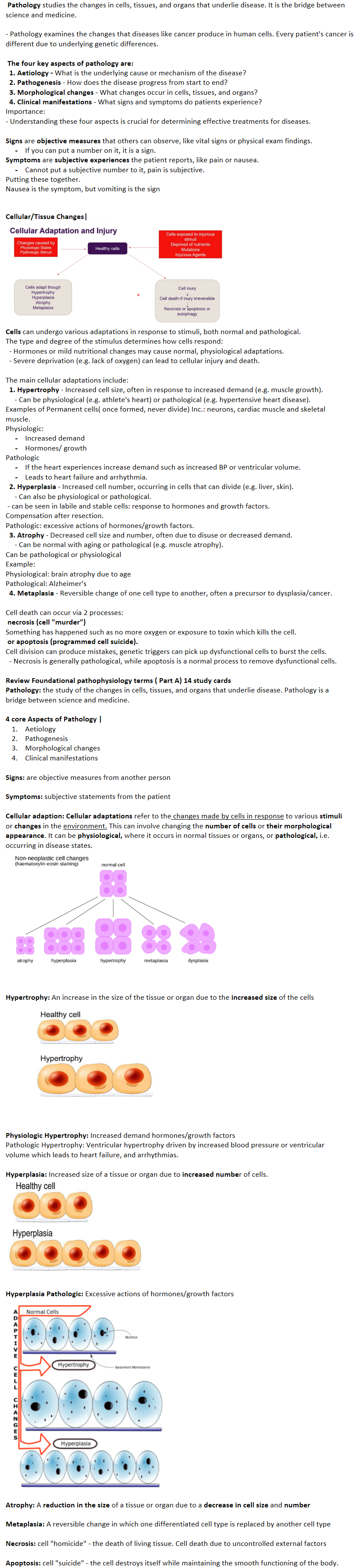
Cells can undergo various adaptations in response to stimuli, both normal and pathological.
The type and degree of the stimulus determines how cells respond:
- Hormones or mild nutritional changes may cause normal, physiological adaptations.
- Severe deprivation (e.g. lack of oxygen) can lead to cellular injury and death.
The main cellular adaptations include:
1. Hypertrophy - Increased cell size, often in response to increased demand (e.g. muscle growth).
- Can be physiological (e.g. athlete's heart) or pathological (e.g. hypertensive heart disease).
Examples of Permanent cells( once formed, never divide) Inc.: neurons, cardiac muscle and skeletal muscle.
Physiologic:
Increased demand
Hormones/ growth
Pathologic
If the heart experiences increase demand such as increased BP or ventricular volume.
Leads to heart failure and arrhythmia.
2. Hyperplasia - Increased cell number, occurring in cells that can divide (e.g. liver, skin).
- Can also be physiological or pathological.
- can be seen in labile and stable cells: response to hormones and growth factors.
Compensation after resection.
Pathologic: excessive actions of hormones/growth factors.
3. Atrophy - Decreased cell size and number, often due to disuse or decreased demand.
- Can be normal with aging or pathological (e.g. muscle atrophy).
Can be pathological or physiological
Example:
Physiological: brain atrophy due to age
Pathological: Alzheimer's
4. Metaplasia - Reversible change of one cell type to another, often a precursor to dysplasia/cancer.
Cell death can occur via 2 processes:
necrosis (cell "murder")
Something has happened such as no more oxygen or exposure to toxin which kills the cell.
or apoptosis (programmed cell suicide).
Cell division can produce mistakes, genetic triggers can pick up dysfunctional cells to burst the cells.
- Necrosis is generally pathological, while apoptosis is a normal process to remove dysfunctional cells.
Review Foundational pathophysiology terms ( Part A) 14 study cards
Pathology: the study of the changes in cells, tissues, and organs that underlie disease. Pathology is a bridge between science and medicine.
4 core Aspects of Pathology |
Aetiology
Pathogenesis
Morphological changes
Clinical manifestations
Signs: are objective measures from another person
Symptoms: subjective statements from the patient
Cellular adaption: Cellular adaptations refer to the changes made by cells in response to various stimuli or changes in the environment. This can involve changing the number of cells or their morphological appearance. It can be physiological, where it occurs in normal tissues or organs, or pathological, i.e. occurring in disease states.
Hypertrophy: An increase in the size of the tissue or organ due to the increased size of the cells
Physiologic Hypertrophy: Increased demand hormones/growth factors
Pathologic Hypertrophy: Ventricular hypertrophy driven by increased blood pressure or ventricular volume which leads to heart failure, and arrhythmias.
Hyperplasia: Increased size of a tissue or organ due to increased number of cells.
Hyperplasia Pathologic: Excessive actions of hormones/growth factors
Atrophy: A reduction in the size of a tissue or organ due to a decrease in cell size and number
Metaplasia: A reversible change in which one differentiated cell type is replaced by another cell type
Necrosis: cell "homicide" - the death of living tissue. Cell death due to uncontrolled external factors
Apoptosis: cell "suicide" - the cell destroys itself while maintaining the smooth functioning of the body.