Egyptian Culture and Art
Egypt – Key Notes
Egypt is famous for ancient monuments:
Pyramids at Giza
Great Sphinx
Karnak Temple
Valley of the Kings
Egypt is known for its ancient civilization, which created these monuments.
Greek historian Herodotus said:
“Egypt is the gift of the Nile.”
Importance of the Nile River
The Nile River is the longest river in the world.
It was essential to the survival and growth of ancient Egypt.
Roles of the Nile:
Provided food and water for Egyptians.
Annual flooding fertilized nearby land, making agriculture possible.
Created fertile soil in an otherwise arid (dry) region.
Supplied mud for bricks used to build houses.
Served as a transportation route for trade and travel.
Acted as a natural barrier, helping protect Egypt from foreign invaders.
Growth of Egyptian Civilization
The Nile’s “gifts” helped early Nile villages grow.
Small villages developed into small states.
These states eventually united into one large, prosperous civilization.
Role of the Pharaoh
The pharaoh was the king of Egypt.
The pharaoh became the central political and religious figure in society.
Pharaohs were seen as powerful rulers who maintained order and stability.
Dynasties
A dynasty is a line of rulers from the same family.
Power was passed from one family member to another.
Many dynasties ruled Egypt over time.
Stability of Egyptian Culture
Despite changes in rulers, Egyptian customs and culture changed very little.
This stability helped Egyptian civilization flourish for thousands of years.
Egyptian History Periods
Ancient Egyptian history is divided into three main periods (shown in the table):
Old Kingdom
Middle Kingdom
New Kingdom
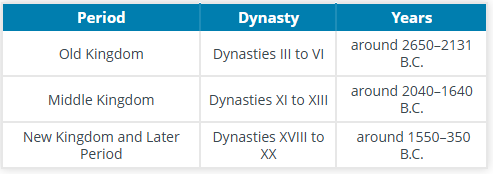
Old Kingdom (Overview)
The Old Kingdom was the most prosperous and creative period in ancient Egyptian history.
Many of Egypt’s most famous pyramids were built during this time.
This period showed the growing power and wealth of the pharaohs.
Burial Practices
Early Egyptians used mastabas for burial.
A mastaba was:
flat-roofed
rectangular
had sloping sides
made of mud bricks or stone
Growth of Pharaoh’s Power
As the pharaoh’s power increased, burial structures became:
larger
more complex
more impressive
Mastabas eventually evolved into pyramids, reflecting the pharaoh’s importance in society.
Step Pyramid of Zoser
Pharaoh Zoser ruled during the Third Dynasty.
His architects created a new type of burial structure.
They started with a square mastaba.
Smaller mastaba-like structures were stacked on top.
This created the first stepped pyramid.
Zoser’s tomb is known as the first pyramid in Egyptian history.
Development of Smooth-Sided Pyramids
By the Fourth Dynasty, pyramid design improved.
Stepped pyramids evolved into smooth-sided pyramids.
These pyramids were made of:
limestone
earth
stone
Famous examples include the Pyramids of Giza.
Inside the Pyramids
Pyramids contained small interior rooms.
These rooms held the pharaoh’s possessions, such as:
jewelry
clothing
cosmetics
toys
furniture
figurines
models of houses
Egyptians believed the pharaoh would need these items in the afterlife.
Egyptian Art in Pyramids
Pyramids were decorated with carved and painted images.
Images showed:
people
animals
furniture
scenery
Egyptians used a distinct artistic style:
head shown from the side
eyes and shoulders from the front
arms, legs, and feet from the side
Objects were drawn from the angle that showed their most recognizable features.
Importance for Historians
Art and objects inside pyramids provide valuable information.
They help historians understand daily life during the Old Kingdom.
Middle Kingdom (Overview)
Egyptians continued building pyramids, but they were smaller than those of the Old Kingdom.
This change likely happened because:
pyramids were very expensive to build, and/or
Egyptians began using temples more often.
Burial Changes
Tomb robbing increased, and many old pyramids were looted.
Egyptians needed safer burial methods to protect pharaohs’ belongings.
As a result, they developed new types of tombs.
Example: Beni Hasan
Beni Hasan is a key Middle Kingdom burial site.
Tombs there were:
carved directly into limestone cliffs
more hidden and secure than pyramids
These cliff tombs helped protect burial goods from robbers.
New Kingdom (Overview)
During the New Kingdom, pharaohs focused on building large stone temples rather than pyramids.
These temples showed Egypt’s wealth, power, and religious devotion.
Architecture: Post-and-Lintel Construction
Egyptians used post-and-lintel (post-and-beam) construction.
This technique used:
vertical posts or columns to support
horizontal beams
The weight of the structure was carried straight down to the ground.
It was a simple but very strong building method.
Important Temples
Temple of Amun at Karnak
One of the largest temple complexes in Egypt
Built using post-and-lintel construction
Hatshepsut
The only female pharaoh of ancient Egypt
Built a marble temple at Deir el Bahari
Temple of Deir el Bahari
The front of the temple featured:
rows of pillars
three tiered levels
ramps connecting each level
The design emphasized symmetry, grandeur, and order
Abu Simbel – Ramses II
Pharaoh Ramses II built a unique temple at Abu Simbel on the upper Nile.
The temple was engineered so that twice a year at dawn, sunlight:
enters the doorway
passes through the main hall
reaches the inner shrine
This design shows Egyptians had advanced scientific and architectural knowledge.
Akhenaton and Religious Change
Pharaoh Akhenaton attempted a major religious reform.
He promoted worship of one god, the sun god Aton.
Akhenaton built a temple for Aton at Amarna.
After his reign, later pharaohs and priests destroyed the temple and rejected his religious changes.
Art of Akhenaton’s Reign
Art from Akhenaton’s time was more realistic than earlier Egyptian art.
Sculptures and wall paintings showed:
natural body shapes
emotional expression
A famous example is the bust of Nefertiti, Akhenaton’s queen.
Importance
This period shows:
advances in science and engineering
attempts at religious change
a shift toward realism in art
Beliefs About the Pharaoh
Egyptians believed the pharaoh held ultimate power.
The pharaoh was seen as:
a representative of the god Horus
the son of the sun god Ra
His role was to maintain divine order, including Egypt’s social order.
After death, the pharaoh was believed to rejoin the gods and was worshipped.
Purpose of the Pyramids
A pyramid was:
a tomb for the pharaoh
a resting place for the afterlife
Egyptians believed the pharaoh would continue existence after death.
Power and Scale
The three pyramids at Giza symbolize the extreme power and authority of the pharaohs.
Building a pyramid was:
extremely costly
time-consuming
planned during the pharaoh’s lifetime
Construction of the Pyramids
Construction took decades.
Workers included:
slaves
skilled craftsmen
farmers (often during flood seasons)
Enormous amounts of stone were quarried and transported.
A temporary city formed near each pyramid to house workers for many years.
Key Takeaway
The Great Pyramids demonstrate:
religious beliefs
political power
advanced organization and engineering
the central role of the pharaoh in Egyptian society
Pyramids of Giza
The three main pyramids at Giza were built for:
Menkaure (smallest)
Khafre (middle)
Khufu (largest)
Smaller pyramids surround them, forming a pyramid complex.
Form of the Pyramids
Pyramids were made of dry masonry:
stone blocks stacked without mortar
Each pyramid has:
a square base
four triangular sides
The triangular sides meet at a point directly above the center of the base.
The slanted sides rise at a specific angle of inclination.
Interior Structure
The entrance is usually on the north-facing side.
A passage leads to the pharaoh’s burial chamber.
Additional chambers include:
the queen’s burial chamber
storage chambers for ritual objects and useful items
These items were believed to be needed in the afterlife.
Pyramid Complex
A large pyramid was surrounded by:
temples
smaller pyramids
Together, these structures formed a pyramid complex.
Religious Journey and Rituals
Priests and officials traveled a long ritual path to reach the pyramid:
Boat ride from the Nile to a canal
Arrival at the valley temple
Walk along a long covered path called the causeway
Arrival at the mortuary (pyramid) temple
Connection to the eastern face of the pyramid
Challenges Over Time
Many pyramids were robbed by grave robbers.
Valuable burial goods were stolen over centuries.
Pyramid of Khufu (Great Pyramid of Giza)
Khufu was a pharaoh of the Old Kingdom.
He ruled from 2589–2566 B.C.
Khufu built the Great Pyramid of Giza, also called the Pyramid of Khufu.
Location
Located on the Giza Plateau, just outside modern-day Cairo.
Built near the pyramids of:
his son Khafre
his grandson Menkaure
Importance
One of the largest pyramids in the world.
The only surviving structure of the Seven Wonders of the Ancient World.
Symbolizes the power, wealth, and engineering skill of ancient Egypt.
Size and Scale
At completion, the Great Pyramid:
covered 13 acres
stood 146.7 meters high
Built using about 2.3 million stone blocks
Average block weight: 2.5 metric tons
Largest blocks weighed up to 15 metric tons
Workers and Organization
Construction involved thousands of workers, both:
skilled (stonecutters, sculptors)
unskilled (laborers)
Support workers included:
bakers
carpenters
water carriers
An estimated 35,000 men and women participated overall.
Shows high organization and planning, not random labor.
Construction Techniques
Architects chose a flat bedrock site for stability.
Pyramid was built in horizontal layers of stone.
Stone sources:
interior stones quarried nearby
smooth limestone casing brought from across the Nile River
Builders used techniques developed from earlier pyramids.
Interior Design
The pyramid contains a series of passages leading to different rooms.
Includes the pharaoh’s burial chamber.
Burial chamber originally held items for the afterlife.
Tomb robbers later stole all burial goods.
Key Takeaway
The Great Pyramid demonstrates:
advanced engineering
massive labor coordination
strong religious beliefs
the immense power of the pharaoh
Pyramid of Khafre (Overview)
Khafre was the son of Khufu and a pharaoh of the Old Kingdom.
He ruled from 2520–2494 B.C.
Khafre built the second-largest pyramid at Giza, known as the Pyramid of Khafre.
Construction Details
Took about 26 years to build.
When completed, it:
stood 143.5 meters high
covered 11 acres of land
It is the only Giza pyramid that still has part of its smooth limestone casing at the top.
Khafre’s Pyramid Complex
The complex included:
a mortuary temple
a valley temple
the Great Sphinx
The Great Sphinx
A sphinx is a statue combining:
a lion’s body
a human head representing the pharaoh
The Great Sphinx:
is 57 meters long
is 20 meters high
It symbolized the pharaoh’s strength and divine power.
Key Takeaway
Khafre’s pyramid and the Great Sphinx show:
advanced architecture
strong religious symbolism
continued royal power during the Old Kingdom
Pyramid of Menkaure (Overview)
Menkaure was the grandson of Khufu.
He built the smallest of the three pyramids at Giza.
His pyramid is called the Pyramid of Menkaure.
Size and Dimensions
Each side of the square base is 105 meters long.
When completed, the pyramid stood 65.5 meters tall.
Much smaller compared to the pyramids of Khufu and Khafre.
Reasons for Smaller Size
By this time, Egyptians were beginning to:
use hidden tombs
build temples to better protect treasures
High cost and labor demands of pyramid construction likely influenced the smaller size.
Key Takeaway
Menkaure’s pyramid reflects a shift in burial practices and changing priorities in ancient Egypt.
It marks the transition away from massive pyramid construction.
🏺 What Is Funerary Art?
Funerary art refers to artworks created for burial rituals and tombs. In ancient Egypt, it wasn’t decoration for decoration’s sake. It was survival equipment for eternity.


📦 Examples of Funerary Art and Their Meanings
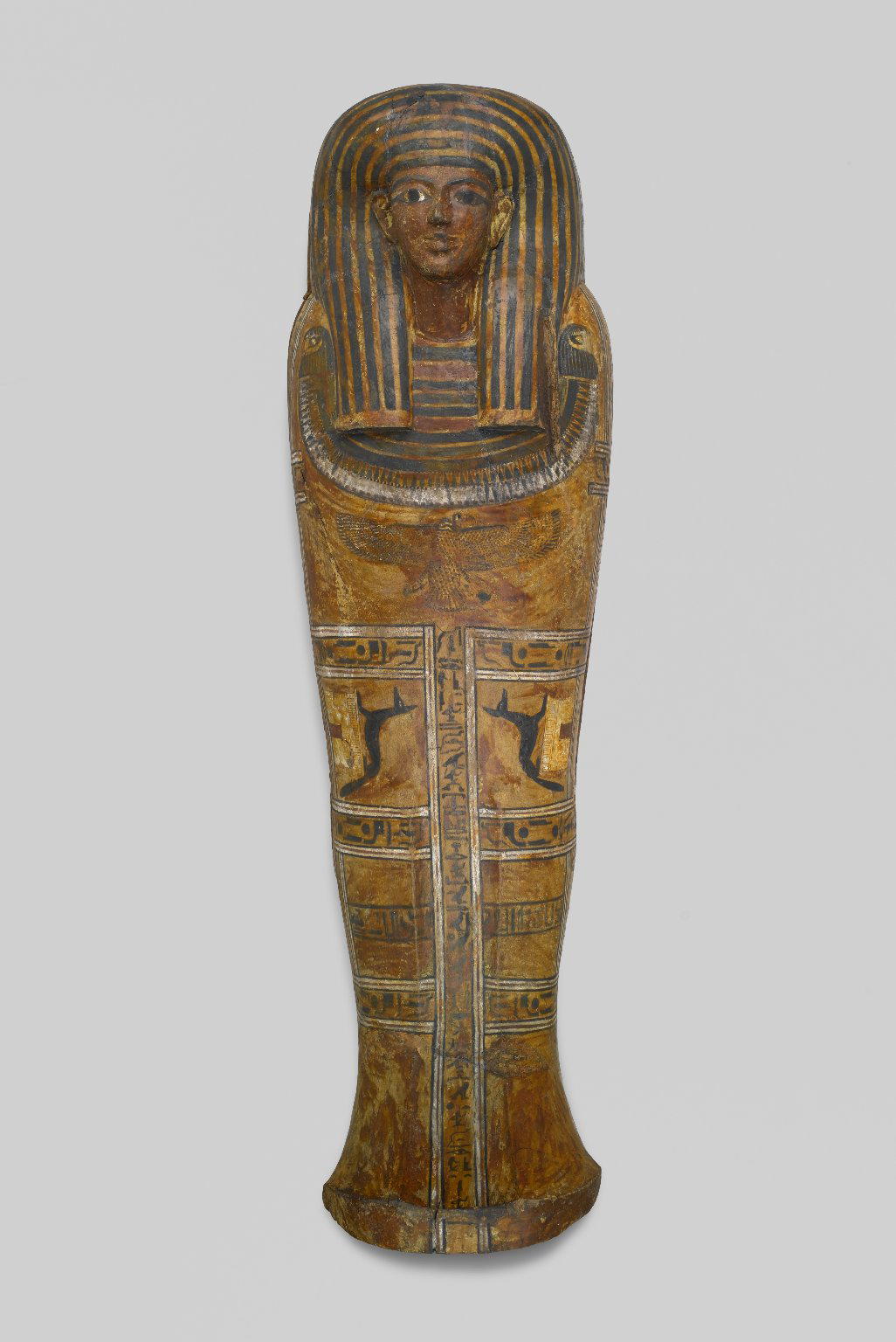
1. Decorated Coffins (Sarcophagi)
Example: Anthropoid coffins shaped like the human body
Meaning:
Protected the mummy physically and spiritually
Decorations showed gods, rebirth symbols, and spells
Complexity reflected social status
Multiple coffins acted like spiritual armor layers
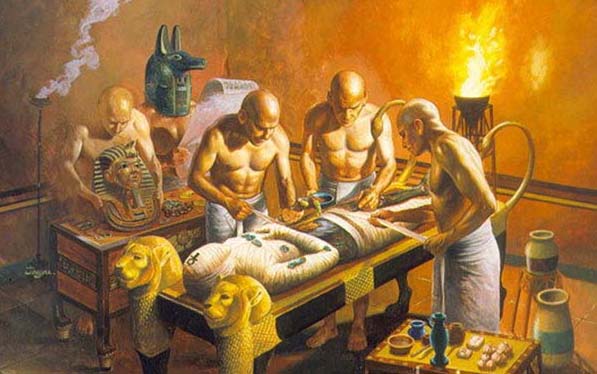
2. Mummification
Example: Bodies wrapped in linen after drying with natron
Meaning:
Preserved the body so the soul could return to it
Egyptians believed the afterlife was impossible without a preserved body
Oils and wrappings symbolized purification and rebirth
3. Burial Masks
Example: Gold masks worn over the mummy’s face
Meaning:
Gave the dead a recognizable face in the afterlife
Helped the soul identify its body
Royal masks were made of precious metals to signify divinity and eternity
4. Shabti (Ushabti) Figurines
Example: Small statues placed in tombs
Meaning:
Acted as servants who did labor for the dead in the afterlife
Ensured comfort and leisure forever
Often stored in wooden boxes inside coffins
5. Tomb Paintings and Wall Reliefs
Example: Scenes of farming, feasting, or baking bread
Meaning:
Made daily pleasures permanent
Egyptians believed images could become reality in the afterlife
Showed an ideal, peaceful continuation of earthly life
6. Hieroglyphic Inscriptions
Example: Spells written on coffins and tomb walls
Meaning:
Protected the dead from danger
Guided the soul through the afterlife
Included prayers, names of gods, and magical formulas
7. Grave Goods and Ritual Objects
Example: Jewelry, furniture, food offerings, statues of gods
Meaning:
Provided protection, status, and comfort
Reflected the belief that the afterlife mirrored earthly life
Offerings from relatives sustained the dead spiritually
👑 Famous Example
The tomb of Tutankhamun revealed:
Solid gold coffins
Jewelry inlaid with glass and semiprecious stones
Guardian figures, ritual objects, clothing, and furniture
This tomb shows how funerary art combined religion, magic, and craftsmanship into one eternal package.
🕊 Big Idea to Remember
To the Egyptians, death was not an ending.
Funerary art was a guarantee of rebirth, a way to freeze joy, identity, and status forever in material form.