Semester Exam Study Guide
Study Guide for Honors Chemistry I Final
Directions: Answer each completely. Ask your teacher if this should be turned in for credit. There is a reference sheet on the last page to use for this study guide.
- What is the relationship between the position of two elements on the PT and their electronegativity difference? The greater the distance between the two elements, the greater the electronegativity difference.
- True or False: All molecule with polar bonds are polar molecules. Explain. False. Carbon dioxide is an example. The outside molecules are equal but in opposite positions. Each bond is polar but since they are in opposing directions, the polarity cancels out, thus making the molecule nonpolar.
- What do you need to consider when determining if a molecule is polar? (2 or 3 aspects) What type of bonds are present (polar or nonpolar), if the central atom has unbonded electrons, or if the outside atoms are the same or different.
- Which bond will be the least polar? The most polar? H-C, N-F, H-F, O-F Least: C-H, most, H-F; remember, H has an electronegativity value of 2.1 so it is close to the value of carbon.
- LIST the steps for drawing correct Lewis Structures? List valence electrons, create a single bond from the central atom to each outside atom, place electrons around all outer atoms to make 8 valence electrons, if necessary – add electrons around the central atom to make 8 valence electrons, make double bonds only if 8 electrons cannot be produced for atoms in the structure, expand the octet for the central atoms if there are extra electrons.
- Draw the Lewis Structure for each of the following molecules, name the shape of the molecule/VSEPR geometry as linear, trigonal planar, trigonal pyramidal, tetrahedral, bent, trigonal bipyramidal, or octahedral, determine if the molecule is polar (asymmetrical, has a permanent dipole) or is non-polar (symmetrical)
- BF3 b. BeCl2 c. CO2 d. NH3 e. PF3 f. H2 g. O2 h. N2 i. H2O j. SiF4 k. PCl5 l. SF6
- Trigonal planar (nonpolar), b. linear (nonpolar), c. linear (nonpolar), d. trigonal pyramidal (polar), e. trigonal pyramidal (polar), f. linear (nonpolar), g. linear (nonpolar) h. linear (nonpolar), i. bent (polar), j. tetrahedral (nonpolar) k. trigonal bipyramidal (nonpolar) l. octahedral (nonpolar)
- List 3 intermolecular forces (forces between molecules) in order of increasing strength. London dispersion forces, dipole-dipole forces, hydrogen bonding.
- List forces that occur between atoms and the types of elements they form between (3 total). Also, list the force that would be an intramolecular force. Covalent bonds (nonmetals only), ionic bonds (metal and nonmetal) and metallic bonds (metals only). Intramolecular – Covalent Bonds.
- What state of matter typically has the strongest intermolecular forces? Solids The weakest? gases
- How are melting point & boiling point related to intermolecular forces? The stronger the intermolecular forces, the higher the boiling and melting points.
- What is a limiting reactant? The reactant that is completely consumed in the reaction.
- What does it limit? It limits how much product can form.
- What’s the theoretical yield? The maximum amount of product that can be formed in a reaction. A reaction that goes to 100% completion.
- How can you tell by reading a stoichiometry prompt that you need to determine the limiting reactant? If at least 2 given values for reactants are given. See next question.
- If 60.3 g of C3H6O react with 41.6 g of O2,what’s the theoretical yield of CO in grams, according to the following equation? 2 C3H6O + 5 O2 🡪 6 CO + 6 H2O (HINT:Fastest method is pick-a-product)
60.3 g x 1 mole x 6 mole x 28.01 g = 87.2 g
58.09 g 2 mole 1 mole
41.6 g x 1 mole x 6 mole x 28.01 g = 43.7 g ****** 43.7 g carbon dioxide produced.
32.00 g 5 mole 1 mol
- For 15A-15C, consider the combustion of methane, CH4(g) + 2 O2 (g)→ CO2 (g)+ 2 H2O (g).
- If there are 63.5 L of methane, how many L of water are produced at STP?
63.5 L x 1 mole x 2 mole x 22.41 L = 127 L a simpler way is to multiply the coefficients
22.41 L 1 mole 1 mole
63.5 L x 2 L = 127 L A common sense way to solve and it is acceptable.
1 L
- Consider the combustion of methane, CH4 (g) + 2 O2(g) → CO2(g) + 2 H2O(g) at a pressure of 1.5 atm & a temp of 350 °C. How many L of O2 (g) are required to produce 5.25 L of CO2(g) under the same set of conditions?
You have twice as much oxygen as methane, therefore, 5.25 L x 2 = 10.5 L (Avogadro’s hypoth)
Could solve for moles of carbon dioxide, use Stoich, and then solve for V = nRT/P too much work.
- How many L of H2O are produced when 25.5 g of methane burns in excess O2 @ 35°C & 1.2 atm?
25.5 g x 1 mole x 2 mol = 3.18 mole water
16.05 g 1 mol
V = 3.18 mol * 0.0821 * 308.15 K = 67 L
1.2 atm
- If a 2.41 moles gas has a pressure of 1.13 atm at 3.45 degrees C, what is the volume of the gas?
V = 2.41 mole * 0.0821 * 276.6 K V = 48.4 L
1.13 atm
- If a 55.4 L gas contains 4.37 g at STP, what is the molar mass of the gas in g/mol?
n = 1.00 atm * 55.4 L n = 2.47 mol 4.37 g = 1.77 g/mol
0.0821 * 273.15 K 2.47 mol
or 55.4 L x 1 mole/22.41 L = 2.47 mol then, same as above 4.37 g/2.47 mol = 1.77 g/mol
- A sample of a gas occupies 1.40 x 10³ mL at 35.0° C and 760 mmHg. What volume will it occupy at the same temperature and a pressure of 840 mm Hg?
V = 760 mm Hg * 1400 mL V = 1267 mL = 1270 mL
840 mm Hg
- List an example of a strong acid. HCl, HNO3 answers may vary. Are organic acids weak or strong? Weak
- For HCl + H2O → Cl- + H3O+, identify the acid, the base, the conjugate acid and the conjugate base.
A B CB CA
- Write the balanced equation for a reaction that occurs when HI reacts with KOH.
What type of reaction is this? HI(aq) + KOH(aq) → KI(aq) + H2O(l) Neutralization
- A 100.0 mL stock solution of Pb(NO3)2 with a molarity of 3.22 is diluted to 175.0 mL, calculate the new molarity. (Use M1V1= M2V2)
M = 3.22 M x 100.0 mL M = 1.84 M
175.0 mL
- What is the pH of a solution that is made by dissolving 9.263 g of HI in enough water to make 2500 mL of solution? Note: HI ionizes 100% so [H+] = [H3O+]
9.263 g x 1 mole = 0.0724181 mole = 0.0290 M pH = -log (0.028967) = 1.54
127.91 g 2.500 L
- What is the concentration of hydrogen ions [H+] in a solution of NaOH base that is 6.2 x 10⁻⁴ M?
Kbase = 1 x10-14 = 1.6 x 10⁻¹¹ M , You could pOH=-log(6.2 x 10⁻⁴) = 3.208 , 14-3.208 = 10.79,
6.2 x 10⁻⁴ 10-10.79= 1.6 x 10⁻¹¹
- What is the pOH of a 9.22 x 10⁻³ M solution of LiOH?
pOH = -log(0.00922) = 2.035 M
- Write out the T-chart used in class to define oxidation & reduction. Remember LEO the lion says GER? For each process, include how the ox #s change (up or down), if e- are reactants or products, and if e- are gained or lost
Arteaga’s students only for the T-chart…don’t worry about. Oxidation: numbers increase (up) and Reduction: oxidation numbers decrease (down); the electrons are located on the product side for oxidation, e- are located on the reactant side for reduction; Oxidation is loss of electrons, reduction is gain of electrons.
- Assign the most common oxidation number for each of the following (assuming they have bonded with another element) N, Ca, Cl, O, F, H
N = -3, Ca = +2, Cl= -1, O = -2, F = -1, H = +1
- Assign oxidation numbers for each atom in the following: CO2, Na2SO3, N2, CO2, Na2SO4, Cr2O72-
C = +4, O = -2; Na = +1, S = +4, O = -2; N2 = 0; Na = +1, S = +6, O = -2; Cr = +6, O = -2
- For the reaction, Mg + 2HCl → MgCl2 + H2, identify what is oxidized and what is reduced.
Mg is oxidized 0 to +2, H is reduced +1 to zero, Cl neither oxidizes nor reduces and remains at -1.
Which of the following equations does not represent an oxidation-reduction reaction? Show the numbers above each element for credit. | ||
A) | 3Al + 6HCl 3H2 + AlCl3 | |
B) | 2H2O 2H2 + O2 | |
C) | 2NaCl + Pb(NO3)2 PbCl2 + 3NaNO3 | |
D) | 2NaI + Br2 2NaBr + I2 | |
E) | Cu(NO3)2 + Zn Zn(NO3)2 + Cu | |
REMEMBER TO LIST THE OXIDATION # ABOVE EACH ELEMENT! I am not doing
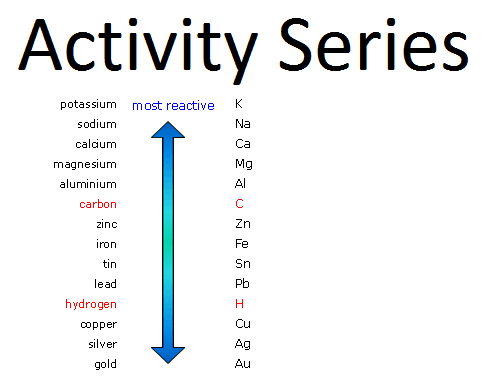
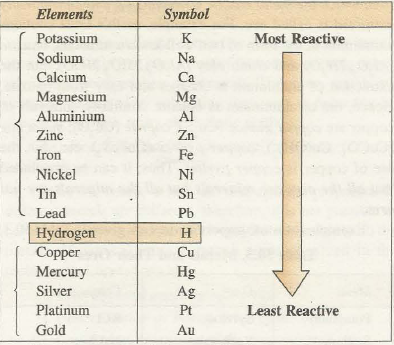
Using the activity series, what elements can displace Sn2+ ions in solution, but is displaced by Al3+ in ionic form?
Iron, zinc, carbon
- Define nuclear decay. Spontaneous disintegration of a radionuclide with the emission of energetic particles or radiation, such as
alpha or beta particles, or gamma rays.
- For beta decay, 0 e-, 0 is the mass number & -1 is the atomic number
-1
For alpha decay 42He
The atomic # is 2, the mass # is 4, and there are 2 neutrons
- Write the balanced nuclear equation for the alpha decay of Po-210: 210 Po → 208Pb + 42He
84 82
- Write the balanced nuclear equation for the beta decay of Ce-144: 144 Ce → 0 e- + 144Pr
58 -1 59
- Define temperature. The avg. kinetic energy or a substance/system.
What are the units of temperature? Kelvin or Celsius
- Define heat. The total kinetic energy of a substance/system What are the units of heat? Joules, kilojoules, calories, etc
- Explain how heat flows between substance A at a temperature of 52.3 degrees C and substance B at 33.4 degrees C when the two substances are combined. Heat flows from A to B because heat flows from higher temperature to lower temperature until their temperatures are equal. .
- In terms of system and surroundings, describe an endothermic process. What’s the sign of ∆H for endothermic rxns? The system absorbs energy from the surroundings. The sign is positive for ∆H
- In terms of system & surroundings, describe an exothermic process. What’s the sign of ∆H for exothermic reactions? The surroundings absorb energy from the system. The sign is negative for ∆H for the system.
- Sketch two energy diagrams/profiles. Label one for an exo thermic rxn and the other one for an endo thermic reaction. Label the relative E of the reactant, product, activated complex, activation energy, & ∆H. You are on your own. It is in your notes in the Thermochemistry notes. You need to know it.
- Of these factors that affect reaction rate, temperature (hot or cold), surface area of reactant (ground up or large chunks, concentration of reactant, presence of a catalyst, what combination of conditions would yield the fastest rate? High temperature, large surface area – ground up, increased concentration, and a catalyst all together will produce the fastest rate.
. | Determine the heat given off to the surroundings when 9.0 g of aluminum reacts according to the equation 2Al + Fe2O3 Al2O3 + 2Fe, H°rxn= –849 kJ. Work it out here by unit cancellation and choose the best answer. | |
A) | 7.6 103 kJ | |
B) | 2.8 102 kJ | |
C) | 1.4 102 kJ | |
D) | 5.6 102 kJ | |
E) | 2.5 103 kJ | |
9.0 g x 1 mol x 849 kJ =
26.98 g 2 mole
45. | Find the heat absorbed from the surroundings when 15 g of O2 reacts according to the equation O + O2 O3, H°rxn= –103 kJ Work it out here by unit cancellation and choose the best answer. | |
A) | 4.6 10–3 kJ | |
B) | 48 kJ | |
C) | 96 kJ | |
D) | 32 kJ | |
E) |
| |
15 g x 1 mole x 103 kJ
- 1 mol
- How much heat, in kJ, is required to raise the temperature of a 15.8 g of a metal from 31.6 degrees C to 54.1 degrees C? The specific heat capacity of the metal is 0.352 J/g°C. (q = mc∆T)
q = 15.8 g x 0.352 J/g°C x 22.5 °C = 125 J = 0.125 kJ
- 2C2H2(g) + 5O2(g) —> 4CO2(g) + 2H2O(g) ΔH reaction = -393.5 kJ/mole. For the preceding reaction, if 350.0 g of C2H2 is burned, how much heat is evolved?
q = 350.0 g x 1 mole x -393.5 kJ = 2645 kJ Rem: kJ/mole …1 mole
26.04 g 2 moles
- What is the definition of equilibrium?
When the rate of the forward reaction is equal to the rate of the reverse reaction.
What is equal at equilibrium?
Rate of the forward and reverse reactions. Note: it does not mean the concentrations are equal; however, the concentrations are not changing.
- When writing an equilibrium expression, which phases are omitted? s, l, g, aq
Solids and liquids.
- When the equilibrium constant, k, has a high value, will the reaction favor the products or the reactants? products
- When the equilibrium constant, k, has a low value, will the reaction favor the products or the reactants?
Reactants
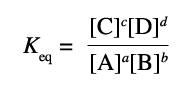
- Write the equilibrium expression, keq = , for following equations:
- 2 CH2H6(g) + 7O2(g) ↔ 4CO2(g) + 6 H2O(g) keq = [CO2]4[H2O]6
[CH2H6]2[O2]7
- 2 H2(g) + O2(g) ↔ 2H2O(g) keq = [H2O]2
[H2]2[O2]
- SnO2(s) + 2 CO(g) ↔ Sn(s) + 2CO2(g) keq = [CO2]2
[CO]
- . If K = [A][B] what does [A][B] represent and what does [C][D] represent?
[C][D]
[A][B] concentration of the products; [C][D] concentration of the reactants
- 2BrF5(g) <-> Br2(g) + 5F2(g) If BrF5 is removed from the reaction vessel, the reaction will shift right or left and the concentration of Br2 will increase or decrease.
To the left, bromine concentration will decrease
- When the temperature is decreased in the following system at equilibrium:
 2 HCl + Mg MgCl2 + H2 ∆H – 150 kJ. Which direction will the equilibrium shift?
Towards the product side
 The reaction achieves equilibrium: N2 (g)+ 3 H2 (g) 2NH3 (g). If the volume is increased, how will the pressure change? ____________________ In response to this stress, which direction will the equilibrium shift in order to re-establish equilibrium?____________________ Why?_____________
If volume is increased, the pressure is decreased. It will shift to the side with more moles of gas (to the reactant side). Why: the pressure is decreased, to compensate for this decrease, the reaction will shift to the side with more moles that creates more pressure. This will reestablish equilibrium. The reaction would not shift to the side with less pressure, that would exacerbate the decrease and create greater disequilibrium.
| The equilibrium constant expression for the reaction 2BrF5(g) <-> Br2(g) + 5F2(g) is | |
A) | Kc = [Br2] [F2] / [BrF5] | |
B) | Kc = [Br2] [F2]5 / [BrF5]2 | |
C) | Kc = [Br2] [F2]2 / [BrF5]5 | |
D) | Kc = [BrF5]2 / [Br2][F2]5 | |
E) | Kc = 2[BrF5]2 / ([Br2] 5[F2]5) | |
| The following reactions occur at 500 K. Arrange them in order of increasing tendency to proceed to completion (completion here means move to product lots of products) (least greatest tendency). 1. 2NOCl <-> 2NO + Cl2 Kp = 1.7 10– 2 2. 2SO3 <-> 2SO2 + O2 Kp = 1.3 10 –5 3. 2NO2 <-> 2NO + O2 Kp = 5.9 10 –5 | |
A) | 2 < 1 < 3 | |
B) | 1 < 2 < 3 | |
C) | 2 < 3 < 1 | |
D) | 3 < 2 < 1 | |
E) | 3 < 1 < 2 | |
Reference Sheet Chem I Final
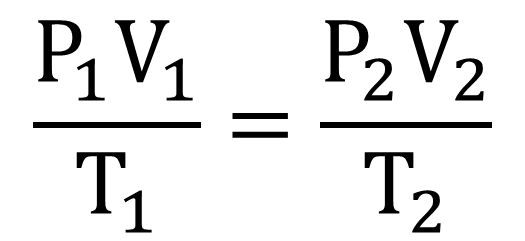
Ideal Gas Constant, R
= 0.0821 atm L/ mol K
Temp in Kelvin = °C + 273
n = moles of gas

Molar Mass of Gas, MR = D R T
P
Density of Gas, D = g/L
Pressure Units: 1 atm = 760 mmHg = 101 kPa
Calorimetry & Thermochem
Heat transferred, q = mc∆T
m = mass
c = s = specific heat
specific heat of H2O(l) = 4.184 J/ g °C
1000 J = I kJ
pH Calculations
pH = - log [H+] [H+] = 10(-pH)
pOH = - log [OH-] [OH-] = 10(-pOH)
Kw = [H+][OH-] = 1.0 x 10⁻¹⁴
Dilution of Solutions
M1V1 = M2V2
Equilibrium
For an reaction at equilibrium aA + bB ↔ cC +dD