Phototropism and auxin
Experiments
Many conducted using coleoptiles (a sheath that surrounds the young growing shoot of grass plants)
Darwin (1880)
Discovered that removing the tip of a coleoptile stopped the phototrophic response to a unidirectional light source (light coming from one side) from occurring
To ensure this was not simply due to the wounding caused to the plant, he covered the tip of a coleoptile with an opaque cover or ‘cap’ instead, to block out the light.
Also stopped the phototrophic response from occurring, showing that the tip of the coleoptile was responsible for detecting light.
Boysen-Jensen (1913)
Found that if he replaced the cut tip back on top of the coleoptile and inserted a gelatine block as a barrier in between, the phototrophic response was restored
Shows that stimulus for the growth was a chemical (hormone) which was able to travel through the gelatine block
Then inserted a mica (impermeable to chemicals) barrier halfway through the coleoptile just below the tip, first on the lit side then the shaded side.
When inserted into the lit side, phototropic response occurred
When inserted into shaded side, didn’t occur
Confirmed that stimulus for growth was a chemical (hormone) and showed that is was produced at the tip, before travelling down the coleoptile on the side opposite to the stimulus
Also showed that stimulus acted by causing growth on the shaded side (rather than inhibiting growth on lit side)
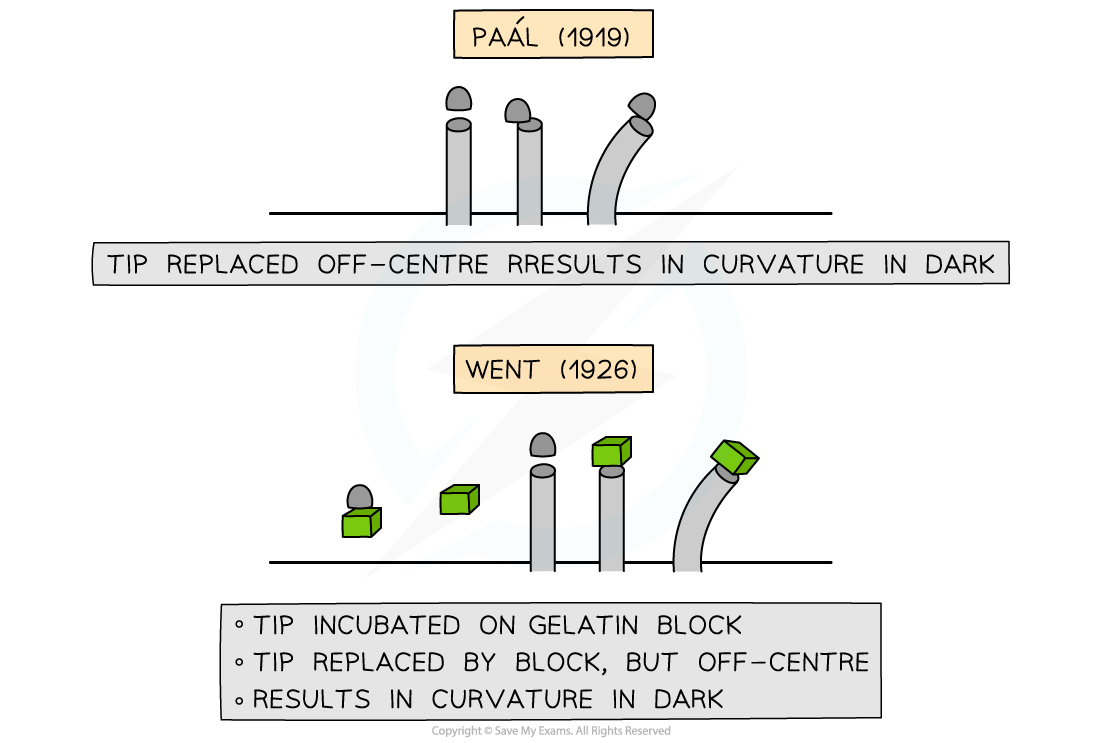
Paál (1919)
Cut tip of coleoptile and then replaced it off-centre in the dark
Side of coleoptile that tip was placed on grew more than the other side, causing coleoptile to curve (similar to phototropic response)
Showed that in the light the phototropic response was caused by a hormone diffusing through the plant tissue and stimulating the growth of the tissue
Went (1926)
Placed cut tip of a coleoptile on a gelatine block, allowing hormones from tip to diffuse into block
Placed on coleoptile, off centre and in dark
Side of coleoptile that the block was placed on grew more than the other side, causing coleoptile to curve
The greater the concentration of hormone present in the block, the more the coleoptile curved

How it works
Auxins exert their influence in an unknown way, possibly by somehow attracting nutrients to the matrix
As auxins move down the other parts of the plant, they stimulate elongation of cells just behind the apical meristem, but inhibit the growth of the lateral pubs
Apical dominance is a classical example of one [art of a plant controlling another, via the influence of a growth substance
This is called CORRELATION
The degree of dominance or the apical bud is, however, very variable between species.
More auxin = more cell elongation
Auxin increases the stretchiness of the cell wall by promoting active transport of H+ ions into the cell wall (energy provided by ATPase)
H+ ions decrease pH which wall-loosening enzymes (expansins) work best at
Expansins break bonds within the cellulose. Simultaneously, H+ ions disrupt hydrogen bonds within the cellulose. Both lead to less rigid cell walls that can expand and stretch