Meteorites
Source of meteorites
Building blocks of planet formation, they give great estimation of their formation, since they don’t go under a lot of geological transformation
Asteroids when orbiting the sun
Meteor when enters the atmosphere
Meteorite when lands on the surface
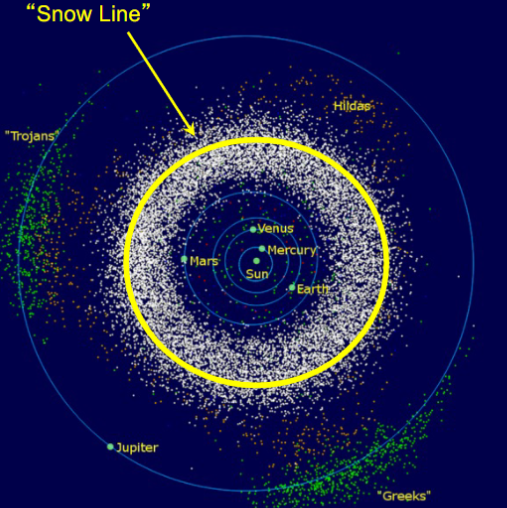
The Asteroid Belt (source of most meteorites) - between Mars and Jupiter
Snow-Line/Evaporation Front: The region in the solar system where water ice can condense and solidify dynamically (half rock, half stable ice).
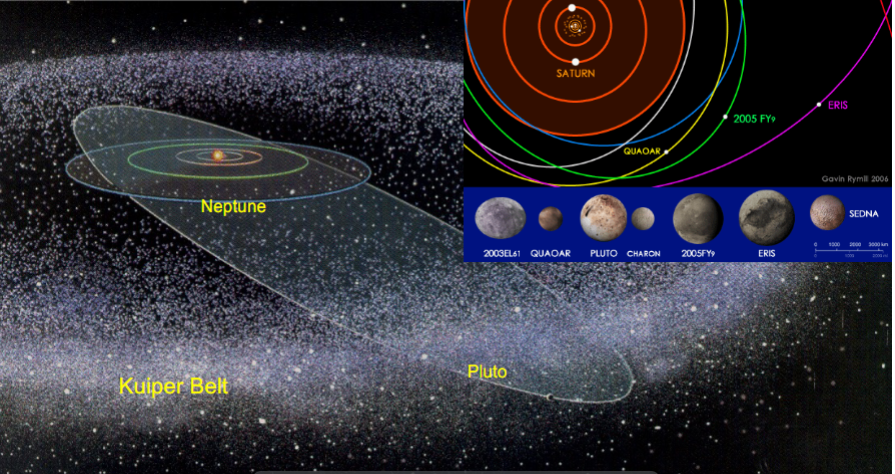
Edgeworth-Kuiper Belt: Region beyond Neptune where icy bodies, including dwarf planets, reside collectively as trans-Neptunian objects.
Spherical bodies of ice that, if pushed, will become comets
Ex: Oort Cloud - source of long-period comets
Source of Meteorites:
Cometary debris strung out along the orbit of their parent comet
The Moon
Mars (SNC meteorites - igneous martian rocks named after the place they were found in)
The Accretion of the Solar System (how solid collide and combine)
Process by which the Sun and the planets formed from a collapsing cloud of has and dust (small particles gradually clump together to form larger bodies)
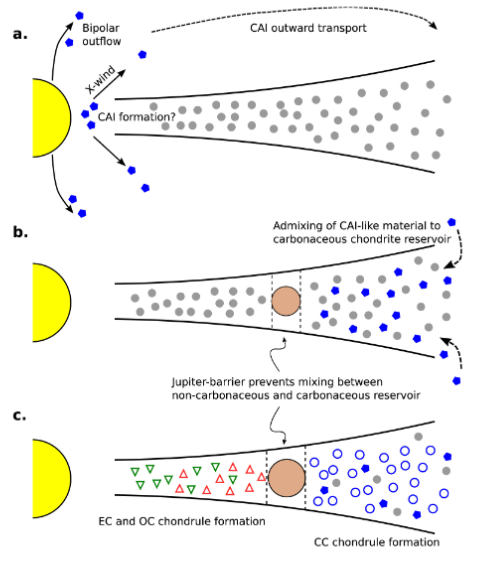
CAI outward transport
Mixing of CAI-like material to carbonaceous chondrite reservoir
EC and CC chondrule vs. CC chondrule formation
Solar Accretion
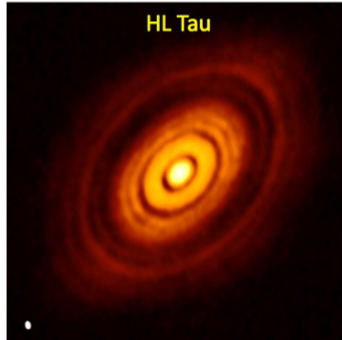
Star forming system: central star blow away gas and dust so we can see it, the disk around it creates materials that will eventually coalesce into planets and other celestial bodies, providing insights into the early solar system's formation (then no gas, just dust).
CO is a great proxy for molecular hydrogen (absorption lines are an indicator that there’s H)
Condensation of the Solar Nebula (gas becomes solid or liquid)
Nebula Collapse/Nebula Instability - Planets form DURING gravitational collapse of the original nebula or from the protoplanetary disk
Nebular Hypothesis Kant: Solar system formed from a rotating, cooling nebula that collapsed under it’s own gravity, eventually forming the sun and planets.
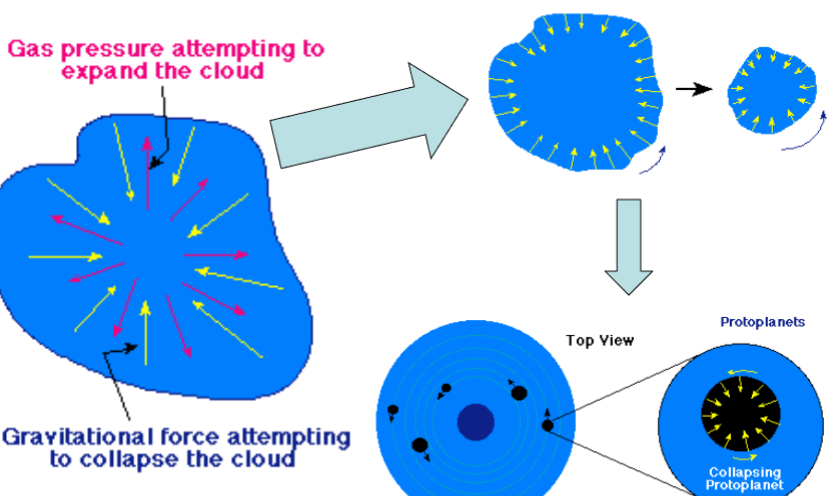
Planetesimal or Core Accretion - Planets grow via binary collision and accretion of smaller solid bodies
Massive giant planets outside ‘snow-line’ gravitationally accumulate H2 + He atmosphere + other volatiles on ‘rocky cores’
Ex: Caloris Basin Mercury and Imbrium Basin Moon
Pebble Accretion - Planet grows via accretion of mm to meter-sized bodies
Clumps that are larger will start to affect each other gravitationally (increase interaction and growth of clumps)
Most likely to happen outside the snow line, where solid clumps have accumulated (snow line is the pebble factory)
Solid clumps with masses exceeding Earth’s are capable of accreting gas and experiencing runaway growth, and rapidly clear an annulus ring in the planetary disk of dust and gas.
EARTH = INSIDE SNOW LINE = ROCKY
JUPITER = OUTSIDE SNOW LINE = H AND HE GAS GIANT
Formation of the Moon
Large Impact as the Solar System was Cleared of Debris between Earth and Mars might have formed the Moon
2 types of surfaces: light + craters from meteorites or imbirums from large impacts (lava plains) tells us about the age of a celestial body
Volcanic theory of craters come from energic explosion and high speed projectiles during WW2 (hypervelocity impactor and show wave), then theses come from impacts!
Even in Quebec there’s traces (Manicouagan Crater - 210 million years ago meteorite impact)
Chondrite Meteorites
Approximate the primordial condensed material of the solar nebula, while the achondrite ones have undergone ‘igneous’ processes - form rocks through cooling and solidification of magma - that have fractionated their compositions
Contain chondrules - small and spherical mineral grains (not like achondrites) - no modification ever proof, also recognised by their gravily exterior
CV Chondrites: carbenous chondrite that contain a high organic compounds, water content as well (well-defined chondrules)
CAI’s (Calcium Aluminium-Rich Refractory inclusions) - particularly abundant in CV chondrites: oldest dated solid materials in the solar system - light colored crystalline ingredient in carbonaceous chondrites meteorites
said to have formed from high-temperature condensates in the early protoplanetary disk
The short life of 26Al suggests a supernova occurred before the collapse of the solar nebula, maybe even the cause of it
Ways to Measure Composition of Solar System
CI carbonaceous chondrites
Their composition is almost identical to the one of the Sun (except for volatile elements)
Asteroids in the outer asteroid belt have dark spectral characteristics and appear to correspond to carbonaceous chondrite composition
may mark transition from inner rock planets to outer gaseous ones
Key Differences:
Degree of Alteration: CV chondrites are more thermally altered, while CI chondrites are more primitive and less altered.
Water Content: CI chondrites are more hydrated, containing more water, while CV chondrites are drier.
Mineralogy: CI chondrites have more hydrated minerals, while CV chondrites contain more anhydrous minerals and are richer in materials like olivine and pyroxene.
Primitive Nature: CI chondrites are closer to the original composition of the solar nebula, making them more primitive compared to CV chondrites, which have undergone more heating and alteration.
Stabe Isotope - don’t decay
Many elements of low atomic weight have two or more stable isotopes - H, N, S, C, O (the different masses cause isotopes to behave differently in physical and chemical processes)
heavier ones might be left behind during evaporation
Kinetic Energy = Temperature = 0.5*Mass*Velocity 2
Lighter isotopes can more easily break bonds (since move faster, then react faster)
At high temperatures the equilibrium constant changes to unity, since small differences in mass are less important when all molecules have high kinetic and vibrational energies
Most common O isotope is 16O (compare due to a scaled deviation from a standard ratio)
If it’s positif, means the sample is heavier relative to a standard and vice versa.
Fractionation occurs when the bonds are selectively broken or formed (the wekest bonds -lightest isotope broken first), and (stronger bonds - heavier isotopes formed first) fractionation is a function of temperature
LIFE IS GOOD AT FINDING WEAK BONDS TO BREAK (enzymes)
SHORTEN :
Simple Analogy: Snow Line between Mars and Jupiter - volatile substances (outside - gas and ice)
Think of it like baking cookies. Imagine you're baking cookies on a cold countertop. The snow line is like the edge of the countertop where the dough starts to freeze. On one side of the counter (closer to the oven), the dough stays soft (like the area inside the snow line), but on the other side (past the snow line), the dough gets hard and frozen because it's too cold.
In space, this line divides the regions closer to a star (where it's too hot for ice to form) from the regions farther out (where ice can freeze and stick around).
The snow line marks where the temperature is low enough for ice to form, while the Kuiper Belt is a specific region beyond the snow line where many icy objects exist (beyond Neptune)
Icy bodies beyond Neptune become comets when their orbits are disturbed, causing them to move closer to the Sun, where the heat causes the ice to turn into gas and form a glowing tail.
Source of Meteorites:
Asteroid belt
Cometary debris strung along the orbit of their parent comet
The Moon
Mars (SNC mteorites)
In short, SNC meteorites are pieces of Mars that have landed on Earth, giving scientists valuable insights into the Red Planet's history.