Lesson 10: Organisms Sense Their Environment
Lecture Notes:
Comparison of the Three Categories of Vertebrate Sensory Receptors
Sensory receptors detect stimuli from both inside and outside the body.Interoceptors: Detect internal stimuli.
Exteroceptors: Detect external stimuli.
Sensory receptors are further categorized based on the type of stimuli they respond to:Mechanoreceptors: Detect mechanical forces, including touch, pressure, pain, hearing, and balance. These are distributed throughout the body and have specialized structures for detecting sound and movement.
Chemoreceptors: Detect chemical stimuli, including taste, smell, and pH changes in the blood and cerebrospinal fluid.
Electromagnetic Receptors: Detect electromagnetic energy such as light and heat. Vision is the most common example, though some animals have additional electromagnetic receptors.
Four Steps in Conveying Sensory Information to the CNS
Sensory information is processed through four distinct steps:Stimulation: A stimulus impinges on a sensory receptor.
Physical stimulus acts as receptor (ex: sound waves vibrate cilia)
Transduction: The receptor converts stimulus energy into graded potentials in the sensory neuron’s dendrites.
Transmission: Graded potentials are transformed into action potentials, which travel along the axon to the central nervous system.
Interpretation: The brain processes the sensory input and forms a perception, which may not always match reality (e.g., optical and auditory illusions).
Brain “modulator” makes sense of sound
Stimulus-Gated Ion Channels
Sensory transduction involves stimulus-gated ion channels, which open in response to a specific stimulus rather than neurotransmitters.
Example: Mechanically gated ion channels in touch receptors open when a physical force is applied, leading to a receptor potential (a graded potential).
If this receptor potential reaches the threshold potential, an action potential is generated and transmitted to the CNS.
Relationship Between Stimulus Intensity and Frequency of Action Potentials
The intensity of a stimulus is not determined by the size of action potentials (since they are all-or-nothing) but by their frequency.
A stronger stimulus creates a larger receptor potential, leading to more frequent action potentials.
Example: Holding a warm coffee mug versus touching a hot stove—stronger heat produces more frequent action potentials, signaling greater intensity.
Special Senses: Sensory Receptor Type, Location, and Stimuli
Touch (Mechanoreceptors): Found throughout the skin, detecting pain, temperature, pressure, and vibration.
Hearing (Mechanoreceptors): Hair cells in the cochlea of the inner ear detect sound waves.
Balance (Mechanoreceptors): Hair cells in the utricle, saccule, and semicircular canals detect motion and position.
Taste (Chemoreceptors): Found in taste buds on the tongue and mouth, detecting sweet, salty, sour, bitter, and umami flavors.
Smell (Chemoreceptors): Located in the nasal mucosa, detecting airborne molecules dissolved in mucus.
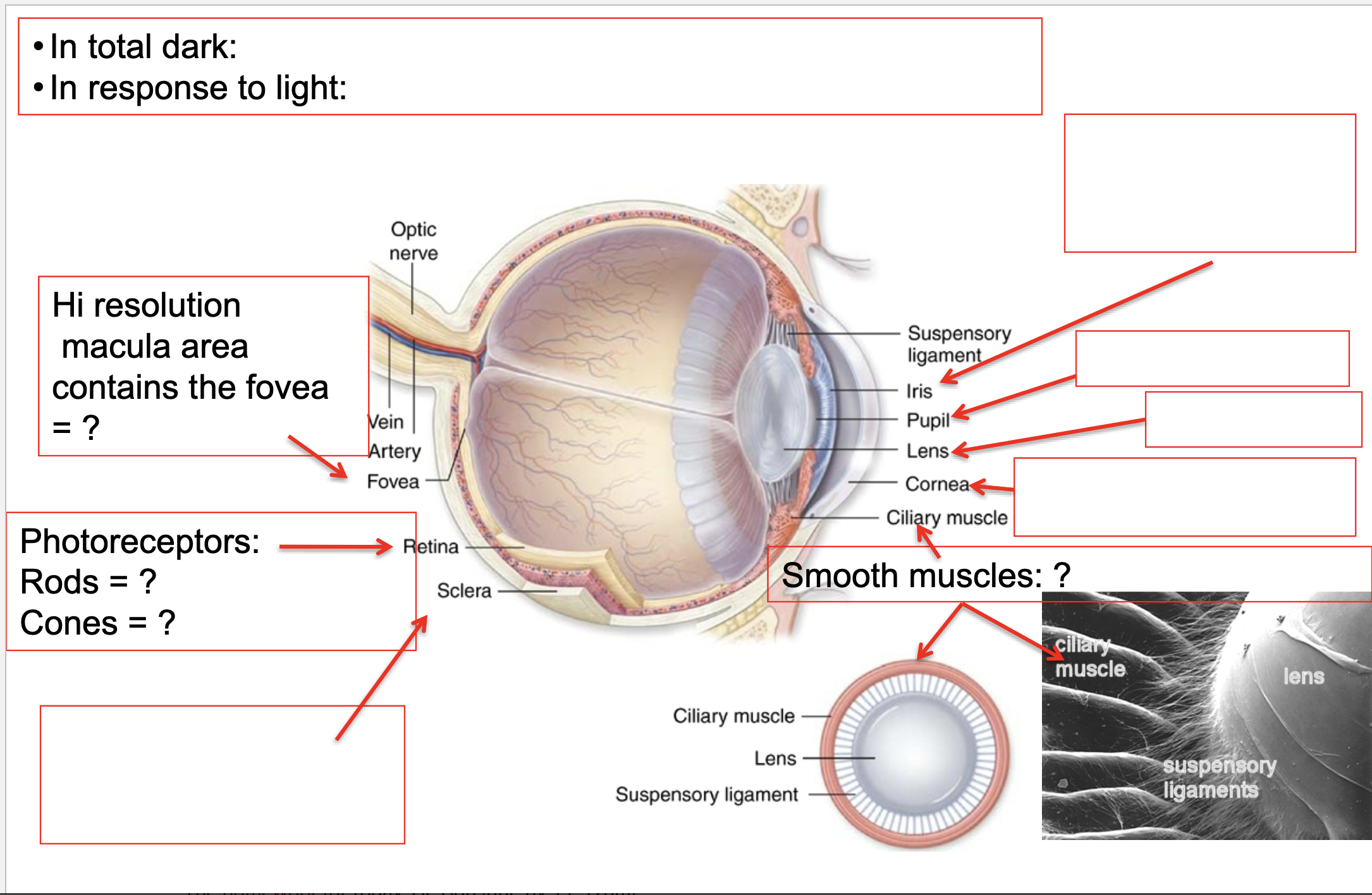
Vision (Electromagnetic Receptors): Rods and cones in the retina detect light and color.
Detection of Sound, Body Position, and Movement
Hearing (Cochlea and Organ of Corti):
Sound waves vibrate the tympanic membrane, which transfers vibrations to the middle ear bones.
Vibrations reach the oval window, converting them into pressure waves in the fluid-filled cochlea.
The basilar membrane vibrates, causing the stereocilia of hair cells to bend.
This bending opens mechanically gated ion channels, generating receptor potentials and action potentials that travel to the brain.
Different frequencies vibrate different parts of the basilar membrane—low frequencies at the apex, high frequencies at the base.
Balance and Motion Detection (Vestibular System):
The utricle detects horizontal motion, while the saccule detects vertical motion.
Hair cells with stereocilia are embedded in a gelatinous membrane containing otoliths, which move with changes in position.
Semicircular canals detect angular motion using a similar mechanism, but instead of otoliths, they contain a cupula, a gelatinous structure that bends hair cells in response to fluid movement.
Comparison of Invertebrate and Vertebrate Eyes
Many invertebrates have eyespots that detect light but do not form images.
Image-forming eyes evolved in multiple phyla, including mollusks and arthropods.
Vertebrate Eyes vs. Mollusk Eyes:
In vertebrates, light passes through multiple layers before reaching photoreceptors, creating a blind spot due to the positioning of nerve fibers.
Mollusks (e.g., octopuses) have a more efficient design where photoreceptors are the first to receive light, eliminating the blind spot.
Sensory Transduction in the Vertebrate Eye
Photoreceptors include rods (light/dark detection) and cones (color and sharp vision).
In darkness, sodium channels remain open, keeping the photoreceptor depolarized and releasing an inhibitory signal to bipolar cells.
In light, sodium channels close, causing hyperpolarization and reducing inhibition on bipolar cells, which then transmit signals to the brain.
The signal passes from photoreceptors → bipolar cells → ganglion cells, which send action potentials to the brain.
Uncommon Special Senses
Infrared Detection: Pit vipers have pit organs that detect infrared radiation, allowing them to "see" heat from prey or predators.
Electroreception: Some fish, such as sharks, detect electrical currents in water to locate prey.
Magnetoreception: Many species, from insects to whales, can sense the Earth’s magnetic field for navigation.
Be able to:
Label inner ear
Complete this slide **ON TEST