Vision Lecture Flashcards
Vision
Sensory Receptors
The human body uses various sensory receptors to interact with the environment:
Eye: Vision
Ear: Hearing and balance
Nose: Smell
Tongue: Taste
Skin: Touch, etc.
Sensory Transduction
Sensory transduction is the process by which sensory neurons convert external stimuli into neuronal activity.
PNS (Peripheral Nervous System): Contains sensory receptors like hair cells, taste receptors, cones, Pacinian corpuscles, olfactory receptors, and free nerve endings.
CNS (Central Nervous System): Receives signals from the PNS.
Examples of transduction:
Sound to neuronal activity via hair cells.
Taste to neuronal activity via taste receptors.
Vision to neuronal activity via cones.
Touch to neuronal activity via Pacinian corpuscles.
Smell to neuronal activity via olfactory receptors.
Pain to neuronal activity via free nerve endings.
Inner Hair Cells
Inner hair cells transduce vibrations into neural signals.
Outer Hair Cells
Outer hair cells amplify or attenuate sounds. They convert sound to movement rather than directly to neural signals.
Components of the inner ear:
Cells of Hensen
Cells of Claudius
Tectorial membrane
Outer hair cell
Pillar cells
Tunnel of Corti
Cells of Deiters
Nerve fibers
Basilar membrane
Hair bundle
Reticular lamina
Inner hair cell
Cells of Boettcher
Transducing Temperature and Touch
David Julius and Ardem Patapoutian are notable figures in the study of temperature and touch transduction.
Transducing Temperature
Different receptors are activated at different temperatures:
TRPV1: Activated by heat pain () and capsaicin (spicy pepper extract).
TRPM3
TRPA1
TRPM2
TRPM8: Activated by menthol.
These receptors are sensory neurons that open ion channels in response to temperature changes.
Nobel Prize 2021
The 2021 Nobel Prize was awarded for the discovery of the mechanisms of sensing heat and touch. Gunther Hollopeter contributed to the study of menthol's effects (giving cells menthol).
Gene Silencing and Mechanical Force
Gene silencing is used to identify genes responsible for mechanical force transduction. Candidate genes are tested to measure their response to mechanical force. PIEZO1 and PIEZO2 are examples of such genes.
PIEZO1
PIEZO2: Involved in touch and proprioception. They are ion channels that open in response to mechanical force.
Electromagnetic Spectrum and Vision
We only see a tiny sliver of the electromagnetic spectrum.
Radio Waves: Hz, meters (length of a football field). Includes AM radio.
Microwaves: Hz, meters to meters (width of a baseball). Includes FM Radio, cell phones, microwave ovens and Wi-Fi.
Infrared: Hz, meters to meters (thickness of paper). Human bodies radiate heat, remotes.
Visible Light: Hz. The optical window.
Ultraviolet: Hz, meters to meters. Sunblock.
X-rays: Hz, meters to meters (width of a water molecule). Medical X-rays.
Gamma Waves: meters to meters (size of atomic nuclei). Nuclear Power.
The atmosphere is opaque to many wavelengths except for radio waves (Radio Window) and visible light (Optical Window).
Light and Objects
Light with some combination of wavelengths is emitted by a source. Objects absorb some wavelengths and reflect others. We see the wavelengths in the visible spectrum. What we see depends on light sources and absorptive/reflective objects.
The Eye
The eye consists of several key components:
Cornea: The transparent outer layer.
Iris: Controls the size of the pupil.
Pupil: The opening through which light enters.
Lens: Focuses light onto the retina.
Ciliary muscle: Controls the shape of the lens.
Sclera: The white part of the eye.
Retina: Contains photoreceptor cells.
Fovea: The central focal point in the retina.
Optic nerve: Transmits signals to the brain.
Blind spot: Where the optic nerve leaves the eye.
Ligament
Eye muscle
Cell Types in the Retina
The retina contains several layers and cell types:
Photoreceptors: Rods and cones.
Outer nuclear layer: Contains the cell bodies of rods and cones.
Outer plexiform layer: Where photoreceptors synapse with bipolar and horizontal cells.
Bipolar cells: Transmit signals from photoreceptors to ganglion cells.
Horizontal cells: Mediate lateral interactions in the outer plexiform layer.
Inner nuclear layer: Contains the cell bodies of bipolar, horizontal, and amacrine cells.
Amacrine cells: Mediate lateral interactions in the inner plexiform layer.
Inner plexiform layer: Where bipolar cells synapse with ganglion and amacrine cells.
Ganglion cells: Transmit signals to the brain via the optic nerve.
Ganglion cell layer: Contains the cell bodies of ganglion cells.
Photoreceptors: Rods and Cones
Rods:
Sensitive to low light levels.
Mediate vision in the dark.
Cones:
Active at high light levels.
Mediate color vision.
The Photoreceptors
Opsins are proteins that transduce photons
work similarly to metatropic receptors
Retinal changes shape when it absorbs a photon
Light transduction hyperpolarizes the photoreceptor
Photoreceptor Density determines visual acuity
The fovea
cone density is highest in the fovea
visual acuity is only sharp here
Eye muscles scan the fovea across the visual scene
Eye movements depend on what information youre after
Receptive field - the location in the visual scene in which a stimulus can influence the activity of a given cell
There are no photoreceptors in the blind spot
Electrophysiological Recording
metal electrode is inserted into the brain
when it is close to a neuron it can record that neurons action potentials
Stronger stimulus = more action potentials
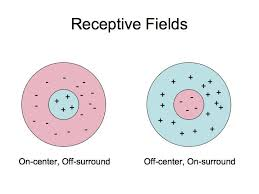
Center-Surround Receptive Fields
neural integration creates a “center-surround” receptive field that emphasize edges
On-center - fires action potentials at the highest rate if light is presented tp its center, reduces its firing rate if light is presented to the surround, firing rate is unaffected if light is presented center & surround at the same time
Off-center - fires APs at the highest rate if light is presented to its surround, reduces its firing rate if light is presented to the center, firing rate is unaffected if light is presented center & surround at the same time
Retinal ganglion cells respond to edges
Color Vision
Trichromatic theory - Hermann von Helmholtz
color matching experiments - can match all of the colors in the visible spectrum by mixing of three primary colors
proposed that there were three types of receptor
Electromagnetic Spectrum
wavelength = hue/color
amplitude = brightness
light reflected from an object depends on the light source
Color Constancy - for a given object, different illuminants present a different color spectrum to the eyes, the brain corrects this
Retinal circuits contributes to color constancy
cones
bipolars
B/Y ganglion
Color Afterimages
Off response caused by sudden release of inhibition from neighboring cells
Y+B cell responds to removal of Blue inhibition by firing rapidly for a short period