EARTH & LIFE SCIENCE
Theories on the Origin of the Solar System
Nebular hypothesis
- The solar system formed from a spinning cloud of gas and dust.
- As it collapsed, it formed the Sun in the center and planets around it.
- Explains why all planets orbit in the same direction.
Protoplanet hypothesis
- Small space rocks (planetesimals) bumped into each other and stuck together.
- Over time, they grew into protoplanets (early planets).
- Inner planets (like Earth) formed from rock and metal.
- Outer planets formed from gas and ice.
Collision hypothesis
- A star passed close to the Sun and pulled material off of it.
- That material became the planets.
- Problem: Doesn’t explain why planets move in almost perfect circles.
Accretion shock theory
- A supernova (exploding star) nearby sent a shockwave through space.
- This shockwave caused a cloud of gas and dust to collapse, forming the Sun and planets.
Features of the Solar system
Sun and Mass Distribution
Sun holds most of the Solar System's mass.
Outer planets hold most of the angular momentum (spin and orbital motion).
Planetary Orbits
Planets move in elliptical (oval-shaped) orbits.
All orbits lie roughly on the same flat plane.
Revolution Periods (Orbit Time)
Closer planets to the Sun orbit faster.
Farther planets orbit slower.
Example: Mercury orbits quickly, Neptune orbits slowly.
Small-Scale Features
🧭 Planets
Not fixed like stars – they move across the sky.
Historically believed to influence events (astrology origins).
Planet | Key Features |
|---|---|
Mercury | No atmosphere |
Venus | Thick CO₂ atmosphere, hottest planet |
Earth | Supports life, has water and balanced climate |
Mars | Thin atmosphere, evidence of past water |
Planet | Key Features |
|---|---|
Jupiter | Largest planet, Great Red Spot (storm) |
Saturn | Most prominent ring system |
Uranus | Rotates on its side |
Neptune | Strongest winds in the Solar System |
Dwarf Planets
Smaller bodies that orbit the Sun, but not dominant in their orbits (e.g. Pluto).
Not included in either terrestrial or gas giant categories.
Rotation of Planets
Prograde Rotation
Rotates in the same direction as the Sun (counterclockwise).
Most planets (including Earth) rotate this way.
Retrograde Rotation
Rotates in the opposite direction.
Venus and Uranus rotate retrograde.
Likely caused by massive impacts early in their history.
Kepler’s Laws of Planetary Motion
Law of Ellipses
Planets orbit the Sun in ellipses, not perfect circles.
The Sun is at one focus of the ellipse.
Law of Equal Areas
Planets move faster when closer to the Sun (perihelion) and slower when farther (aphelion).
A planet sweeps out equal areas in equal time.
Law of Harmonies
The farther a planet is, the longer it takes to orbit the Sun.
Formula: P2∝a3P^2 \propto a^3P2∝a3 (orbital period squared is proportional to distance cubed).
🌍 Planetary Habitability
Factors needed for a planet to support life:
Atmosphere – Controls temperature and blocks harmful radiation.
Water – Essential for life; it's a universal solvent.
Temperature – Must be right for liquid water to exist (in the habitable zone).
Light Energy – Needed for photosynthesis.
Nutrients – Elements like nitrogen and phosphorus support life processes.
🌎 Earth’s Subsystems & Interactions
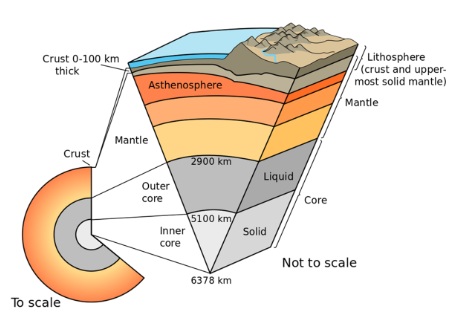
Geosphere – Includes:
Crust & Mantle (solid rock),
Outer Core (liquid metal),
Inner Core (solid metal).
It's the solid part of Earth, interacting with other systems like the atmosphere and biosphere.
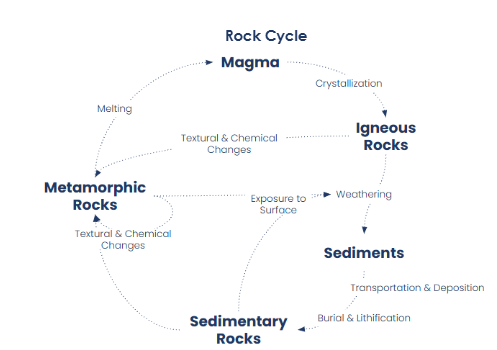
Earth’s Subsystems & Interactions (Simplified)
Geosphere
Solid Earth: crust, mantle, liquid outer core, solid inner core.
Provides land, rocks, minerals, and supports Earth's structure.
🌬 Atmosphere
Earth’s invisible blanket of gases.
Regulates temperature, protects from space debris and radiation.
💧 Hydrosphere
All water on Earth: oceans, rivers, lakes, groundwater, and water vapor.
Supports life and drives the water cycle and weather systems.
🌱 Biosphere
All living organisms on Earth.
Includes interactions between life forms and the environment (air, water, soil).
❄ Cryosphere
Frozen parts of Earth: glaciers, icebergs, permafrost, frozen lakes/rivers.
Affects sea level and climate.
🧲 Magnetosphere
Area around Earth controlled by its magnetic field.
Shields Earth from solar wind and cosmic radiation.
Interaction | Subsystems Involved |
|---|---|
Volcanoes release gases | Geosphere → Atmosphere |
Deforestation increases CO₂ | Biosphere → Atmosphere |
Acid rain breaks down rocks | Atmosphere → Geosphere |
Melting ice causes sea level rise | Cryosphere → Hydrosphere |
Coral bleaching due to warm ocean temperatures | Hydrosphere + Biosphere |