Rivers notes
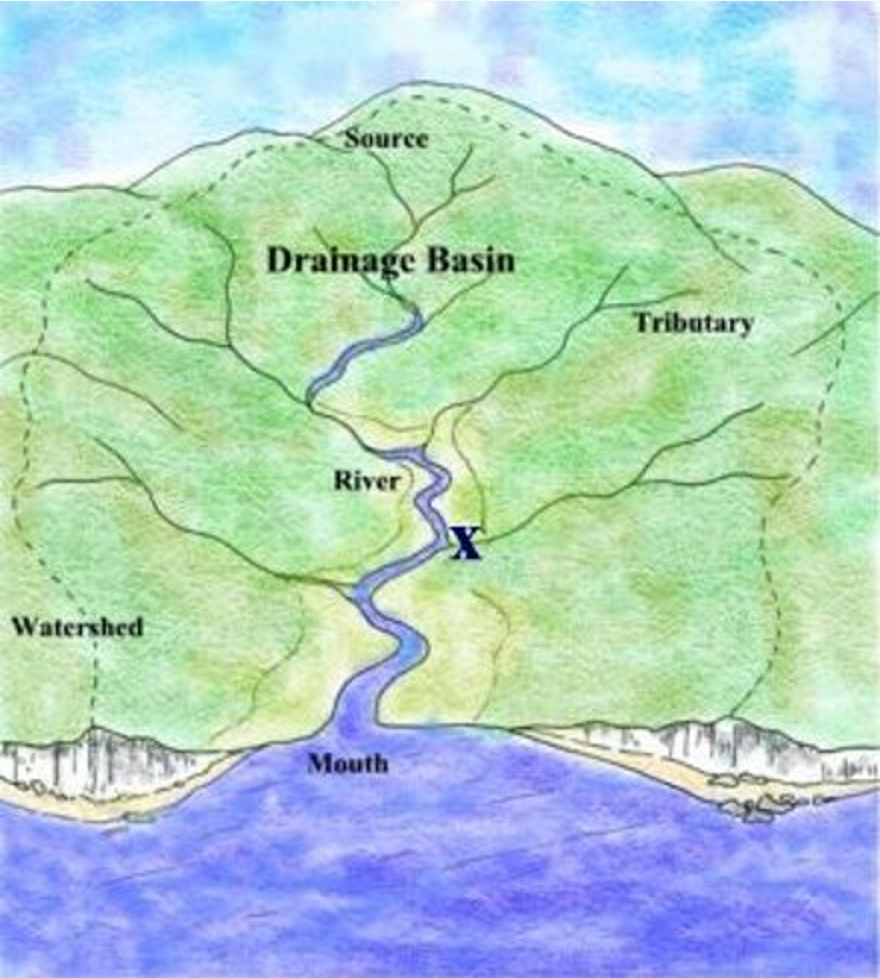
A drainage basin is the catchment area from which a river system obtain its water
Keywords
Watershed - The area of high land forming the edge of the river basin.
Source - Where a river begins
Mouth - Where a river meets the sea
Confluence - The point at which 2 rivers meet
Tributary - A small river or stream that joins a larger river
Channel - This is where the river flows
Drainage basins - This is the area of land drained by a river and its tributaries
The global hydrological (water) cycle - The global hydrological (water) cycle is a movement of water in a continuous cycle between land, sea and air
The Drainage Basin Water Cycle
Inputs:
Precipitation
Flows:
Channel flow
Surface run off
Infiltration - water going through the top layers of the soil
Through flow - when its travelling through soil downwards
Percolation - water going through the soil down deeper into the rocks
Inter flow - water travelling through rocks
Ground water flow - water flowing through the ground/rock (deeper down)
Base flow
Through fall
Stemflow
Stores:
Interception - stopping
Vegetation storage
Surface storage
Ground water storage
Channel storage
Outputs:
Evaporation
Transpiration
Evapotranspiration
Run off into the sea
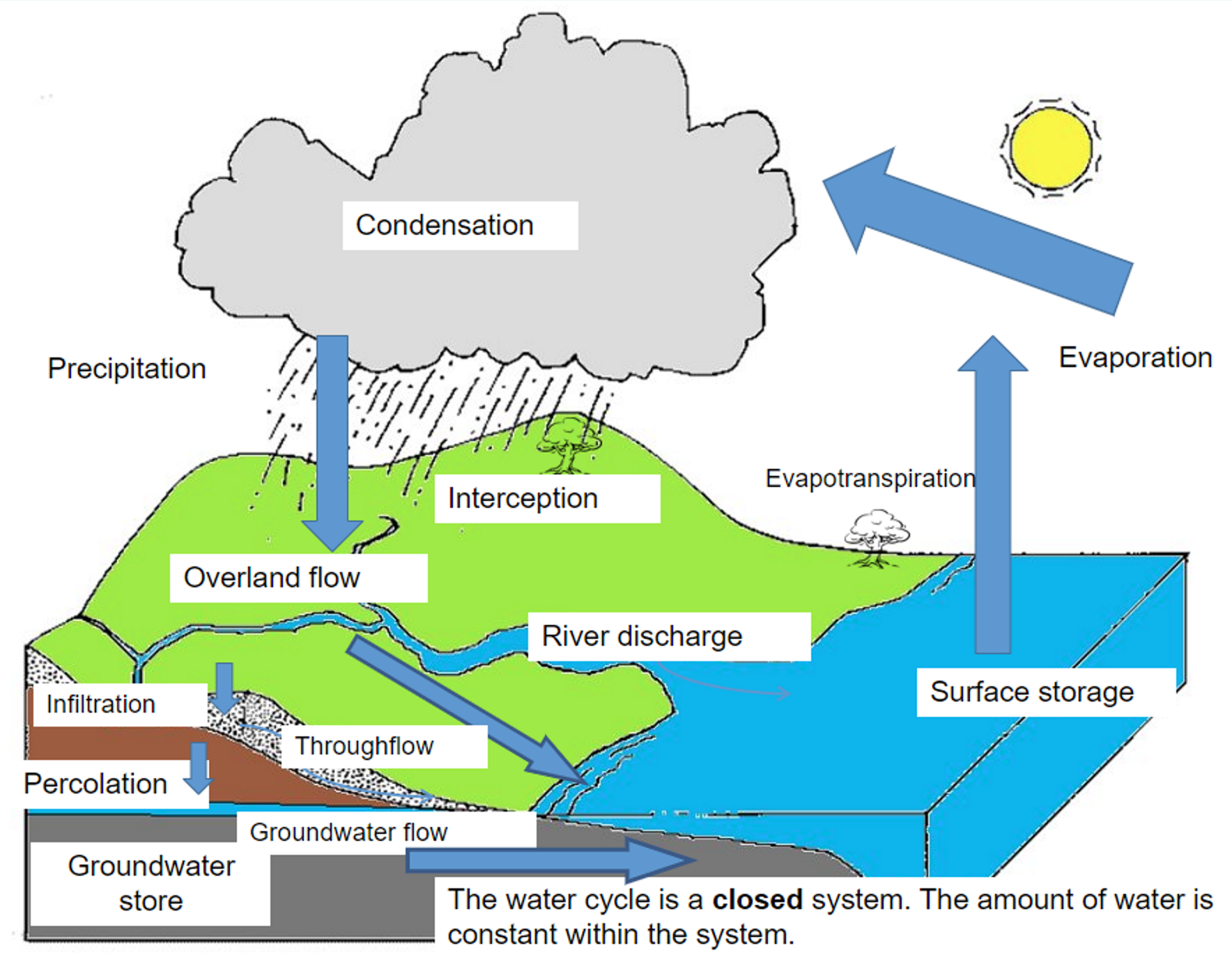
Discharge - The volume of water flowing through a point in a river at a given time
Evaporation - The transformation of water droplets into water vapour by heating (e.g. from the run)
Transpiration - The loss of water from the drainage basin into the atmosphere from surface storage and plants
Evapotranspiration - The loss of water from the drainage basin into the atmosphere from plants (through the stomata)
Surface storage - The total volume of water held on earths surface in lakes, ponds and puddles
Ground water storage - the storage of water underground in permeable rock strata (layers)
Infiltration - The downward movement of water into the soil surface
Overland - the movement of water over the surface of the land, usually when the ground is saturated or frozen or when precipitation is too intense for infiltration to occur
Through flow - The movement of water downslope within the soil layer
Percolation - The deep movement of water through the underlying rock strata (layers)
Precipitation- Any form of liquid falling to the ground e.g. rain, hail, snow, fog
Interception - The prevention of rain from reaching the Earth’s surface by trees ad plants
River Processes
Erosion - The wearing away and removal of the river bed and banks by the water in the river
Hydraulic action - This occurs as water hits the riverbed and banks. Air becomes trapped in cracks in the rock which expands these cracks causing the rock to wear away.
Abrasion - This occurs as pebbles move and grind along the riverbank and bed. As they scrape, they cause the riverbed and bank to wear away. (This process is like when you sand paper wood)
Attrition - This occurs as smaller rocks which are carried along by the river knock and bounce into each other. This breaks the rocks down into smaller and more smooth, rounded rocks.
Solution - This occurs as he water dissolves more alkaline rocks such as limestone. The rocks are dissolved into the water and then carried along in the water solution
Vertical erosion
This occurs at the upper course of the river, the gradient is steep and the river flows quickly, resulting in vertical erosion. This causes the channel to deepen to form a deep sided V shaped valley.
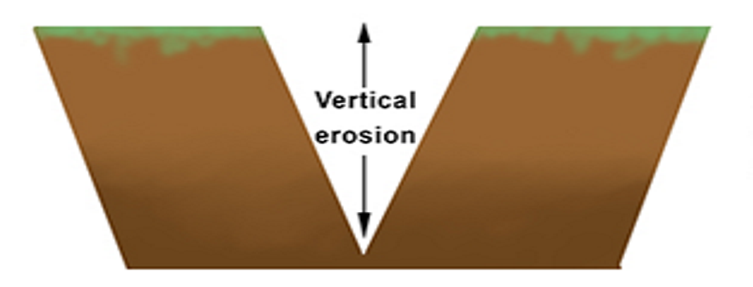
Definition: When the river erodes the bed of the river, making the channel deeper and lower, combined this creates V shaped valleys in the upper course.
Lateral erosion
This occurs at the lower course of the river, where the gradient is gentler and shallow and the volume of water is higher.
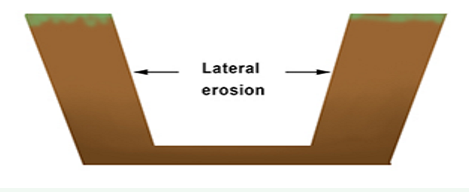
Definition: When the river erode the banks of the river, making the channel wider, in the lower course more lateral erosion takes place making a wider and flatter river.
Transportation
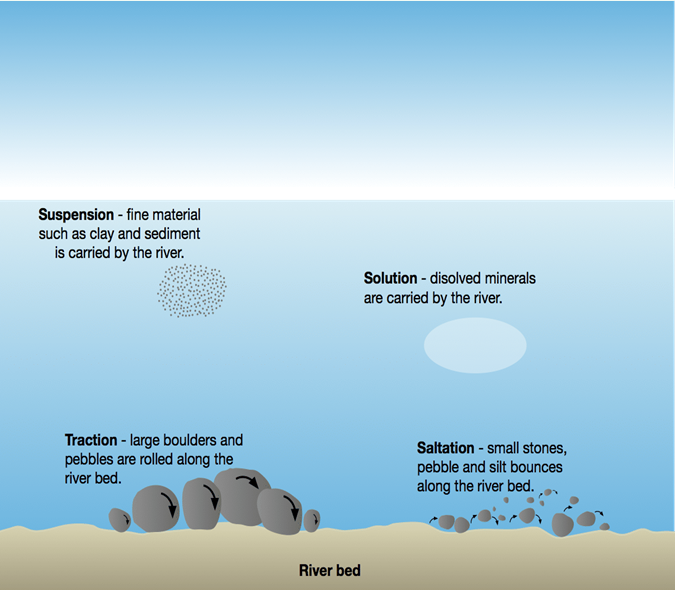
Transportation - The movement of sediment along the riverbed
Solution load - The transport of dissolved chemicals. This varies along the river depending on the presence of soluble rocks
Suspension load - Lighter sediment is suspended (carried) within the water, most commonly near the end of the river.
Saltation load - Pebbles are bounced along the river bed, most commonly near the source
Traction load - Large, heavy pebbles are rolled along the river bed. This is most common near the source of a river, as here the load is larger.
Deposition
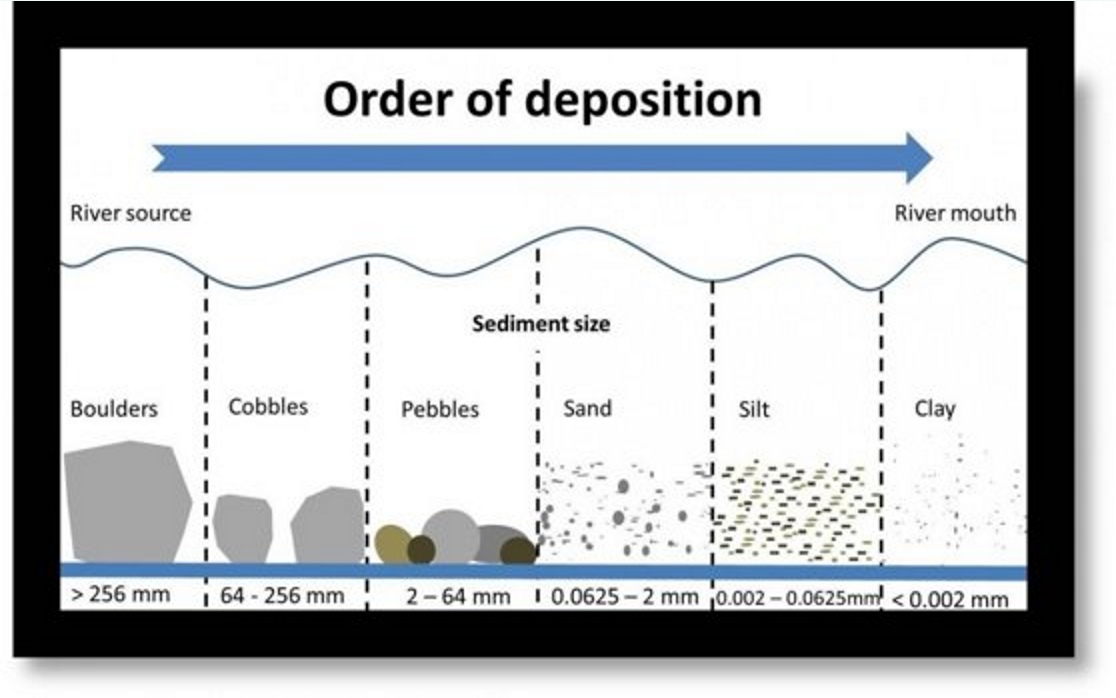
When he river loses energy, it drops all of the material its been carrying, this is known as deposition.
Factors that affect deposition are:
Shallow water
The course of the rivers journey e.g. the rivers mouth
When the volume of the water decreases
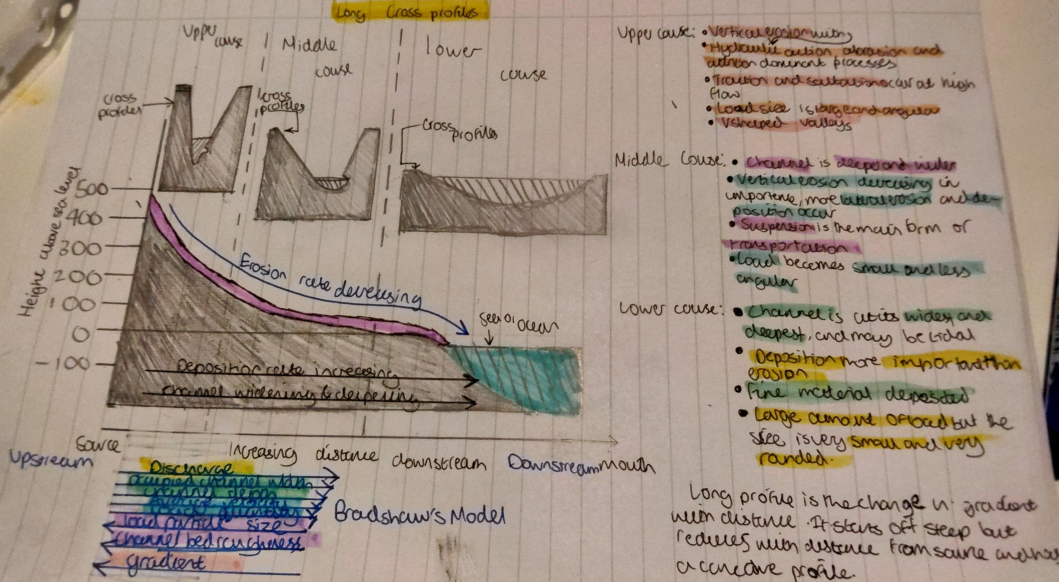
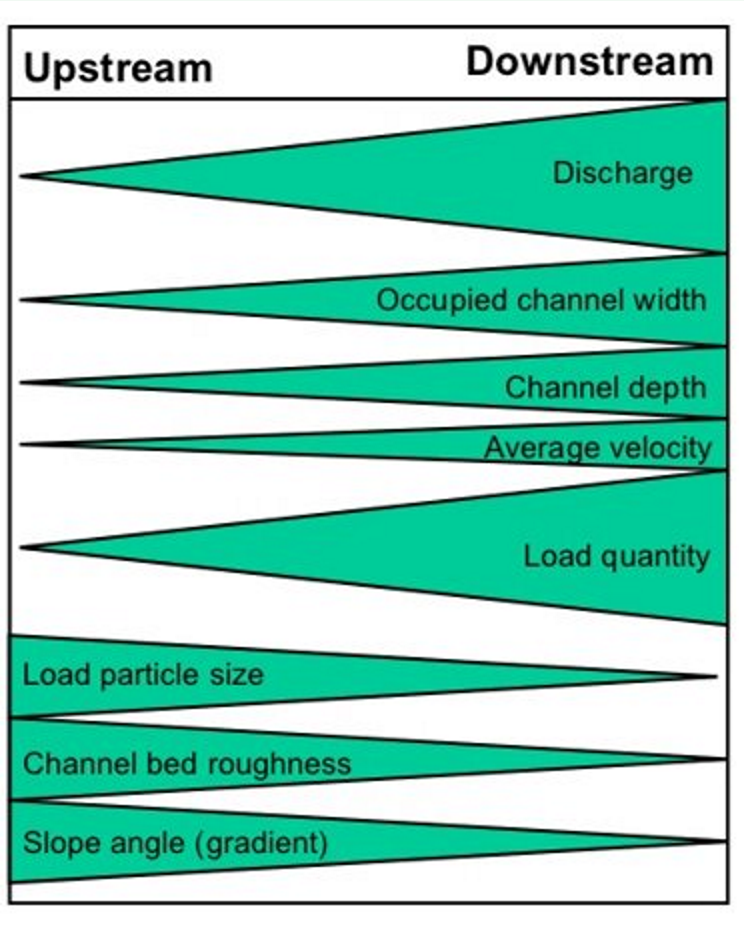
How each variable on the Bradshaw model changes as the river moves downstream
River discharge - More added water due to tributaries, surface run off and ground water flow increases the volume of water in the river.
Occupied channel width - Greater discharge causes lateral erosion (hydraulic action and abrasion) to widen the river.
Channel depth - Greater discharge causes vertical erosion (hydraulic action and abrasion) to deepen the river, but not by much as the river is flowing close to sea level
Average velocity - Increases because discharge has increased and friction has reduced therefore speeding up the river
Load Quantity - Attrition increases the number of rocks in the river as they bump into each other and break down into more particles
Load particle size - Decreases because attrition makes the particles break down into smaller pieces
Channel bed roughness - Decreases as there are smaller particles and therefore the channel bed is smoother
Gradient - The river is flowing towards the sea and out of the mountains
Hydraulic radius - Increases downstream - this is the efficiency of the river. As the river moves downstream there is less friction as the channel bed roughness has reduced and the river can flow more quickly and efficiently
Turbulence - decreases downstream as the gradient is reduced and the river has less friction
Friction - Reduces downstream as channel bed roughness has reduced and gradient has reduced, there is less
Wetted Perimeter is the total length of the river bed and banks in cross section that are in contact with water in the channel. The wetted perimeter influences the velocity of water. If there is a large wetted perimeter in relation to the amount of water in the river there will be more friction and therefore a loss of energy and a lower velocity.
Hydraulic radius is the ratio of the cross sectional area of the river channel. In order to calculate the hydraulic radius, we must first find out the cross sectional area and then divide the cross sectional area by the wetted perimeter. The greater the hydraulic radius the lower the amount of water in contact with the bed and banks which means there is less friction and the river can flow faster with greater velocity and efficiency.