Discussion (+ChatGPT) Notes
Lethal, Ethical and the Nursing Process
Core Ethical Principles in Nursing
Autonomy: respecting the patient’s right to make informed choices regarding their care.
Challenge: patient’s choice may conflict with medical advice/personal opinions.
Mnemonic: Autonomy is All by my best.
Beneficence: ethical principle of promoting good care.
Challenge: balancing what is “good” for the patient with respecting their independence, especially if they refuse beneficial treatment.
Mnemonic: Beneficence = benefit
Fidelity: keeping promises and being committed.
Challenge: limited time, staffing, or resources may prevent the nurse from fully following through on promises.
Mnemonic: Fidelity = Faithful
Accountability: involves owning one’s actions and decisions.
Challenge: admitting errors or oversights can be difficult and may create fear of disciplinary action.
Mnemonic: Accountability = I am accountable for my actions.
Justice: fairness in the distribution of care and resources.
Challenge: personal biases, systemic inequities, or scarce resources may influence decisions.
I JUST want FAIR call for all
Non-Maleficence: “do no harm”; ensure patient safety and minimize risks.
Challenge: some treatments may cause discomfort or side effects while still being necessary (e.g., chemotherapy, painful wound care).
Veracity: being truthful and honest with patients; providing clear, accurate information.
Challenge: delivering bad news compassionately while maintaining honesty can be emotionally difficult.
Compassion fatigue/burnout: critical challenges faced by nurses, impacting their mental and emotional wellbeing
Key indicators: emotional exhaustion, detachment from patients, and diminished empathy.
Strategies to combat these issues: promoting self-care, implementing mindfulness practices, participating in debriefing sessions, and engaging in support groups to foster resilience and maintain compassionate care; consider joining a union.
Overview of Legal Responsibilities
Advance directives: allows pt. to outline their wishes regarding medical treatment in case they become unable to communicate these decisions themselves.
Living wills and durable powers of attorney for healthcare; ensures pt.’s preferences are respected even when they cannot advocate for themselves.
Informed consent: legal requirement where patients must be given clear information about their treatment options, risk, benefits, and alternatives, allowing them to make educated decisions regarding their healthcare.
If pt. has a question, let them ask the provider.
Standards of Practice: guided by BON and ANA; outlines the expected level of care.
Torts:
International torts (e.g. assault; battery; false imprisonment; verbal threats)
Unintentional torts (e.g. negligence; malpractice)
Quasi-intentional torts (e.g. breach of confidentiality; defamation of character)
Protected Health Information (PHI)
Protecting PHI is a legal obligation for nurses, governed by laws, such as HIPAA.
Only personnel can access PHI.
Nursing Process:
ADPIE:
Assessment (data is collected)
Diagnoses (identifying pt.’s need)
Planning (care strategies are developed)
Implementation
Evaluation
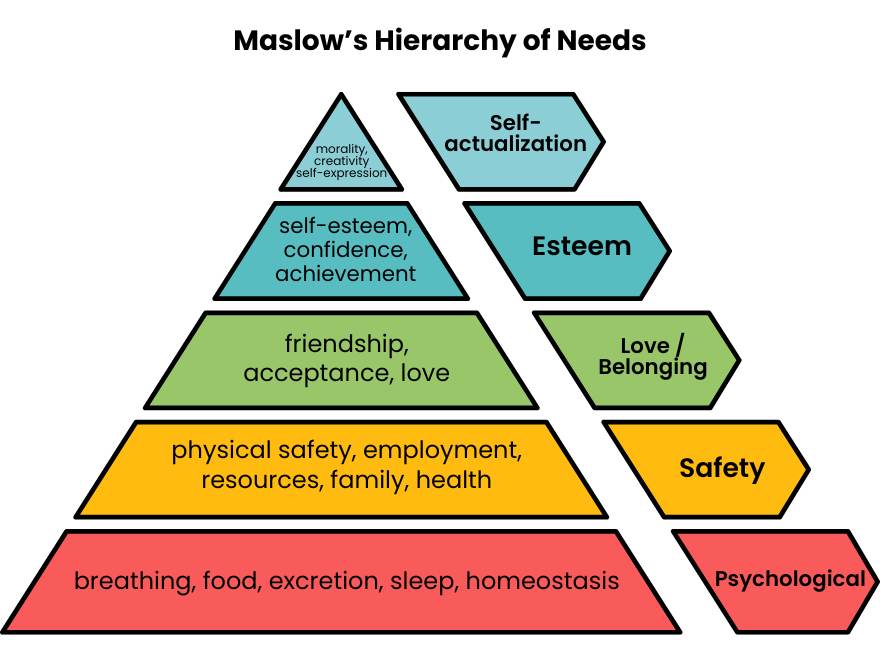
Maslow’s Hierarchy of Needs in Nursing
Physiological Needs (most critical need): food, water, warmth, rest, sexual reproduction needs, oxygen, shelter
tied to another nursing principle: ABCs—Airway,
Safety Needs: emotional security, proper mental health, and financial stability
Nursing interventions to address barriers to giving quality care to pt.
Love and Belonging needs: family visits, supportive relationships with providers
Esteem Needs: promoting pt.’s autonomy and self worth
Celebrating a pt.’s achievement (e.g. being able to properly do
Self-Actualization: support pt. to achieve their goals into healing.
Remind the pt. how far they have gone in their nursing journey.
Subjective Data: pt.-reported insights (patient’s feelings, perceptions, and self-reported experiences).
Objective Data: measurable facts (e.g. VS, lab results, and physical examination findings)
Clinical Judgment Action Model
Recognizing cues
Analyzing cues
Prioritizing Hypotheses
Generating solutions
Taking Actions
Evaluating outcomes
Understanding the Five Rights of Delegations
to a pt. who is stable only.
do not delegate what they E.A.T.
“Terrific Care Promotes Client Safety)
Right task: activities that are appropriate
Right circumstance: health status and complexity of case.
right person: verify competence and scope of practice
right supervision: provide instruction on tasks.
right direction and communication