Elisabeth Chu - CH. 13 GLACIATION
Geography 12 CH. 13 GLACIATION
Ms. Soares
Glacial Landscape Key Terms. Define and include how they are formed. Use Physical Geography workbook Ch. 13.
Glaciation: when something is covered by ice
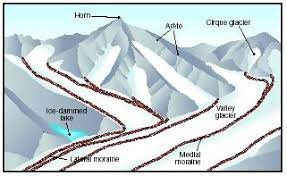
Medial Moraine: form when two tributary glaciers come together
Glacial till/drift: unsorted glacial sediment, types of debris include outwash, sorted, stratified, rockflour
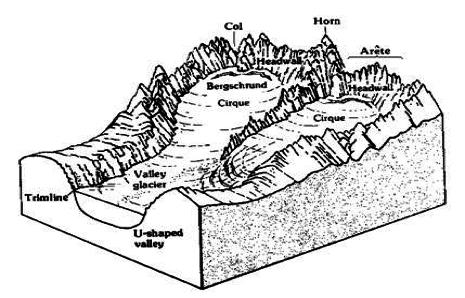
Alpine glaciation: smaller than continental, occurs in mountainous areas and high elevations
Lateral Moraine: occurs on side of mountain
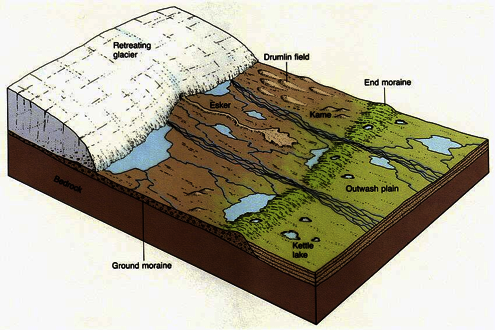
Kettle Lake: depression/hole in an outwash plain formed by retreating glaciers or draining floodwaters, more circular and looks like massive potholes
Continental glaciation: largest on earth, occurs in lowland regions, massive sheets of ice
Col: lowest point of a ridge between two peeks
Drumlin: hills of sediment that have been streamlined by glacier flow
Cirque: bowl-shaped amphitheater like depressions that glaciers carve into mountains and valley sidewalls at high elevations
Truncated Spur: landform created by glacial erosion
Erratics: large boulders or rocks that have been transported by glacial ice and deposited in locations far from their origin
Horn or peak: sharp, steep mountain peak or ridge formed by process of glacial erosion
U shaped valley or trough: glacial valley characterized by its steep high walls
Eskers: long, narrow ridges of gravel and sand deposited by streams flowing within or beneath glaciers or ice sheets
Arete: narrow, sharp ridge of rock that forms between two glaciers
Terminal Moraine: type of moraine that is formed at the end of a glacier
Recessional moraines: type of glacial landform formed by accumulation of sediment and rock debris at edges of a glacier
Tarn: small mountain lake formed in glacial depressions
Finger Lake: lakes that can be formed the type of rock formed beneath the surface
Striations: scratches found on rock surfaces and are created by movement of glaciers
Hanging Valley: feature formed when tributary glacier flows into a larger glacier or ice stream at a higher elevation than the main glacier
Fiord: long, narrow inlet of sea bordered by steep cliffs created by glacial erosion
Roche Moutonnee: rock formation created by glacial erosion
Alpine Glaciation
Continental Glaciation
Use your workbook to answer questions A-H below:
A. How has Ice Shaped the landscapes on all Continents?
Glacial erosion has shaped the landscapes on all continents in a variety of ways. This has created u-shaped valleys, cirques, horns, aretes, moraines, eskers, drumlins.
B. Explain how Glacial Ice forms? (Accumulation, Ablation, Latitude & Altitude, Global cooling, Axis tilt)
Glacial ice forms through a process called snow accumulation. During winter months, snowfall accumulates on the ground and forms a thick layer of snow.
C. What would trigger an Ice Age? What is the process?
The main factors that would trigger an ice age are changes in the Earth’s orbit and tilt. Another factor that can trigger an ice age is the amount of greenhouse gasses in the earth’s atmosphere. This is because they trap heat which keeps the Earth warm. However, if the amount of greenhouse gasses in the atmosphere decreases, the Earth's temperature will drop, which can lead to an ice age.
D. Differences & Similarities between Alpine and Continental Glaciers
| ALPINE | CONTINENTAL |
|---|---|
| found in mountainous regions and are confined to valleys and cirquessmaller in size compared to continental glaciersmove slowercolder than continental glaciersmore steep-sided and confined to valleys | found on large land massesmore dome-like shape and cover large areas of land |
SIMILARITIES
| ALPINE & CONTINENTAL |
|---|
| Both alpine and continental glaciers are formed by the accumulation and compaction of snow and ice.Both types of glaciers move under the influence of gravity and can shape the landscape as they move.Both alpine and continental glaciers can erode and deposit rock and soil, creating distinct landforms such as cirques, moraines, and drumlins. |
E. List the Features of Alpine Glaciers (Erosional and Depositional)
- u shaped valleys
- cirques
- horns
- aretes
- moraines
F. List the Features of Continental Glaciers (Erosional and Depositional)
- fjords
- ice sheets
- crevasses
- seracs
- ice streams
- ice shelves
G. Draw out and provide the names to landscape features as a result of glacial action/glaciation.
H. Briefly explain the benefits provided by Glaciers.
Some of the benefits include water supply, flood control, hydroelectric power, irrigation, tourism, and biodiversity.