Forces and Motion
Newton’s Laws
Newton’s First Law - If a stationary object’s resultant force is zero, the object will remain stationary. If a moving object’s resultant force is zero, the object will continue to move at a constant velocity.
Newton’s Second Law - F = ma; An object’s acceleration is directly proportional to the resultant forces acting on it, and inversely proportional to the object’s mass.
Newton’s Third Law - The forces that two objects exert on each other when they act on each other are equal and opposite.
Equations
Force = Mass * Acceleration
F = ma
Force = Newtons
Mass = Kg
Acceleration = M/s^2
Distance = Speed * Time
P = mv
M = Fd
Forces
Force - Push or pull that can change the shape, direction and speed of an object.
Forces are invisible, although you can see the effect.
Types of Forces:
Gravitational (or weight) - the force between any two objects with mass (like the Earth and the Moon)
Electrostatic - the force between any two objects with charge (like a proton and an electron)
Thrust the force pushing a vehicle (like the push from rocket engines on the shuttle)
Upthrust the upward force on any object in a fluid (like a boat on the surface of a river)
Air resistance (or drag) - the force of friction between objects falling through the air (like a skydiver in freefall)
Compression forces that squeeze an object (like squeezing a spring)
Tension forces that stretch object (like two teams in a tug-of-war)
Reaction force the force between any two objects in contact (like the upwards force from a table on a book)
Graphs
On a distance-time graph, the gradient is the speed.
The higher the gradient, the higher the speed.
On a velocity-time graph, the gradient is the acceleration.
The higher the gradient, the higher the acceleration.
Force and Free Body Diagrams
Force Diagrams
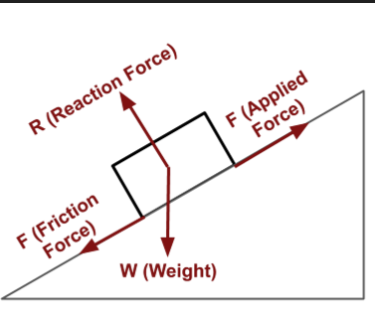
Free Body Diagrams

Stopping Distance
Stopping Distance = Thinking Distance + Braking Distance
Factors that affect:
Thinking Distance:
Tiredness
Medication
Drinking
Speed
Braking Distance:
Speed
Mass
Brake Conditions
Road being wet
Tire conditions
Gradient of road
Terminal Velocity
Terminal Velocity - When weight = drag; the resultant force is 0N and maximum velocity is reached.
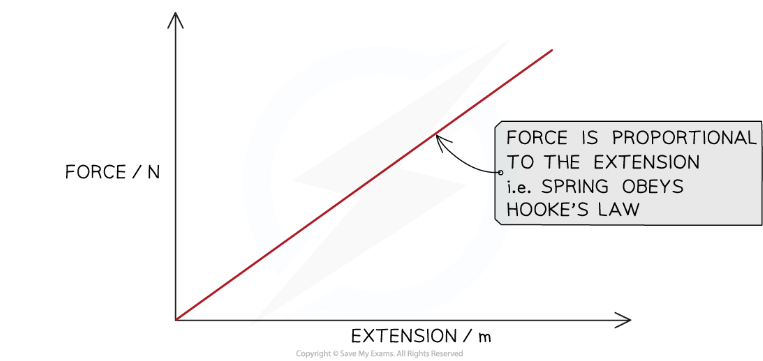
Hooke’s Law
The force applied to a spring is directly proportional to extension until it reaches it’s elastic limit.
Plastic Behaviour - Once a spring’s elastic limit is reached, it will be permanently deformed.
Measure the original length of the spring.
Place spring on a clamp stand and attach a weight to the bottom of it. Measure the spring’s length.
Subtract the weighted length from the original length to find the extension.
Repeat and average concordant results
Scalars and Vectors
Scalar values - Only have a magnitude
Vector values - Have a magnitude and direction.
Momentum
There is a change of momentum when two objects collide. Impact time is inversely proportional to the force exerted on an object. Increased impact time will decrease force exerted on the object.
Principle of momentum - Momentum before collision = Momentum after collision in a closed system.
P = mv
Momentum = Mass * Velocity
kg . m/s = kg*m/s
F = mv - mu / t
Force = change in momentum / t
Impact time is inversely proportional to the average force exerted.