Unit 4 - Financial Sector
Chapter Breakdown
4 - Financial Sector Overview: Discusses the network of institutions that link borrowers and lenders, including key concepts like assets, interest rates, and interest-bearing assets.
4.1 - Financial Assets: Analyzes the different types of financial assets such as stocks, bonds, and cash equivalents, detailing their functions and how they provide returns to investors.
Personal Finance: Covers the basics of personal finance, including budgeting, saving, spending, investment, and asset management.
Risks of Buying Assets: Examines different types of risks associated with asset purchases, such as market risk, default risk, and inflation risk.
Liquidity: Explains the concept of liquidity and the general rule that higher liquidity often means lower returns.
Bonds vs. Stocks: Compares these two types of financial instruments, highlighting their characteristics and implications for investors.
Bond Prices and Interest Rates: Discusses the inverse relationship between bond prices and interest rates, with examples.
4.2 - Nominal vs. Real Interest Rates: Differentiates between nominal and real interest rates, explaining how to calculate each.
Time Value of Money: Introduces calculations for future value and present value, discussing their importance in finance.
subtract real from nominal to know the difference of interest rates over the given amount of time. This is applicable to finding what the rate of change is over any given interest bearing asset or liability and thus what amount of money is lost/gained in comparison to a fixed rate.
4.3 - Definition and Functions of Money: Defines money, explains its types (commodity vs. fiat), and outlines its functions in the economy.
Why do we use money?
The Barter System - goods and services are traded directly. No money is exchanged
Barter system is ineffective because:
“Double Coincidence of Wants” - both traders need to want the goods or services offered by the other party
Some goods cannot be split.
if 1 goat = 5 chickens… then how do I get 1 chicken..?
What is money?
Money - is anything that is generally accepted as payment for goods and services.
money is NOT the same as wealth or income
Wealth - total collection of assets
Income - flow of earnings per unit of time
Commodity of Money - something that performs the function of money and has intrinsic value (i.e. gold, silver, cigarettes, etc.)
Fiat Money - something that serves as money, but has no other value or uses (i.e. paper money, coins, digital currency)
Functions of Fiat Money
A Medium of Exchange - easily used to buy goods and services w/ no complications of barter system.
Unit of Account (measure of value) - universal standard to compare the value of goods and services.
A Store of Value - money allows you to be able to store purchasing power for the future.
What backs the money supply?
There is no longer a gold standard, money’s value comes from the collective belief that it is valuable.
what makes it effective?
generally accepted - buyers and sellers have confidence that it IS legal tender.
scarcity - money needs to be limited
portable and dividable
Purchasing Power - the amount of goods and services a single unit of money can buy.
M1 - cash, checking accounts, saving accounts - money in circulation
Highest liquidity
Check-able bank deposits (checking accounts)
savings deposits (money market accounts)
M2 - certificates of deposits, money market funds
near-moneys
NOT investments
4.4 - Banking and Money Supply Expansion: Details the fractional reserve banking system and the money multiplier effect.
Fractional Reserve Banking - banks hold part of a deposit (dictated by a reserve requirement)
Money Multiplier = 1/(reserve requirement)
this is the amount of money that can be “created” by the bank
Demand Deposit - money in a commercial bank in a checking acct
Required Reserves - minimum percentage of deposit banks are required to hold.
Excess Reserves - what the bank can loan out
Balance sheet - a record of the banks assets, liabilities and net worth
4.5 - The Money Market: Describes the equilibrium in the loan-able funds market, including demand and supply influences.
Demand for money - people demand a certain amount of liquid asset for two reasons
transaction demand (make purchases)
asset demand (hold money to save)
Quantity demanded falls when interest rates for assets rise
Quantity demanded increases when interest rates for assets fall.
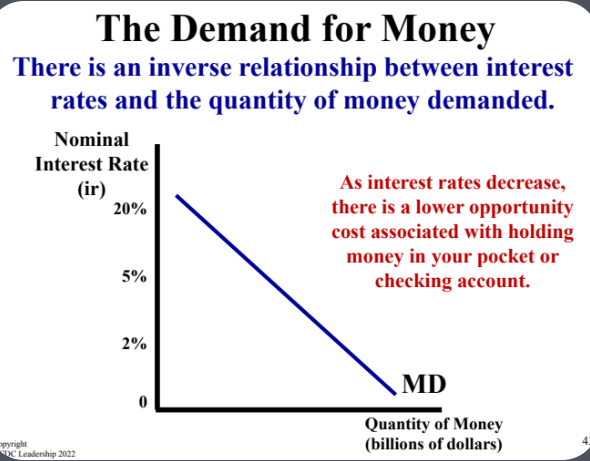
Interest rates / quantity of money demanded
Shifters - changes in price level, changes in income, changes in technology
i.e. things that change the purchasing habits of consumers (how much freedom do they have to spend, what is the incentive for acquiring assets)
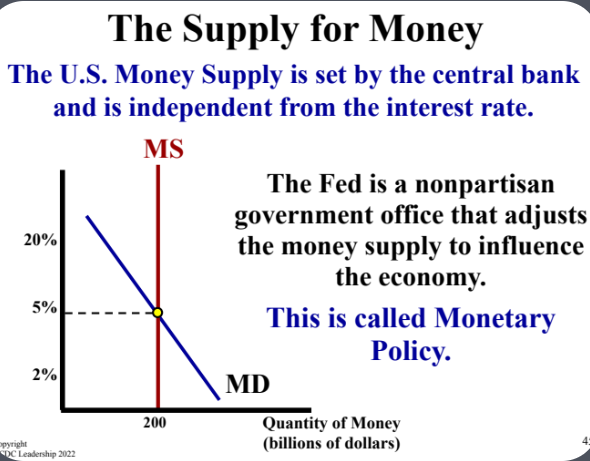
Monetary policy - gov. changes the amt minted money to influence economy.
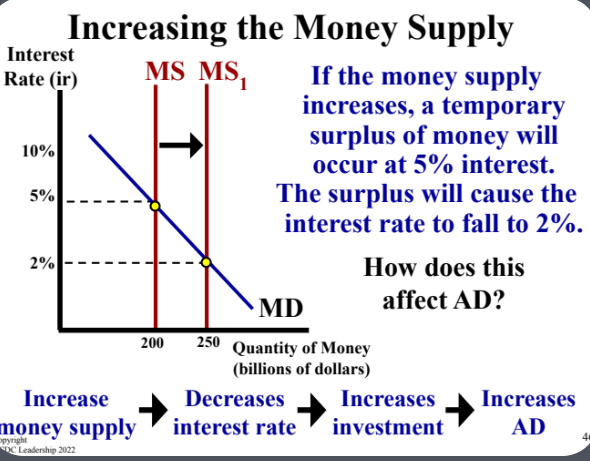
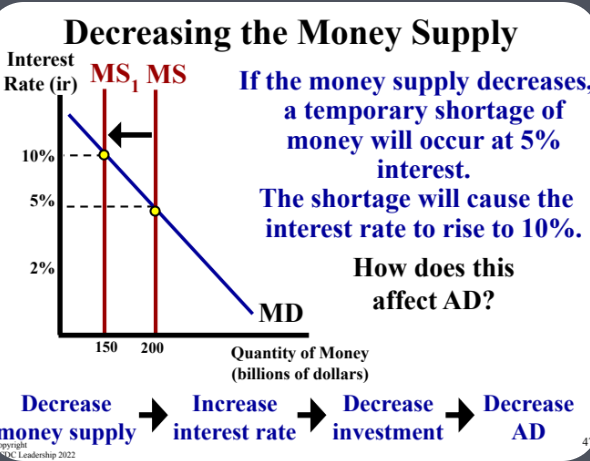
Federal Reserve - the big government agency that monitors the US economy and does stuff to mitigate recession/depressions and regulate inflation
4.6 - Monetary Policy: Summarizes the tools used by central banks for monetary policy and the Federal Reserve's roles.
Now we are talking about the Money Supply
Shifters of Money Supply
Reserve Requirements
Discount Rate
Open Market operations
To increase MS:
Decrease the Reserve Requirements
Decrease Discount Rate
Central bank can buy government securities
To decrease MS:
Increase Reserve Requirements
Increase Discount Rate
Central bank can sell government securities
4.7 - The Loan-able Funds Market: Explains how savings provide the supply of funds available for lending and how this impacts interest rates and investment decisions in the economy.
Private Savings - income we don’t spend
Public Savings - Government income not spent (doesn’t really exist in america)
National Savings - private + public
Net capital Inflow - money coming in - money going out
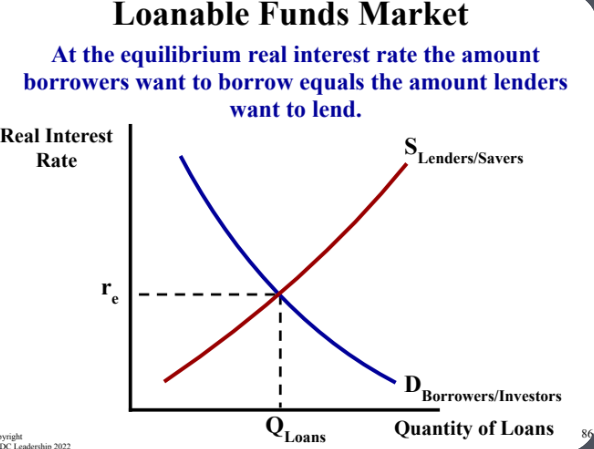
Loan able funds market - shows supply and demand of loans and shows equilibrium real interest rate.
Demand - real interest rate / quantity loans demanded
Supply - real interest rate and quantity loans supplied
SHIFTERS
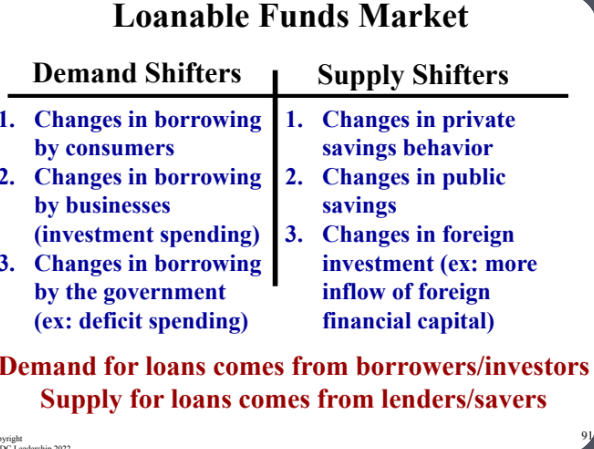
Shifters of SUPPLY - Foreigners lend so the supply depends also on the amt of money that enters or leaves the country.
Capital inflow - amt of money entering the country
Capital Outflow - amt of money leaving the country
Net Capital inflow - (inflow - outflow)
A change in NCI will shift the supply of loanable funds
Shifters of DEMAND - borrowing is the demand of loanable funds
private investment - borrowing by businesses and consumers.
Government Borrowing - deficit spending when government spending is greater than tax revenue.
change that affects borrowing will shift the demand of funds
Unit 4 - Financial Sector Overview
Why is the supply of money vertical?
It is not influenced by interest rates in the short run. Amt. of money in circulation is fixed.
What shifts the supply of money?
Reserve requirements, Discount rates, buying/selling securities
Why is the supply of loanable funds upward sloping?
interest rates increase, people could save more, attracting more money to the loanable funds market.
What shifts the supply of loanable funds?
private savings, public savings, foreign investment
Why is the demand for money downward sloping?
interest rates decrease, opportunity cost of saving lowers, so people hold liquid money rather than invest in interest bearing assets.
What shifts the demand for money?
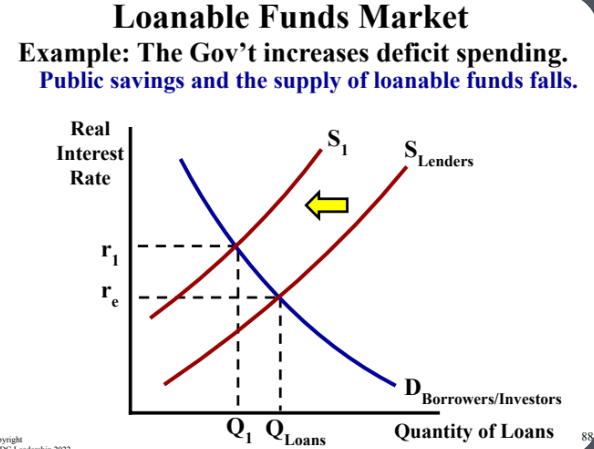
borrowing by consumers/businesses, government borrowing (deficit spending brings the supply down bc its more negative)
Why is the demand for loanable funds downward sloping?
increase in interest rates, reduced business investment, government budget surplus, confidence.
What shifts the demand for loanable funds?
interest rates, business/consumer investments, surplus spending
What kind of interest rate is on the money market graph?
nominal interest rate.
Key Concepts
Financial Sector: A network of institutions linking borrowers and lenders (e.g., banks, mutual funds, pension funds).
Assets: Anything of value, tangible or intangible.
Interest Rate: The cost of borrowing money (the price of a loan).
Interest-bearing Assets: Assets that earn interest over time (e.g., bonds).
Personal Finance
What is Personal Finance?
Involves budgeting, saving, spending, investment, and asset management.
Business Investment Definition:
In economics, investment refers to spending on business tools and machinery. Lower interest rates increase investment.
Risks of Buying Assets
Market Risk: Potential losses from market price fluctuations.
Default Risk: Risk that borrowers fail to meet debt obligations.
Inflation Risk: Reduction in investment value due to inflation.
Liquidity
Definition: The ease of converting an asset into a medium of exchange.
General Rule: Higher liquidity often means lower returns.
Bonds vs. Stocks
Bonds: Loans (IOUs) that require repayment plus interest; no ownership in the company.
A bond is issued at a fixed interest rate over its life.
Stocks: Represent ownership in a corporation and may pay dividends.
Bond Prices and Interest Rates
Inversely Related: As interest rates go up, bond prices go down and vice versa. Example:
A 30-year Treasury bond with a 5% interest rate provides 100 today versus $200 in 5 years under a 10% interest rate.
Definition and Functions of Money
What is Money? Anything accepted for goods/services; distinct from wealth and income.
Types of Money:
Commodity Money: Has intrinsic value (e.g., gold, silver).
Fiat Money: Has value by government decree (e.g., paper currency).
Functions of Money:
Medium of Exchange: Simplifies transactions.
Unit of Account: Measures the value of goods.
Store of Value: Maintains purchasing power over time.
Banking and Money Supply Expansion
Fractional Reserve Banking: Banks keep a fraction of deposits as reserves and lend out the rest.
Money Multiplier: Determines how much total money is created in the economy from deposits.
Example: If the reserve ratio is 10%, a $1000 deposit leads to more than $1000 in total money supply.
The Loan-able Funds Market
Equilibrium in the Market: Demand (borrowers) and Supply (lenders) balance each other regarding real interest rates:
Demand for loans decreases as interest rates increase.
Supply of loans increases with higher interest rates.
Influencing Factors: Public and private savings affect the supply of loan-able funds. Changes in government spending impact demand and supply dynamics.
Summary of Monetary Policy
Tools Used by Central Banks:
Reserve Requirements: Percentage banks must hold from deposits.
Discount Rates: Interest charged by central banks to commercial banks.
Open Market Operations: Buying/selling government securities to influence money supply.
Federal Reserve's Role: Regulates banks and manages the money supply to influence economic stability.
Formulas:
Time Value of Money
Future Value Calculation: Amount gained after a specific period.
Present Value Calculation: Current worth of a future sum.
PV = Future Amount / (1 + i)^N
Nominal vs. Real Interest Rates
Nominal Interest Rate: Percentage increase in money without inflation adjustment.
Real Interest Rate: Actual increase in purchasing power.
Real Interest Rate = Nominal Rate - Inflation Rate
Bond Prices and Interest Rates
Inversely Related: Higher interest rates lead to lower bond prices.
Variables
PV (Present Value): The current worth of future money.
Future Amount: The amount of money expected in the future.
i (Interest Rate): The percentage rate used to calculate interest over a period.
N (Number of Periods): The total number of time intervals until the future amount is received.