Data
Anything you can encode using binary representation
Aim of having it
To retrieve information
How?
Process the data by establishing a flexible, understandable, and common representation for the data
Use databases
Engineering
Process of designing and building systems that allow people to collect, manage, and analyse data
Engineers
Work to make raw data useable for data scientists and business analysts so that organisations can use it to improve performance
Responsible for
Data pipelines - creating data pipelines (flows) to manage and process large sets of data
Data integration - ensuring that data from different sources is integrated seamlessly
Data quality - ensuring that data is of high quality and that the data infrastructure is reliable and efficient
Low quality data - data that doesn’t fit your requirements as developer
Data analysis - creating raw data analyses to provide predictive models and show trends
Data security - managing and storing data securely to protect it from loss or theft
Automation - creating ways to automate tasks within the data pipeline to improve efficiency
Types
Data can be broadly classified into four types
Structured Data
Has a predefined model, which organizes data into a form that is relatively easy to store, process, retrieve and manage
e.g., relational data
Unstructured Data
Opposite of structured data
e.g., flat binary files containing text, video or audio
Note: data may not be completely devoid of structure (e.g., an audio file may still have an encoding structure and some metadata associated with it)
Dynamic Data
Data that changes relatively frequently
e.g., office documents and transactional entries in a financial database
Static Data
Opposite of dynamic data, rarely changes.
e.g., Medical imaging data from MRI or CT scan
Why Classify?
Can help in designing and developing a pertaining storage solution:
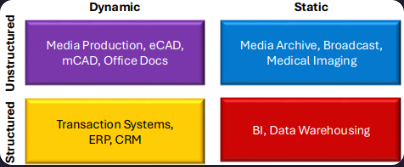
Relational databases are usually used for structured data
File systems or NoSQL databases can be used for (static), unstructured data