Introduction to the English Legal Syste
Overview of the English Legal System
Introduces the participants: Ross Cranston (professor, judge, MP, Solicitor General), Nav Kabani (tribunal judge, Immigration and Asylum Chamber), Tom Grant (barrister, Chambers in Lincoln’s Inn, author, visiting professor at LSE).
The course plan: overview of English law and its parts; personnel of the law (judges, lawmakers, structure); general overview of precedent and statutory interpretation; followed by more detailed lectures later.
Reference to available literature: library books and online resources via the LSE Library catalog (Helen Rutherford et al.; Aliser Gillespie and Shabor We). Online access available now.
Key takeaway: the notes follow slide content and prepare for further lectures on precedent and statutory interpretation.
Jurisdiction: Where the law applies
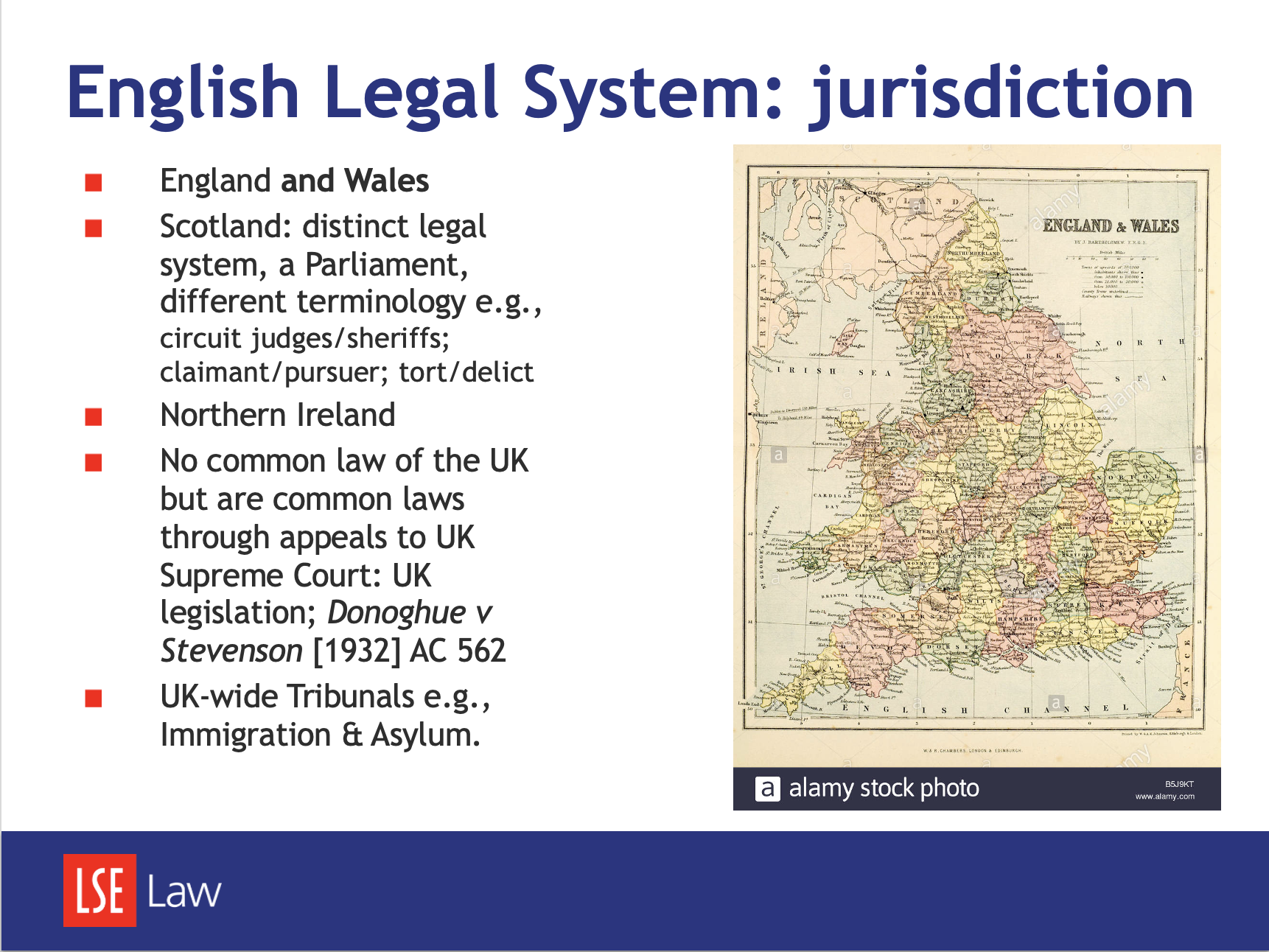
Laws apply within defined geographical areas; jurisdiction = the extent and degree of legal authority.
UK composition: sovereign state comprising England, Wales, Scotland, Northern Ireland.
English law applies to England and Wales only; Scotland has its own criminal and civil law rules (contract and tort differ).
Scottish terminology differences: delict (tort) and pursuers (claimants).
Apex court: the Supreme Court (formerly House of Lords) sits in London; hears appeals from all three jurisdictions; can sit outside London occasionally.
After processing appeal within a jurisdiction, cases can reach the final court of appeal (the Supreme Court) as a single UK-wide court drawing judges from all three jurisdictions.
UK legislation from Westminster Parliament is adaptable, applying either UK-wide or to specific nations/regions, reflecting parliamentary sovereignty within its uncodified constitutional structure. The UK also operates under devolution, empowering bodies like the Scottish Parliament and the Senedd to legislate on specific 'devolved matters.' Despite this, England and Wales largely share a unified legal system, encompassing common law, statute law, and a common court hierarchy.
Tribunals are mixed in scope; some are UK-wide (e.g., Immigration Chamber), others English-only (e.g., Mental Health Tribunal).
Presumption: legislation generally applies within the UK jurisdiction and has no extraterritorial operation unless the face of the statute says so; exceptions exist (e.g., war crimes prosecutions).
War crimes prosecutions: notable London prosecutions for WWII acts in Ukraine/Belarus; an exception to the general rule.
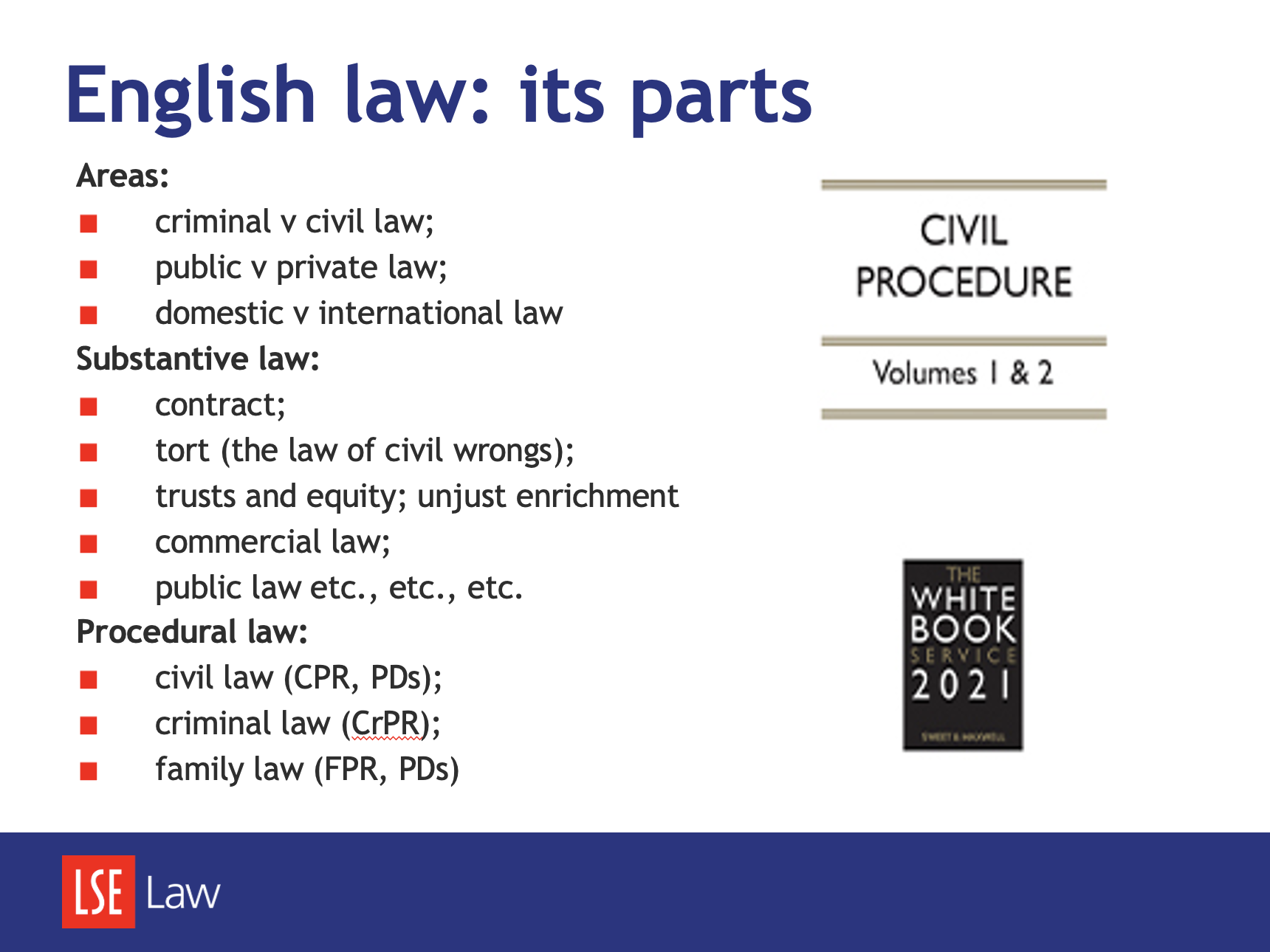
Parts of English Law
Criminal law vs civil law:
Criminal law punishes wrongdoers; civil law regulates relationships between members of society.
An act can give rise to liabilities in both systems (e.g., battery could be a criminal offence and a civil tort).
Private law vs public law:
Private law regulates relationships between individuals and private bodies.
Public law concerns the relationship between individuals and the state; Administrative Court (part of the High Court) and tribunals handle much of public law.
Domestic law vs international law:
UK signs treaties and performs them in good faith; in contrast to monist systems, the English dualist approach requires domestic adoption via legislation for treaties to have effect (e.g., European Convention on Human Rights).
ECHR effect came through the Human Rights Act 1998; before that, it was not part of domestic law by default.
Substantive law: sources and structure
Substantive law sources are twofold:
Common law: judge-made law developed over centuries; still cited across centuries (e.g., cases from the 17th–18th centuries).
Statute: Acts of Parliament creating rights and liabilities (e.g., the Misrepresentation Act 1967).
The roles of writers:
Legal writers shape the coherent body of rules (e.g., Chitty on Contracts; Clark and Lindel on Torts).
These works synthesize judge-made law into clearer principles for contract, tort, etc.
Procedure is a distinct but essential pillar:
Civil procedure rules and practice directions determine how cases progress; crucial for winning cases.
The White Book (Civil Procedure) is a long, expensive core text (commonly ~4{,}000 pages).
Other procedural guides include a Green Book; Red Book for family or crime.
Modern practice emphasizes that procedure can be as important as substantive law in litigation outcomes.
Practical notes: many principles are not just abstract; they are applied in real court practice; online access has reduced the burden of heavy physical books.
Terminology and jargon
Jargon evolves; historically anchored by Latin terms and long-standing terms.
Examples of terminology shifts:
Prosecution vs defendant in criminal cases; historically, charged individuals were called prisoners at the bar; terminology changed for fairness and presumption of innocence.
Civil procedure terms: writs replaced by claim forms; plaintiffs became claimants (post-Woolf reforms) to reflect process more accurately.
Evidence terminology: witness box instead of testimony/stand; standing and locus standi in public law; mandamus vs injunction (historical terminology evolves).
Practical point: a lot of jargon remains for case law predating reforms; dictionaries (e.g., Oxford; Osborne’s Concise Law Dictionary) are still useful.
Access to justice considerations drive simplification and clearer language where possible (litigants in person, easier court communications).
Courtroom customs are changing slowly (addressing judges as judge; earlier forms like gills and ‘Your Honor’ usage vary by court).
Basic concepts and core principles
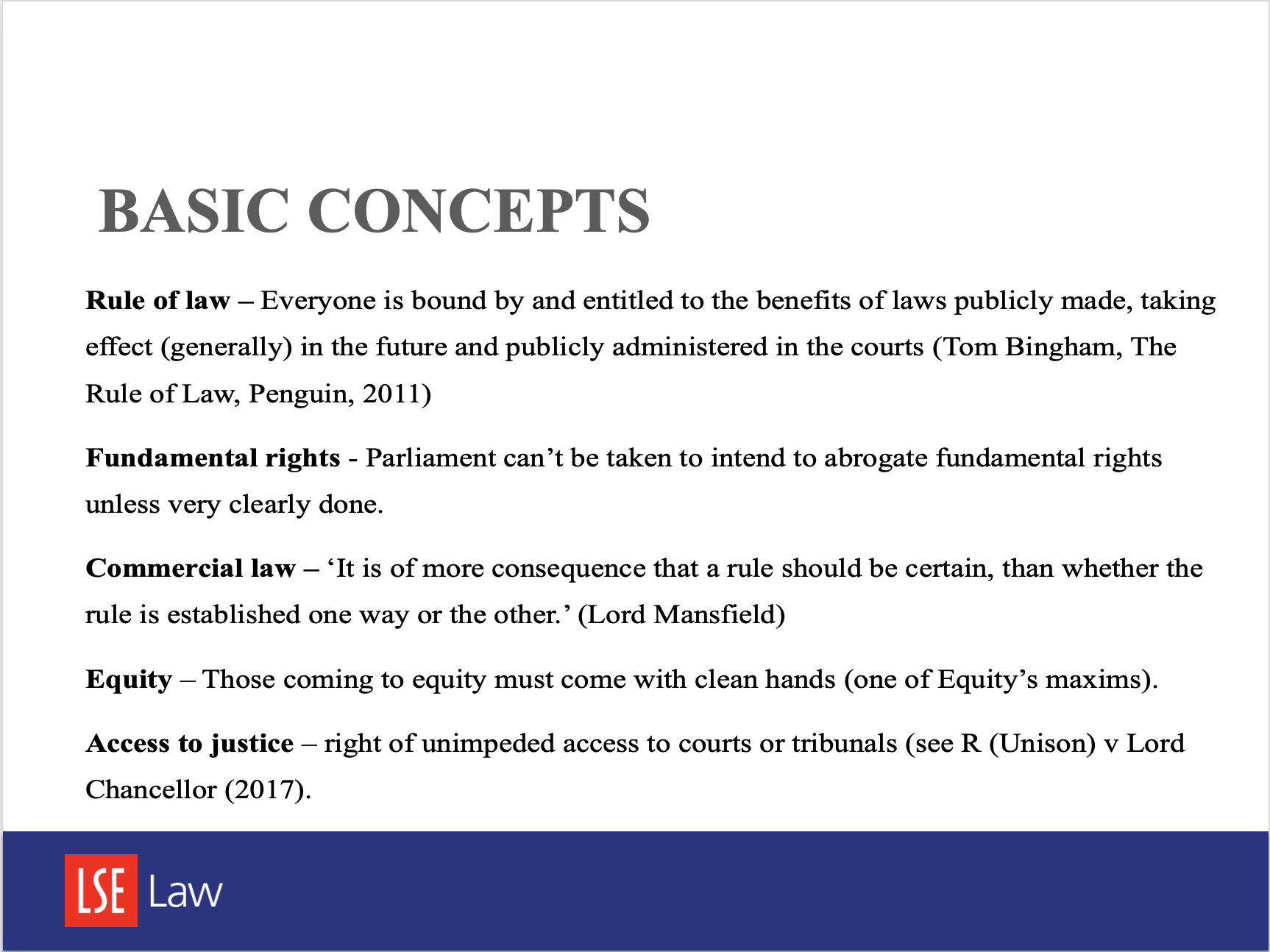
Rule of law (Lord Bingham, The Rule of Law, 2011):
Everyone is bound by and entitled to the benefits of the law; law is publicly made, generally future-oriented, publicly administered in courts.
Four core elements highlighted (expanded in the talk):
Law applies to all, from the Prime Minister downward;
Transparency in lawmaking;
Legislation is prospective (with few exceptions);
Laws administered in courts/tribunals with open justice.
Fundamental rights and Parliament’s supremacy:
Parliament is sovereign; no higher lawmaking body.
Judges have interpretative rules to protect fundamental rights if Parliament appears to override them explicitly; otherwise, Parliament can legislate as it wishes.
Commercial certainty:
In commercial law, the certainty of rules (bright-line rules) supports predictable planning and contracting; equity also provides maxims and flexible remedies where appropriate.
Equity and maxims:
Equity concepts survive alongside common law; many maxims lack literal modern relevance, but some, like clean hands, carry substantive rules.
Example from practice: specific performance may be refused if the claimant’s conduct breaches the clean-hands principle; years of authorities interpret the exact meaning of this doctrine.
Access to justice:
Growing litigants in person; digital hearings; interpreters; cross-jurisdictional access considerations; challenges for vulnerable individuals.
Positive developments: video hearings can speed resolution; case management hearings can be quicker; but there are concerns about fairness and accessibility for some litigants.
Bottom line: English law blends long-standing principles with ongoing reforms to improve accessibility and efficiency.
Structure and personnel of the system
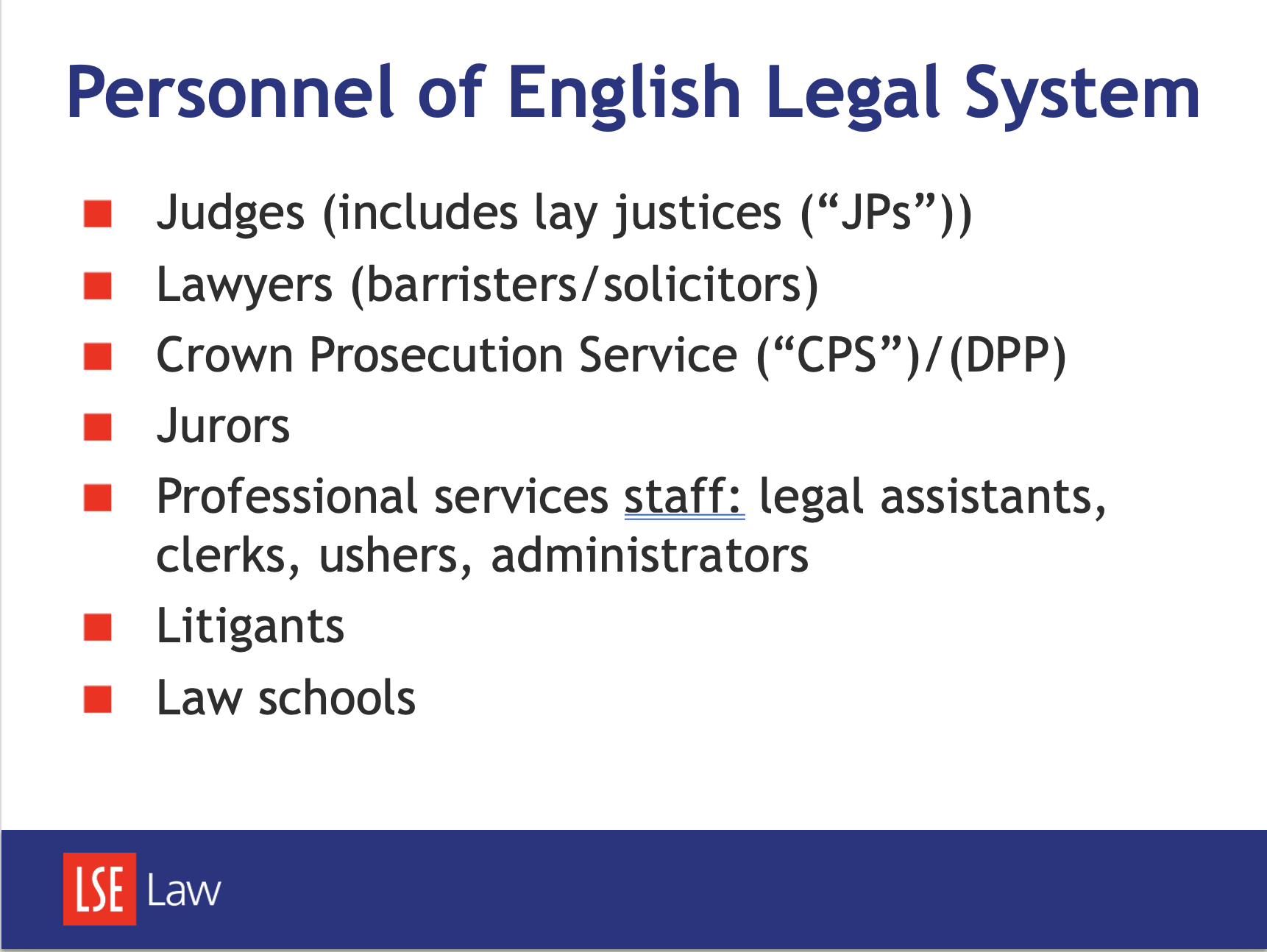
Judges and judiciary:
Current head: Lady Chief Justice (Baroness Carr) described as a dynamic leader; appointment reform includes Judicial Appointments Commission (JAC) processes since the 2000s.
JAC ensures a rigorous process: application, questions, tests, selection days; ongoing monitoring for diversity, independence, transparency.
Titles and address: formal addresses vary by court; informal practice has evolved (e.g., now often simply called “judge”).
Appointment reforms and independence:
The judiciary is designed to be independent from the legislature and the executive; selection and career progression are subject to checks and balances.
Lawyers and practice settings:
Barristers vs solicitors; the term QC/King’s Counsel (silk) denotes senior advocates and involves a change of gown rather than the wig; front-row advocacy norms have shifted to avoid a two-tier system.
Solicitors and barristers:
City law firms: large multi-partner firms, often focused on corporate matters (mergers, acquisitions, finance) with less direct litigation emphasis.
High Street firms: smaller practices handling probate, family, local disputes, and more litigation-oriented work.
Training and qualification routes:
Solicitors: Solicitors’ Qualification Exam after either a law degree or after a Graduate Diploma in Law.
Barristers: Bar Practice Course (previously BPTC; various acronyms over time) to qualify as a barrister.
Other actors in the system:
CPS (Crown Prosecution Service) prosecutions; barristers are often briefed by CPS for cases.
Pro bono and access-to-justice networks: Law Society and Bar support; Free Representation Unit; Advocate (pro bono centers).
Law clinics and student opportunities:
Law clinics enable students to gain practical experience by assisting with debt disputes, property issues, etc.
Pro bono exposure provides real-world advocacy experience and public service.
Courts and tribunals: structure and appeals
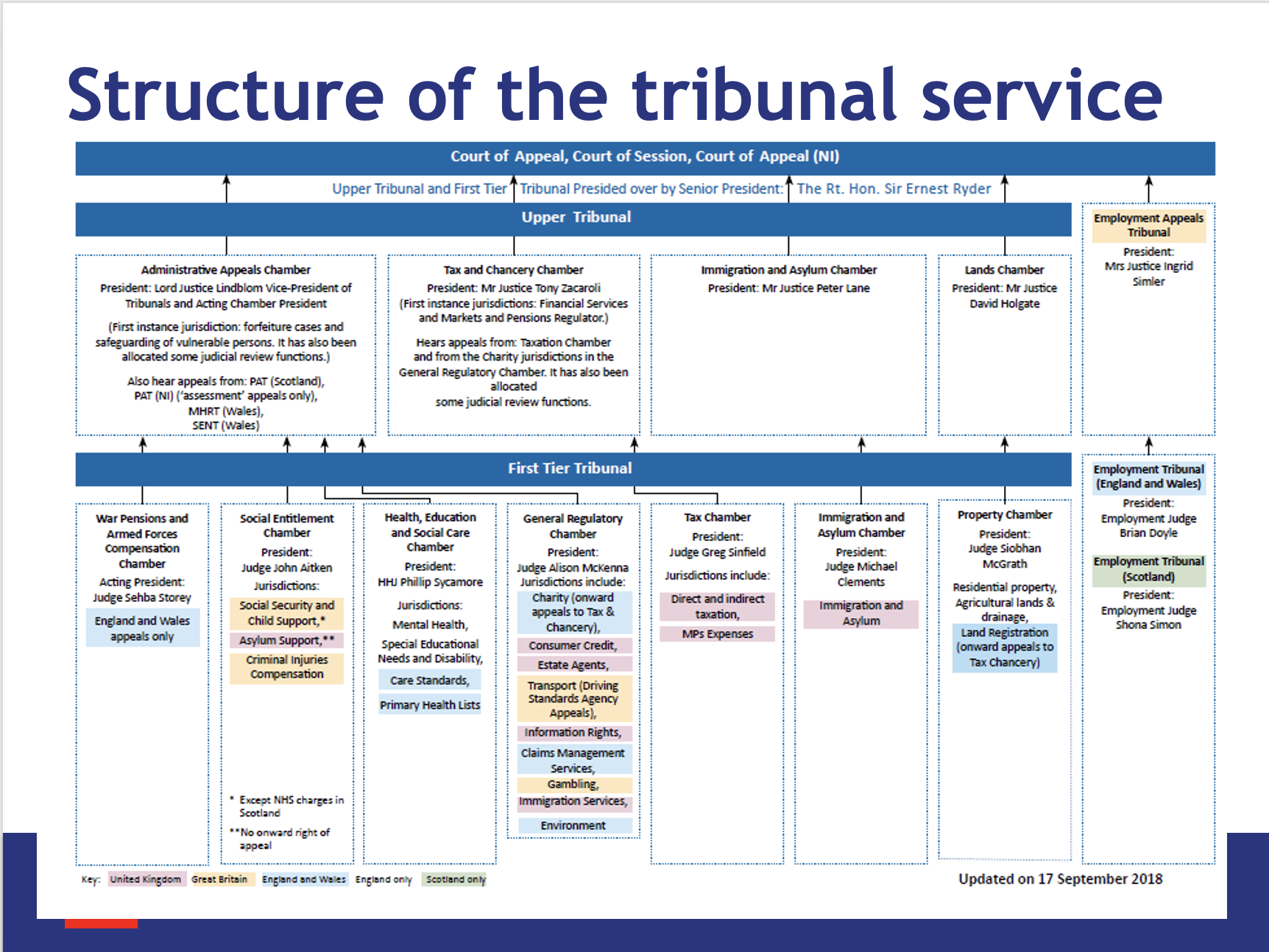
Tribunals:
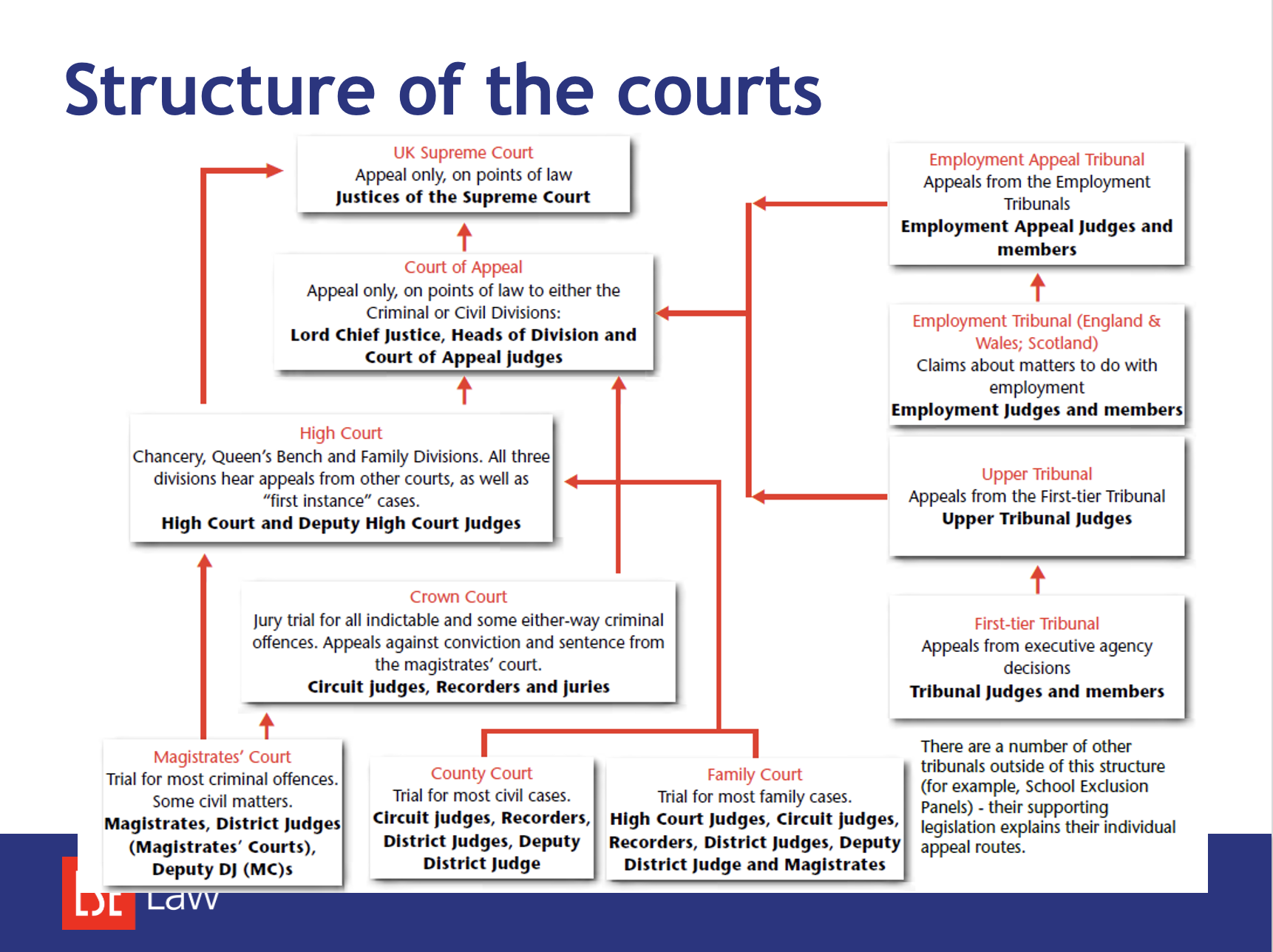
Specialist chambers; e.g., Immigration Tribunal; Home Office decisions appealed within the tribunal framework; judgments may be reviewed or appealed to Upper Tribunals; ultimately to the Court/Supreme Court.
The Employment Tribunal has its own separate appeal pathway.
Tribunals are recognized by the Court of Appeal as expert and specialized; respect for expertise in day-to-day matters.
Court structure (simplified):
County Court: first instance for lower-value matters; heard by district judges/Honourable Judges.
High Court: major claims; divisions include Chancery Division and Commercial Court; most significant/complex cases go here.
Court of Appeal: appeals from County Court and High Court; requires permission to appeal; binding on lower courts.
Supreme Court: the final court of appeal; very selective in hearing cases; most appeals are refused.
Privy Council: appeals from some jurisdictions (e.g., Jamaica, Crown dependencies, some offshore centers); still important for cross-jurisdiction issues; Supreme Court sometimes sits with judges from other jurisdictions in Privy Council settings.
Process of appeals:
Decisions from tribunals or lower courts may be appealed to the Upper Tribunal or Court of Appeal; further appeals to Supreme Court are possible but highly selective (thousands of permission applications per year; ~80% are rejected).
Cross-jurisdictional considerations:
The Court system can reflect UK-wide issues (immigration, human rights) while maintaining jurisdiction-specific tribunals and procedures.
Lawmaking: Parliament, courts, and the evolving role of judges
Parliamentary sovereignty:
Parliament makes laws; it can change or end laws; courts interpret but do not originate law (unless interpreting statutes).
The three arms of state: legislation (Parliament), executive (government), judiciary; all interact to uphold the rule of law.
Notable constitutional moment:
Miller case (2019) on prorogation of Parliament; the Supreme Court ruled that proroguing Parliament was unlawful beyond the necessary limit.
Lawmaking by courts:
In civil law practice, judge-made law is essential as judges decide points of law across thousands of judgments; this continually shapes the common law universe.
Common law vs equity:
Historically, separate courts administered common law and equity; the Judicature Acts of the 1870s merged them into a single court system capable of applying both sets of principles.
Equity remains a discrete body of principles (e.g., Snell on Equity) but exercised by the same judges as common law.
Global perspective:
Common law systems exist in the US, Australia, India, many Caribbean nations, New Zealand, etc.; civil law systems exist in much of Europe and parts of Asia, with codes and top-down statutory frameworks.
Sources of law in practice:
A vast amount of legislation (including secondary legislation) alongside primary law from Parliament; constant need to monitor new immigration rules and human rights case law.
Soft law and street-level bureaucracy:
Policies developed by government departments (soft law) and street-level bureaucrats influence how laws are interpreted and applied; this bottom-up influence can affect case outcomes.
Precedent and interpretation
Precedent structure:
Supreme Court decisions bind all courts below it (supremacy of the Supreme Court).
Court of Appeal binds itself and all lower courts.
High Court binds lower courts; not all authorities cited are binding.
Practical advocacy tip:
When arguing a point of law, citing a single binding authority (Court of Appeal or Supreme Court) can be more persuasive than multiple non-binding authorities.
European human rights framework:
The European Court of Human Rights must be considered due to the Human Rights Act (Section 2); the ECtHR is distinct from the Court of Justice of the European Union.
Prospective overruling:
English courts generally do not practice prospective overruling; cases overrule past holdings with effects for the future (e.g., Evans retrospective considerations); there is debate about prospective overruling in some cases.
Statutory interpretation: headlines
Statutory interpretation concerns how courts interpret Parliament’s Acts; it is a vast and nuanced field with many rules and approaches.
It involves balancing literal meanings, purposive approaches, and the broader context including EU and human rights considerations where applicable.
The interpretation of terms like immigration provisions or human rights standards often depends on how terms are understood in reality and in context; semantic issues frequently arise and evolve with social change.
In practice, interpretation may resolve one problem but create another; semantic flexibility allows for nuanced decisions that reflect current circumstances.
Real-world connections and implications
Real-world relevance:
The English legal system is a hybrid: common law (judge-made), statute, and secondary legislation interact continually.
The dualist approach to treaties means domestic legal effects require domestic adoption (e.g., Human Rights Act 1998 incorporating ECHR rights).
Access to justice is a major concern; technological and procedural reforms have improved speed and reach but also pose challenges for vulnerable groups and individuals representing themselves.
Ethical and practical implications:
The independence and transparency of the judiciary are essential for public confidence.
Language and terminology shifts aim to improve accessibility, but older jargon remains in case law; lawyers need to understand both modern terms and historical context.
The growth of tribunals, law clinics, and pro bono work demonstrates a broader movement toward broader access to justice beyond traditional courtroom advocacy.
Key readings and resources:
The Misrepresentation Act 1967 as an example of a statute creating rights in civil claims.
The European Convention on Human Rights and the Human Rights Act 1998 for integration of international rights into domestic law.
The Judicature Acts of the 1870s merging common law and equity into a single court system.
Lord Bingham’s The Rule of Law (2011) for foundational principles.
Numerical references and highlights:
Immigration-related tribunal activity: approximately cases in 2020–2021, rising in subsequent years.
The Immigration and asylum workload includes multiple Upper Tribunal chambers and accompanying appeal pathways.
The White Book is approximately pages, illustrating the volume of civil procedure rules.
The Supreme Court grants a small fraction of permission applications each year (roughly 80 ext{%} rejected; only a small number granted).
Summary: key takeaways to study
English law operates within a layered system of jurisdiction, with England and Wales sharing one framework and Scotland/Northern Ireland maintaining separate systems; the Supreme Court provides UK-wide final adjudication.
Law consists of substantive sources (common law and statute) and procedures; both are essential to understanding outcomes in real cases.
The legal profession is a mix of solicitors and barristers, with evolving roles and extensive training pathways; access to justice and pro bono work are important complements to formal representation.
Precedent guides lower courts; statutory interpretation is a sophisticated discipline balancing textualism, purposive reasoning, and human-rights considerations.
Parliament remains sovereign, but the judiciary shapes the application of law through judgments; courts and tribunals together form the architecture of the English legal system.
The system continually evolves: reforms to language, procedure, and access; ongoing dialogue between domestic and international (EU/ECtHR) legal frameworks