CARDIOVASCULAR SYSTEM
CARDIOVASCULAR SYSTEM
FUNCTIONS:
- product transport:
- gasses (oxygen to the tissues, co2 from the tissues
- metabolic products (distribution around the body)
- wastes (gaseous & metabolic)
- nutrients
- hormones
- immunity (WBCs)
- thermoregulation (vasodilation, vasoconstriction)
- clotting (occurs in injuries)
COMPONENTS:
BLOOD
- matrix/ground substance
- formed elements
- ERYTHROCYTES (RBCs; transport bases and nutrients)
- LEUKOCYTES (WBCs; responsible for immunity by targeting pathogens that get in the body and exterminating them)
- THROMBOCYTES (platelets; responsible for clotting)
- BLOOD PLASMA: the matrix where they are all found
BLOOD VESSELS
- functions: blood transport
- vasoconstriction, vasodilation
- VASODILATION: size of blood vessel will expand when it’s too hot so that blood comes into closer contact w environment and dissipates heat
- VASOCONSTRICTION: blood vessel will constrict when it's too cold so that blood is brought away from the outside environment and conserve heat
- vasoconstriction, vasodilation
- arteries, veins, capillaries
- ARTERIES
- carry OXYGENATED blood AWAY from the heart
- walls need to be stronger bc the pumping action of the heart has a direct effect on the arteries, so higher elastic fiber content to prevent rupture
- heart contraction: blood sent out from heart into diff parts of body
- in btw contractions: blood to smaller arteries and arterioles and into local tissue
- VEINS
- DEOXYGENATED blood back INTO heart
- presence of valves
- prevents backflow of blood and mixing of deoxygenated blood w oxygenated blood
- thinner than arteries bc of thinner tunica media
- CAPILLARIES
- CONNECTS arteries and veins
- usually lie in btw arteries and veins
- tunica intima only
- very thin to facilitate better exchange of materials
- exchange of NGW
- CONNECTS arteries and veins
- ARTERIES
EXCEPTION:
pulmonary arteries and veins
- PULMONARY ARTERY: carries DEOXYGENATED blood FROM THE HEART to the lungs
- lies btw the heart and lungs
- PULMONARY VEINS: carries OXYGENATED blood FROM THE LUNGS to the heart
- blood vessels are usually made of the ff structures:
- TUNICA INTIMA (innermost layer; includes endothelia)
- TUNICA MEDIA
- TUNICA ADVENTITIA (outermost layer)
MICROCIRCULATION
- circulation btw smallest blood vessels
- formed by arterioles, capillary beds, venules
- transport of nutrients, gasses, removing co2 from tissues
- controlled by general and local events to match cell activity
- body responds by prioritization of blood flow
- CONSEQUENCE: increased stress on brain
- RESPONSE: pressure adjustment to reduce pressure
ex. giraffes trying to drink water.
- when it bends down to ground level, there will be increased pressure on the brain
- CONSEQUENCE: increased body temperature
- RESPONSE: micro circulation increases blood flow to the surface of the body. “hot” blood is in closer contact w the environment, allowing it to dissipate heat
ex. cheetahs cannot run for an extended period bc their bodies will overheat, so they run in short bursts of speed that are accompanied by an increase in body temperature.
- CONSEQUENCE: faster heat loss
- RESPONSE: decreases peripheral blood supply (this will reduce rate of heat loss), maintains core temperature.
ex. in cold temperatures, body loses heat to the environment faster
PHYLOGENY: HEART
FISH
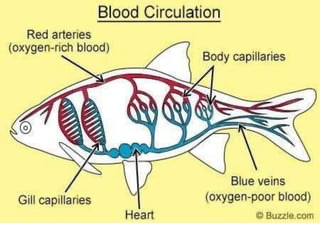
- SINGLE LOOP CIRCULATORY SYSTEM
(blood only flows thru the heart once)
- SYSTEMIC CIRCULATION
- movement of blood to the rest of the body from the gills, and then back to the heart after gas exchange in the tissues
- 2 major components:
- GILL CIRCULATION
- flow of blood from heart into gills
- BLOOD FLOW:
- heart pumps DEOXYGENATED blood to the gills
- blood becomes OXYGENATED @ gills by gill capillaries
- blood flows to the rest of the body
- gas exchange occurs @ the tissues
- blood flows back to the heart
- GILL CIRCULATION
AMPHIBIA
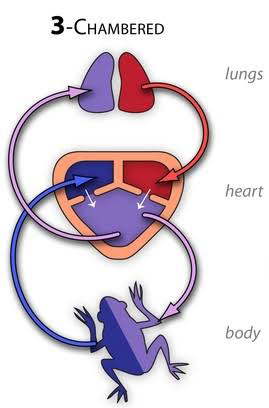
- 3 chambered heart (2 atria, 1 ventricle)
- PULMONARY/PULMOCUTANEOUS CIRCULATION
- SYSTEMIC CIRCULATION
- mixing of oxygenated and deoxygenated blood
- BLOOD FLOW:
- DEOXYGENATED blood from the rest of the body flows into the right atrium; OXYGENATED blood from the lungs flows into the left atrium
- blood from both atria flow into the ventricle, creating a mixture of blood
- mixed blood flows into pulmonary circulation where it will undergo OXYGENATION in the lungs and systemic circulation to the rest of the body
AVIALAE, MAMMALIA
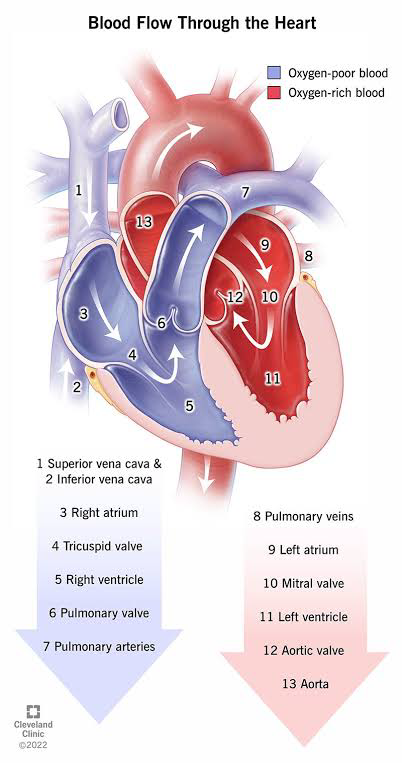
- can be 3 or 4 chambered
- DOUBLE LOOP CIRCULATORY SYSTEM
- blood flows into the heart, then to the lungs to be oxygenated
- from the lungs, blood flows back into the heart and then to the rest of the body
- in a true 4-chambered heart:
- BLOOD FLOW (4-chambered):
- DEOXYGENATED blood flows from inferior/superior vena cava into the right atrium
- right ventricle
- pulmonary artery carries DEOXYGENATED blood to the lungs
- blood becomes OXYGENATED at the lungs
- pulmonary veins carry OXYGENATED blood into the left atrium
- left ventricle
- blood flows into the aorta for systemic circulation to the rest of the body