Culturing microorganisms on an industrial scale
Factors to take into account
chosen microorganism must be able to produce chosen product
Reasonably fast
Good yield
Uses cheap nutrients
Not require extreme conditions
Not produce contaminants
Not mutate into non functioning forms
Primary metabolites
chemicals that are made as direct result of the metabolism of the microorganism and involved in the normal growth of the organism
Eg. Enzymes
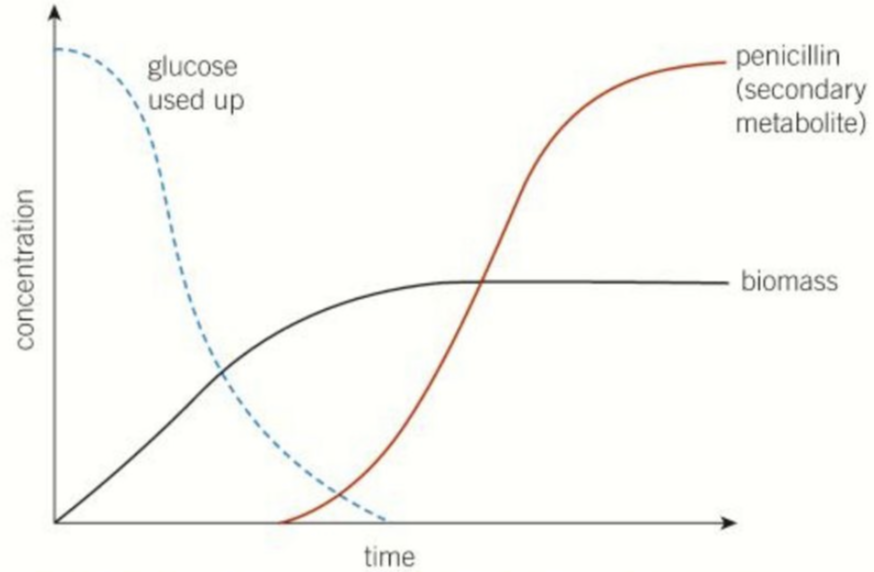
Usually formed during the growth phase
Secondary metabolites
chemicals made by the organism but not essential for growth or metabolic processes
Antibiotics in moulds
Defensive chemicals in plants
Usually formed during the stationary phase
Harvesting a primary or secondary metabolite
Types of reactor
Batch
All nutrients are added at the same time
All stages of microbial growth are seen
Used for production of secondary metabolites
Continuous
Nutrients added continually
Aim to maintain exponential growth used for production of primary metabolites
Batch reactor
Fermenters tend to be relatively large
Closed system
Less chance contamination
Microbes in the fermenter show lag, log, and stationary phases
Most suitable for the production of secondary metabolites
Nutrients are only added at the beginning
Fermenter is washed and sterilised before another batch can be set up
Process is stopped once product is formed
Continuous reactor
Fermenters tend to be smaller
Open system
More chance of contamination
Most suitable for the production of primary metabolites
Optimum or exponential is maintained in the fermenter
The process is not stopped for the collection of the product - removed continuously from fermenter
Washing and sterilisation is not needed
Control factors in a bioreactor to give max product yield
temperature
Too low
Growth rate too slow
Too high
Enzymes dentature
Temperature sensors and negative feedback heating/cooling system used to maintain optimum conditions
Nutrients and oxygen
Added as needed to maintain growth as required
Probes or sample testing provide information on these levels
Mixing things up
Continuous stirring ensures all microorganisms receive nutrients and oxygen
Also helps maintain a constant temperature
Asepsis
Contamination by other microorganisms will affect yield
Most reactors are sealed units to prevent this
Genetically engineered organisms must legally be kept contaminated
Batch reactor producing penicillin
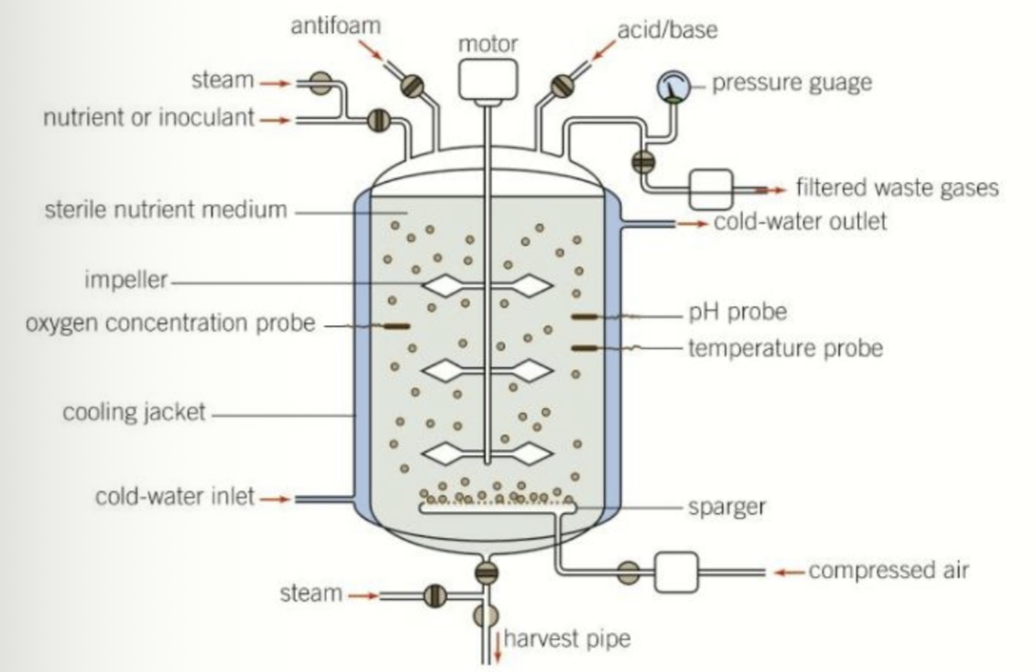
Above is a batch reactor as penicillin is a secondary metabolite
The sparger introduces gases/oxygen continually
It is necessary to circulate cold water through the insulating jacket as heat from respiration could denature enzymes and cold water will maintain optimum temperature