Phonological Awareness
Foundational Skills
Phonological awareness: the awareness of and ability to work with sounds in spoken language
“Print” is not attached to phonological awareness skills as it is all auditory and oral
“Eyes closed or lights off” is a reminder that phonological awareness activities can be done without sight because it does not include print
Phonological awareness if a prerequisite for decoding and encoding
The goal is to support students’ development of phonemic awareness
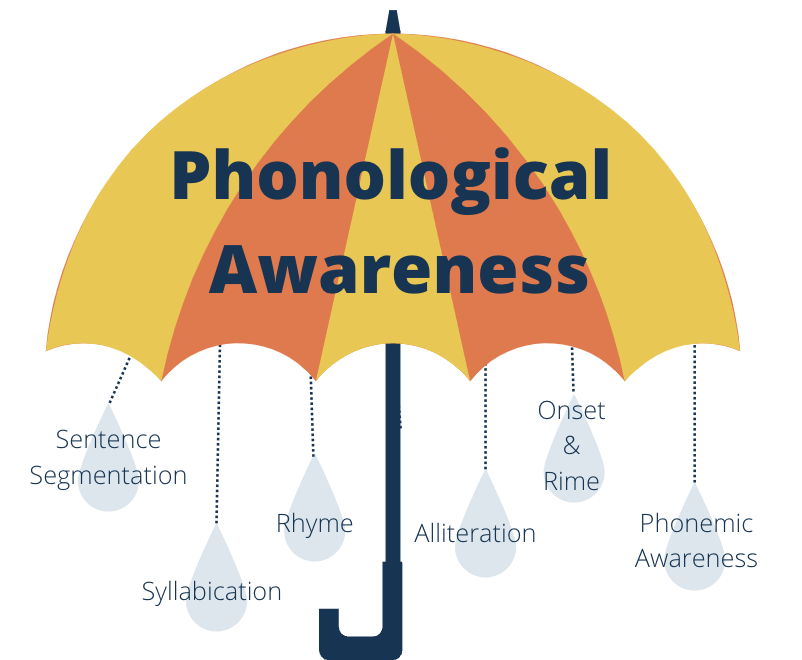
Phonological Awareness includes knowing:
Sentences can be segmented into words
Words can be segmented into syllables
Words can be segmented into their sounds
The individual sounds of words can be blended
The individual sound of words can be manipulated
Syllables are an unbroken single vowel sound within a word
It typically contains only on vowel, and if there are two, one of the vowels is silent
Onset is the first initial phonological sound of a word whereas the rime is the string of letters that follow the onset
Onset and rime are only based on sounds
Terminology
Phonology is the study of the basic sound units of language
Phonemes are individual speech sounds
Graphemes are individual letters or groups of letter that represent phonemes
Phonemic Awareness is the understanding that words can be broken down into individual phonemes (sounds)
Isolation, blending, segmenting, and manipulation (addition, deletion, and substitution) are activities that promote phonemic awareness
Phonics instruction is the step-by-step process of teaching the alphabetic principle
Focuses on teaching the consistent, predictable sounds connected to letters
Skill Progression
To teach phonological awareness a teacher must:
Link sounds to letters early
Provide explicit and systematic instruction that focuses on only 1 or 2 phonemic awareness skills at a time
Use classroom-based instructional assessments to provide ongoing feedback that guides your instruction
Ways to build phonological awareness include:
Listening- reading aloud to children and asking questions
Rhyming- have children pick out rhyming words in books without help
Syllables- clapping out the “beats” of syllables
Guessing games- “I spy” games
Sing- rhyming songs
Blend sounds- putting sound units (phonemes) together
Take words apart- have children work on hearing a word and then taking it apart
Assessment Tools
Observation
Teachers can identify their strengths and areas in need of improvement
Screening and Diagnostic Assessments
Screening assessments focus on specific aspects of phonological awareness while diagnostic assessments cover a wide range of phonological awareness and decoding skills
Cultural and Linguistic Awareness
Be cognizant of the languages and dialects spoken by students, ensuring that assessment practices are inclusive and respectful of their backgrounds
Informed Instruction
Offer support where students need it most
Intervention Resources
Specialists can help with disorders
Research-Supported Instructional Strategies