Electrophilic addition
Electrophilic addition:
It is the addition of an electrophile to an an alkene’s double bond (C=C) that breaks the double bond and creates an alkane (C-C).
An electrophile is an electron acceptor. A common example of an electrophile is hydrogen halides; they are polar molecules due to the difference in electronegativity, therefore the hydrogen atom will be slightly positive and an electrophile. In halogens and hydrogens, they act the same in the addition reactions as hydrogen halides but they do not have a permanent dipole, instead they get an induced dipole from the repulsion of their electrons from the high electron density C=C bond.
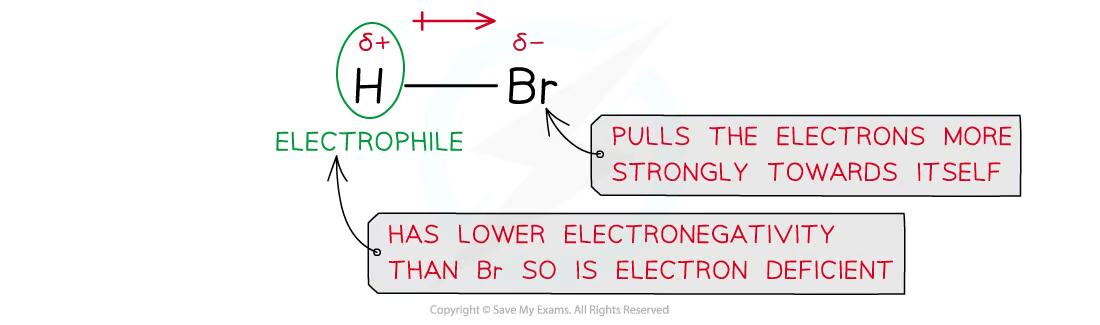
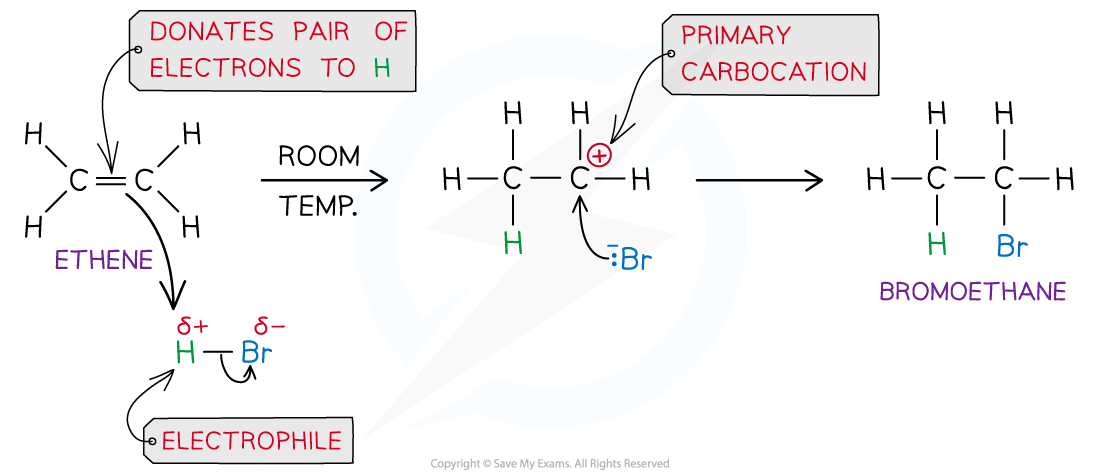
The mechanism of an electrophilic reaction starts with the hydrogen electrophile attacking the C=C and accepting a pair of its electrons, this heterolytically breaks its bond with the halogen forming a -ion. This results in the formation of a highly reactive carbocation intermediate which reacts with the negative ion.
When drawing the mechanism you must:
Use curly arrows to show the transfer of electrons, making sure to draw the arrows coming off of the bonds and electrons.
Write the slightly negative and positive dipole notations.
Write the positive and negative symbols for the carbocations and ions
Markownikoff addition/rule:
Carbocations have three types: primary, secondary and tertiary.