Anatomy
Classification of bones
There are 5 types of bones in the skeleton: long, short. flat, irregular, and sesamoid.
Flat bones-protect internal organs such as the brain, heart, and lungs. (Cranial bones, Scapulae, sternum, and ribs)
Long bones support weight of the body and facilitate movement. (Humerus, radius and ulna, femur, tibia and fibula, metacarpals and metacarpals, and phalanges.
Short bones are cube-shaped components of the wrist and ankle joints. EX. (Carpals and tarsals)
Irregular bones vary in shape and structure. (Vertebrae and pelvic bone)
Sesamoid Bones reinforce tendons, protecting them from stress and wear. (patella)
Parts of the Long bone
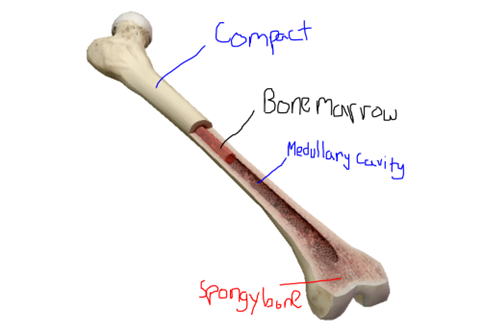
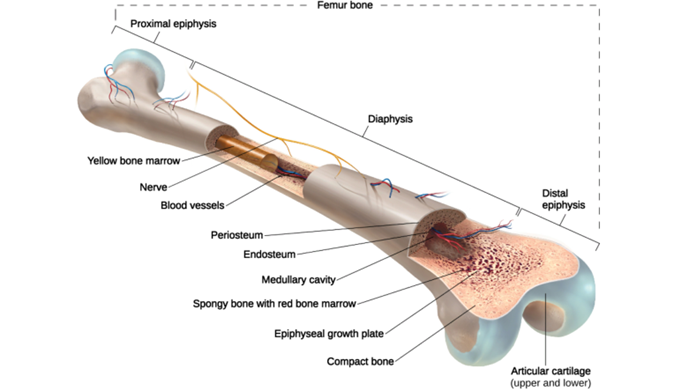
Marrow is soft tissue inside some bones. Yellow bone marrow consists mostly of fat and is found inside the medullary cavity of long bones. Blood cells are produced in red bone marrow, which is located in networks of spongy bone tissue and found mainly in flat bones. Red bone marrow is also located within the ends of long bones.
Histology of Compact Bone
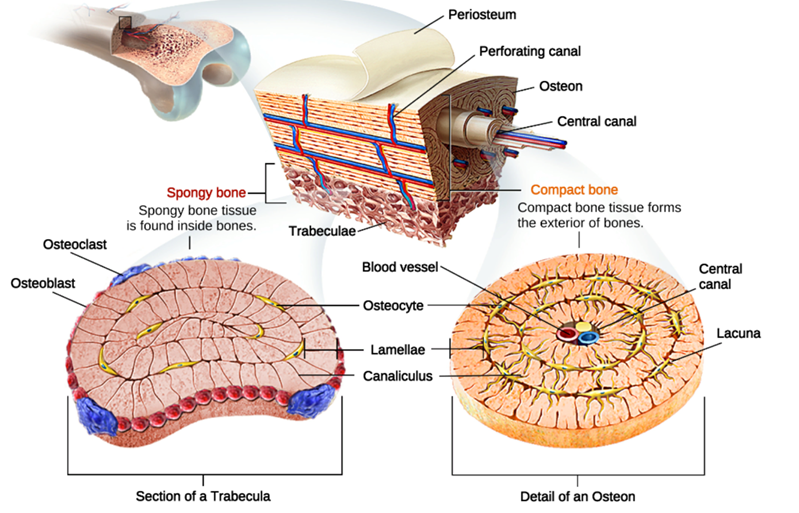
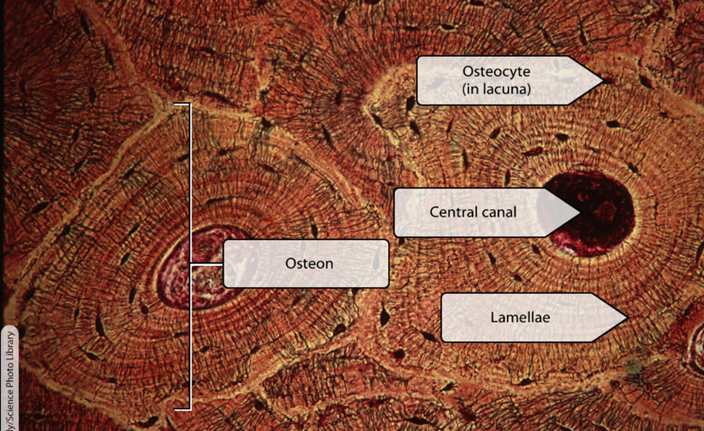
Bones are composed of an exterior layer of compact bone tissue that surrounds the internal spongy bone tissue. Compact bone tissue consists of structural units called OSTEONS, which are arranged in a way that allows them to resist torque. Spongy bone tissue consists of a lattice-like network of flat bone tissue pieces called TRABECULAE, with spaces between them that are filled with red bone marrow. Spongy bone is less dense than compact bone which makes it weaker but also lighter and more flexible. It has a greater surface are, facilitates calcium ion exchange.
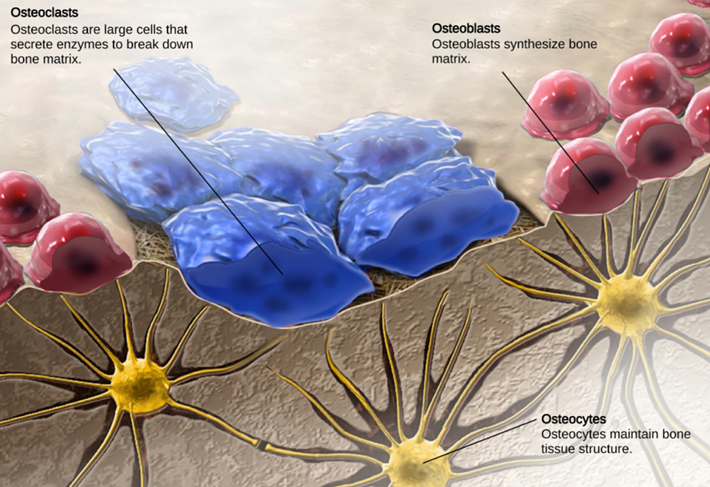
Osteoclasts are large cells that secrete enzymes to break down bone matrix
Osteoblasts synthesize bone matrix
Osteocytes maintain bone tissue