Unit 3-Key area 4
Nerves
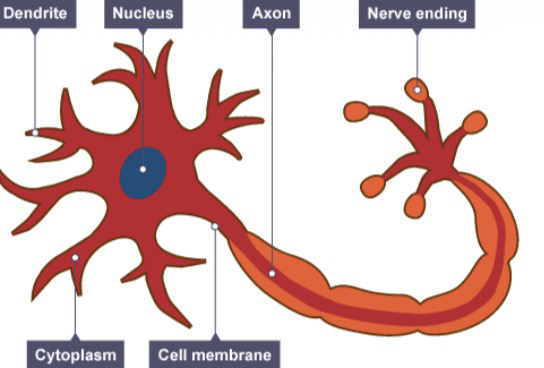
Nerve cells are also called neurons. They are adapted to carry electrical-impulses from one place to another.
They feature:
• an axon – a single nerve fibre that carries nerve impulses away from a cell body which is insulated by a fatty sheath
• dendrites - branched nerve fibres which receive nerve impulses and pass them towards a cell body.
• a cell body, where organelles such as the nucleus are found.
Role of the Myelin Sheath
The role of the myelin sheath is to insulate the axon and speed up impulse conduction (transmission of nerve impulses along the neuron)
Myelination
The process of myelination is not complete at birth. The lower body neurons in particular take around a full year to milenate. myelination continues from birth to adolescence
Consequences of this to a baby
Responses are not as rapid or coordinated
Multiple Sclerosis
Loss of the myelin sheath occurs in neurodegenerative diseases such as multiple sclerosis. It disrupts signals being sent to parts of the body.
Symptoms include:
blurred and double vision
tingling and numbness in arms and legs (neuropathy)
loss of co-ordinated movement and balance
speech impairment
Glial cells
Axons are surrounded by a myelin sheath produced by glial cells 10,000 are found in 1m of axon.
Glial cells are able to:
• hold neurones in place (glial
means 'glue")- supporting cells
• supply nutrients and O2
• insulate one neurone from
another
• destroy pathogens and dead
neurones by phagocytosis
Synapse
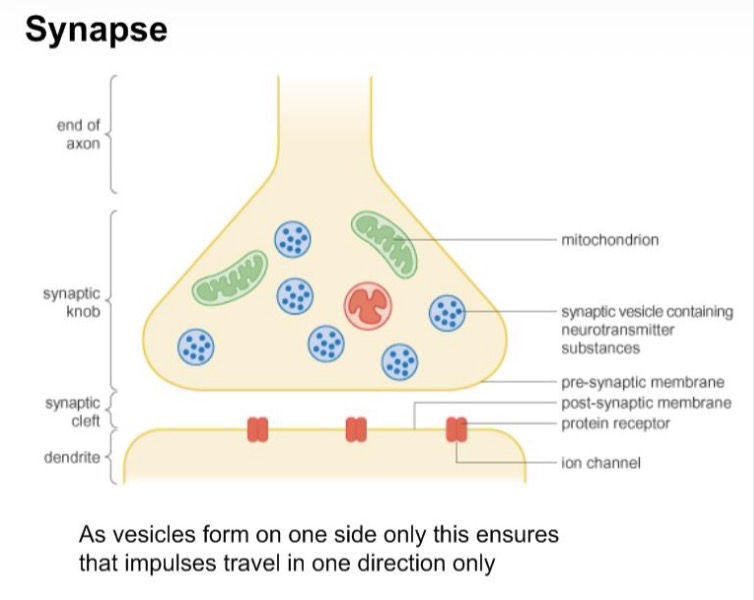
Neurons connect with other neurons or muscle fibres at a synaptic cleft.
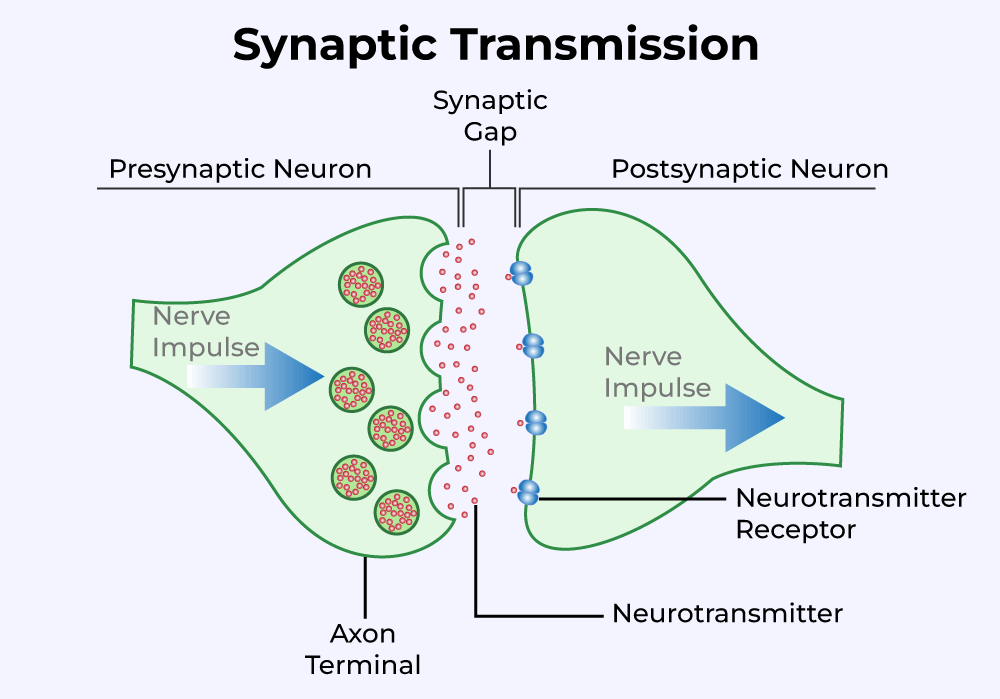
• Neurotransmitters relay impulses across the synaptic cleft.
• Neurotransmitters are stored in vesicles in the axon endings of the presynaptic neuron.
• They are released into the cleft on arrival of an impulse. They diffuse across the cleft and bind to receptors on the membrane of the postsynaptic neuron.
The need for removal of neurotransmitter after transmission of a nerve impulse
Between impulses the transmitter molecules are rapidly removed from the synaptic cleft to prevent continuous stimulation of postsynaptic neurons.
There are two types of removal:
• Re-uptake – the neurotransmitter is reabsorbed back into the presynaptic neuron and restored inside a vesicle ready to be used again. For example, noradrenaline.
• Enzyme degradation – neurotransmitter is broken down by an enzyme into smaller inactive product which are then reabsorbed by the presynaptic neuron and resynthesised into active neurotransmitter.
Excitatory and inhibitory signals
Receptors on the postsynaptic membrane determines whether the signal received is:
• excitatory - e.g. increases contraction of muscle fibres
• inhibitory - e.g. decreases contraction of muscle fibres
Filtering out weak stimuli
A critical number of neurotransmitter molecules is needed in order to affect enough receptors on the postsynaptic membrane.
• A nerve impulse is only transmitted across the synapse if enough neurotransmitter is released. Weak stimuli don't reach this critical number. As a result, not enough neurotransmitter reaches the postsynaptic neuron to generate an impulse. This filters out weak stimuli.
Summation
A series of weak stimuli can combine, increasing the amount of neurotransmitter that is released.
• This results in enough neurotransmitter being diffused across the synaptic cleft to trigger the impulse in the postsynaptic neuron. This process is called summation.
• i.e. convergent neural pathways can release enough neurotransmitter molecules to reach threshold and trigger an impulse
Effects of Neurotransmitters on Mood and Behaviour:
Endorphins are neurotransmitters that stimulate neurons involved in reducing the intensity of pain.
Increased levels of endorphins are also linked to the feelings of pleasure such as eating, sex and prolonged exercise.
Dopamine
Dopamine is a neurotransmitter that induces feelings of pleasure and reinforces particular behaviours by activating the reward pathway in the
brain.
This pathway involves neurons which secrete or respond to dopamine. it is activated when an individual engages in a behaviour that is beneficial to them e.g. eating when hungry
Neurotransmitter-related disorders
There are common diseases that are related to neurotransmitters.
• Alzheimer's disease is linked to low levels of the neurotransmitter acetylcholine which results in a decline in signals between brain cells.
• Parkinson's disease is another condition linked to neurotransmitters. In this case, low levels of dopamine affect the part of the brain controlling movement causing it to not work properly.
Agonists and Antagonists
Many drugs used to treat neurotransmitter related disorders are agonists or antagonists.
• Agonists are chemicals that bind to and stimulate specific receptors mimicking the action of a neurotransmitter at a synapse.
• Antagonists are chemicals that bind to specific receptors blocking the action of a neurotransmitter at a synapse.
• Other drugs act by inhibiting the enzymes that degrade neurotransmitters or by inhibiting reuptake of the neurotransmitter at the synapse causing anenhanced effect.
Recreational drugs
• Recreational drugs can also act as agonists or antagonists.
• Recreational drugs affect neurotransmission at synapses in the brain altering an individual’s mood, cognition, perception and behaviour.
• Many recreational drugs affect neurotransmission in the reward pathway of the brain.