Unit 1.3 Circular Flow
Learning Objectives
Assess ways in which different economic systems answer fundamental economic questions
Analyze the strengths and weaknesses of capitalistic economy
Assess the contributions of economists to economic theory (e.g., Adam Smith)
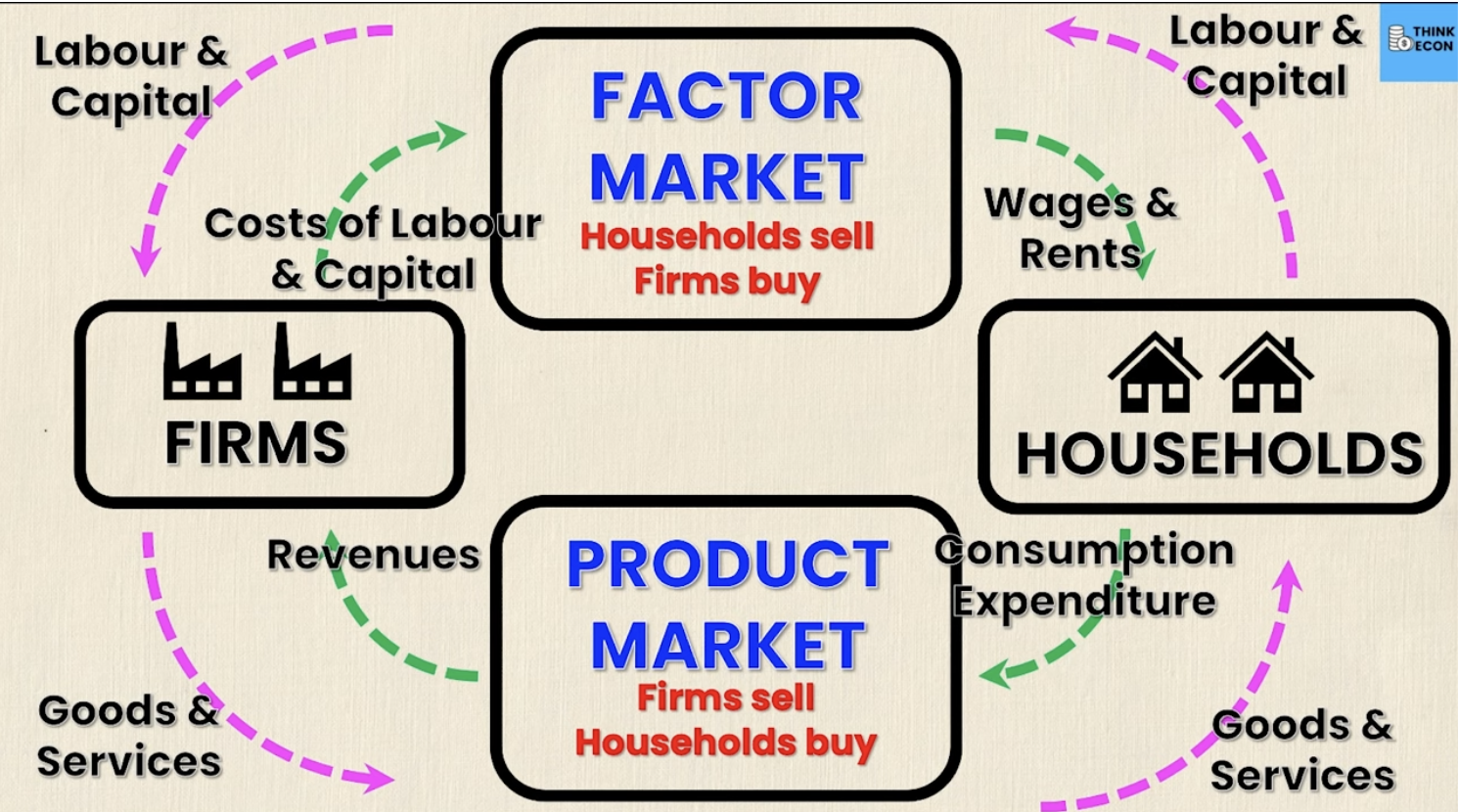
Use the simple circular flow to illustrate a free enterprise economy
Describe the legal and social framework that supports a capitalistic economy, including the functions of government
Economic Systems & Fundamental Questions
Ways in Which Different Economic Systems Answer Fundamental Economic Questions: Different economic systems, such as capitalism, socialism, and mixed economies, provide distinct answers:
What to Produce:
Capitalism: Decided by consumer demand and profit motives.
Socialism: Often determined by central planning based on societal needs.
How to Produce:
Capitalism: Driven by efficiency and cost-effectiveness.
Socialism: Planned methods to meet social goals.
For Whom to Produce:
Capitalism: Based on purchasing power.
Socialism: Distribution is more equalized by design.
Capitalism & the Circular Flow
Strengths and Weaknesses of Capitalistic Economy:
Strengths: Efficient resource allocation, innovation, individual freedom.
Weaknesses: Income inequality, environmental externalities, limited access for some.
Contributions of Adam Smith:
Invisible Hand: Individual self-interest benefits society.
Division of Labor: Increases productivity.
Laissez-Faire: Advocates minimal government intervention.
Circular Flow Model: This model shows the flow of goods, services, and money in a free enterprise economy. Households provide factors of production to businesses, which in turn supply goods and services. Monetary exchanges occur between these sectors to maintain economic activity.
Legal and Social Framework of Capitalism:
Property Rights: Encourage investment and ownership.
Contract Enforcement: Legal systems secure business agreements.
Rule of Law: Ensures fair market behavior and reduces fraud.
Regulation: Maintains market integrity while allowing competition.
Social Safety Nets: Provide minimum support to mitigate inequality.
In conclusion, capitalism depends on a strong legal and institutional structure that protects economic freedoms, facilitates efficient markets, and addresses societal needs through governance and safety programs.