Chapter 6.1 Velocity and Net Change
If we know velocity, we can determine displacement
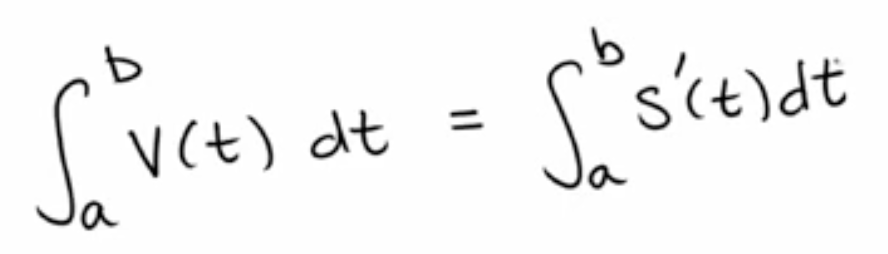
When we integrate a derivate, we get the change of original function values from a to b. So if we have velocity, then we can find the displacement of the function s(b) - s(a)
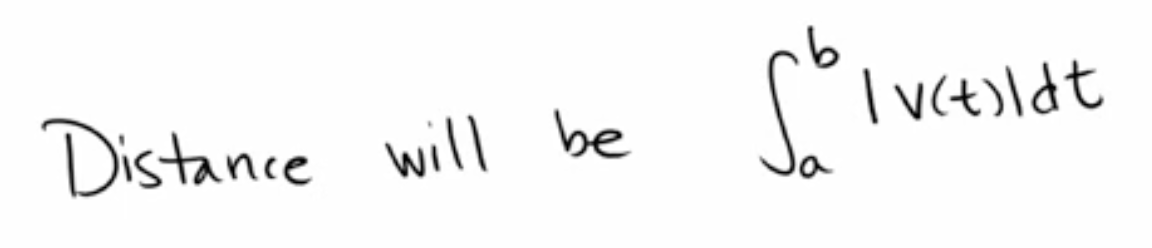
If we want to know distance, then we will have to integrate speed, not velocity. Speed is the magnitude of velocity, so it is given by | v(t) |
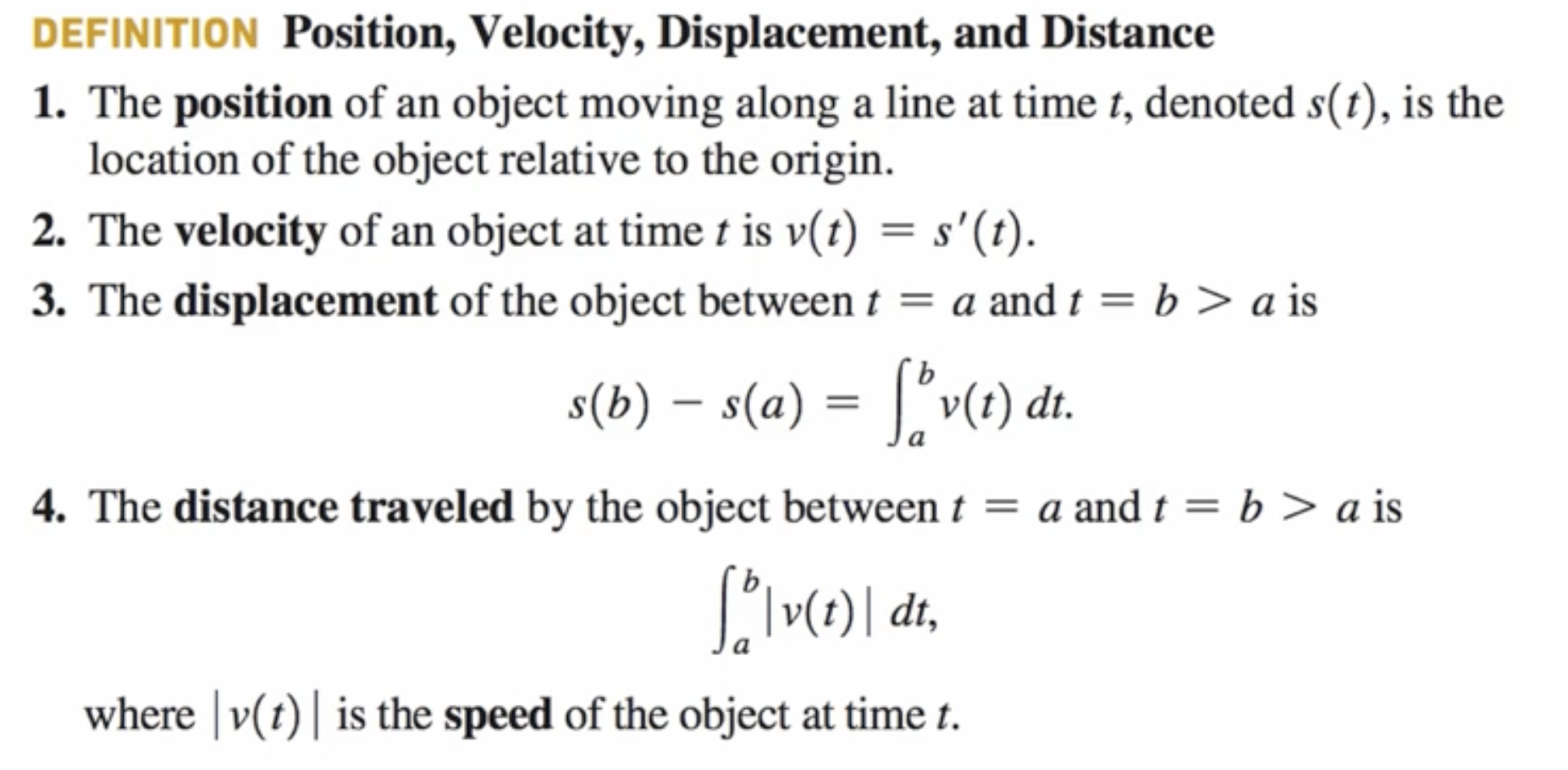
Position → of an object moving along a line at time t, denoted s(t), is the location of the object relative to the origin
Velocity → of an object at time t is v(t), which is equal to s’(t) or the derivative of the position
Displacement → of the object between t = a and t = b > a is s(b) - s(a) = the integral from a to b of the speed, or magnitude of v(t)
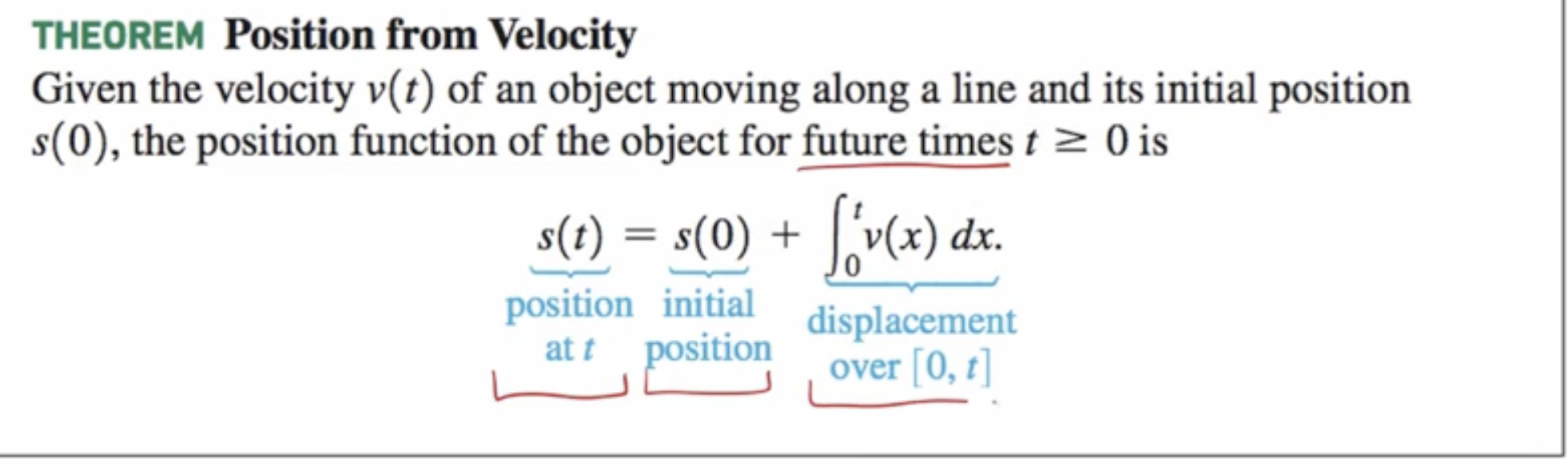
Position from Velocity → initial position + integral from 0 to t of velocity (displacement)
since displacement is s(t) - s(0), and we know how to get displacement (integral of v(t) from 0 to t), we can find position given the initial position.
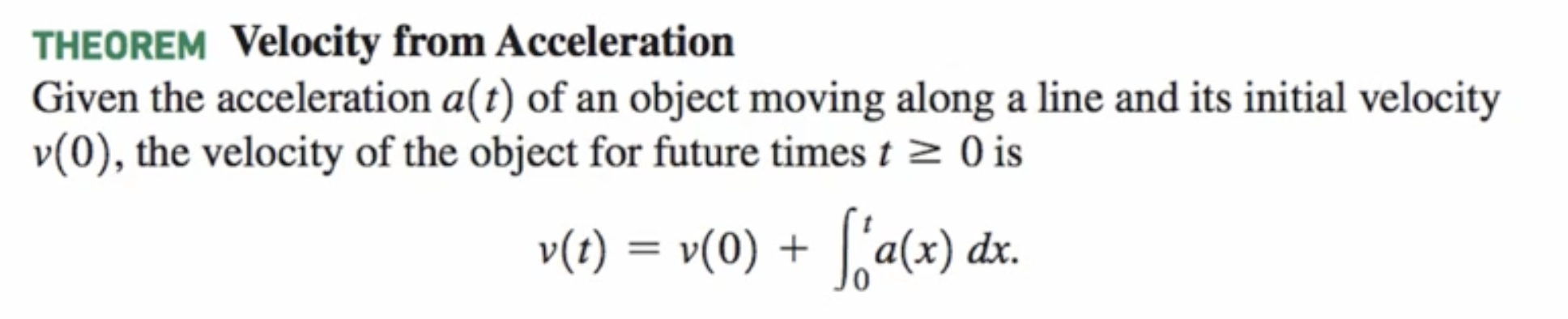
Velocity from Acceleration → initial velocity + the integral from 0 to t of acceleration
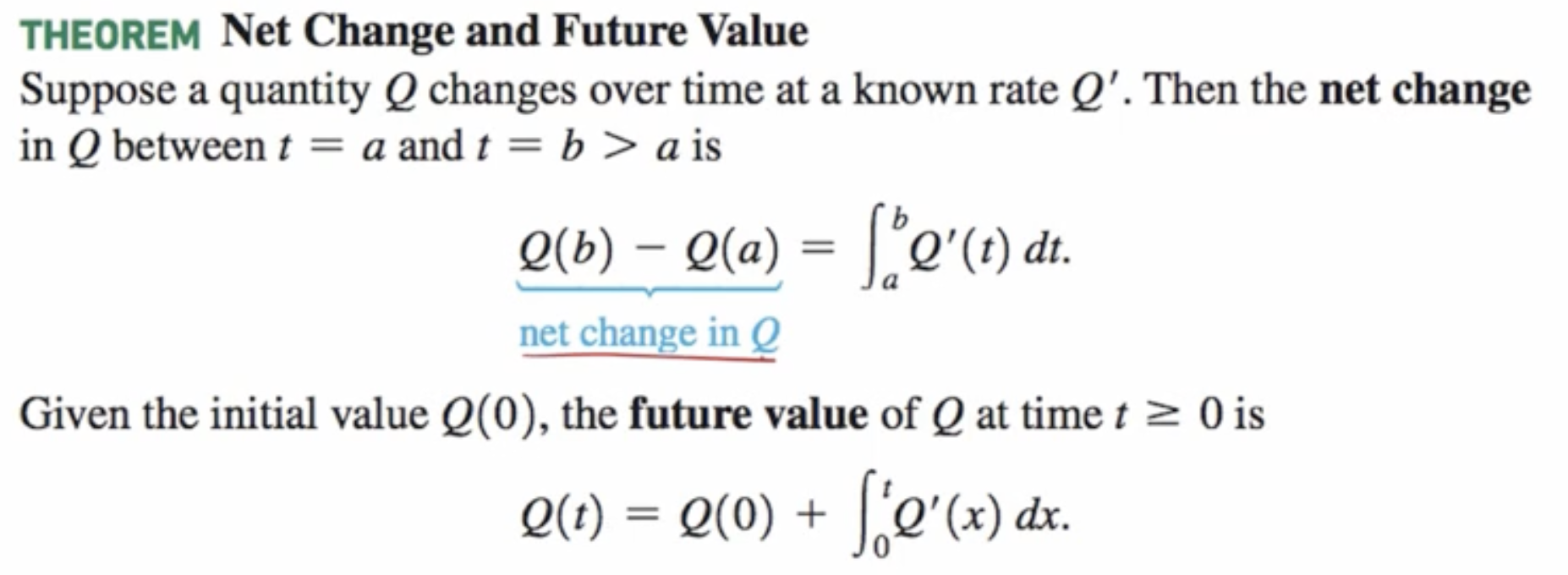
Net Change → The net change of any value between t = a and t = b > a is the integral from a to b of the derivative of Q(t). Given the initial value of Q(0), the future value of Q is Q(0) + the integral from 0 to t of the derivative of Q(x)
Displacement over time → of interval [a,b] is the net area under the velocity curve over [a,b]
Distance traveled → the area bounded by the velocity curve and the t-axis.