Chapter 6: Organisms in The Cell
The Cell Theory
1) All living organisms are made up of cells
2) All cells come from pre-existing cells
3) cells are the basic unit of life
The naked eye can see up to 0.2mm. Cells cannot be seen through the naked eye
Cells can be seen through microscopes
Light Microscopes- can distinguish objects up to 0.5 micrometers apart
Fluorescent Microscopes- can distinguish objects up to 20 nm
Electron Microscopes- can distinguish objects up to 1 nm
Why are cells small?
surface area/ volume ratio determines their size
Larger objects; smaller surface area/ volume ratio
Smaller objects; larger surface area/ volume ratio
Cells need large surface area & volume to transfer things in and out.
Prokaryotes VS. Eukaryotes
Common in Both:
Plasma Membrane- made of a lipid bilayer containing a hydrophilic head & hydrophobic tail.
Lipid bilayer is 2 layers of these heads and tails
Lipid bilayer also contains proteins
Genetic Material: DNA & RNA
DNA is needed in both prokaryotes & eukaryotes
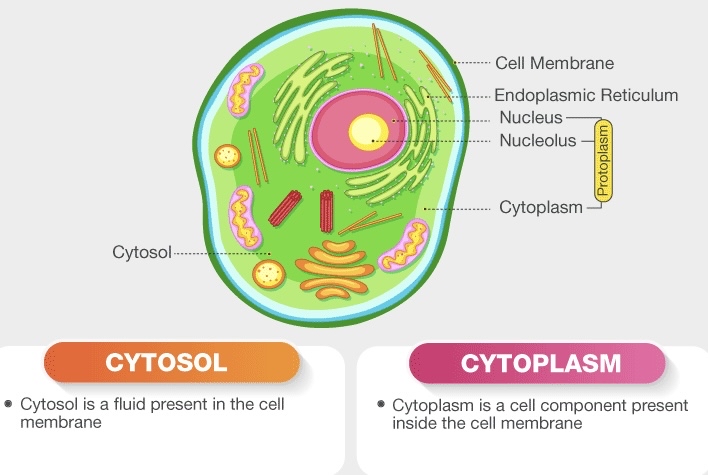
Cytoplasm-
Eukaryotes: anything in between nuclear membrane and plasma membrane
Prokaryotes: anything inside the plasma membrane
Cytosol- Liquid (aq solution) where substance are disolved, fluid portion of cytoplasm
Ribosomes- complex of RNA/ Proteins
Cause for polypeptide synthesis (putting proteins together)
Prokaryotes
most abundant/ most diverse
Cell walls (outside plasma membrane). They provide support and structure
In some: flagella & fimbrae are present
DNA is circular bacterial genome
3 Basic Shapes Associated with Prokaryotes
Spherical
Rod-shaped
Spiral
Not all bacteria is unicellular. Multicellular orangisms are in Prokaryotes & Eukaryotes.
Eukaryotes
have organelles-subcellular structures that are membrane-bound & have specific functions/structures
Nucleus-
contains most of DNA (nuclear DNA); part of chromatin
Chromatin is divided into units which makes up chromosomes
Within the nucleus there is a nucleolus; more dense region becasue there is more DNA. Therefore, synthesis of ribosomes .
Nuclear Membrane/ Nuclear Envelope-
double-membrane; 2 separate lipid bilayers
transport ions, protein, RNA in/out of nucleus through nuclear pores
Right underneath inner membrane is the matrix of proteins (Nuclear Lamina); its a mixture of proteins & provides structure, supports, gives shape to nucleus
Nucleolus-
denser region in nucleus. tends to hold more DNA.
Endomembrane System-
consists a number of organelles. Also continuous with outer membrane part of nucleus.
Endomembrane System consists of four organelles -
- Endoplasmic Recticulum
- Golgi Apparatus
- Lysosomes
- Peroxisome
All organelles in this system are continuous with each other.
Endoplasmic Recticulum (ER)
Smooth Er: there is nothing located on membrane
- sythesis of lipids
- Metabolizes some carbohydrates
- detoxifies toxins/drugs
- Stores calcium
Rough Er: Ribosomes are located on membrane surface
- Ribosomes sythesis(catalyze) of proteins part of endomembrane system.
- This leads to protein processing; Modification of Proteins.
- Functional groups and Carbohydrates are involved
Golgi Apparatus-
There is directionality; normally towards the plasma membrane
golgi recieves proteins from other molecules and further modifies them
- meaning it sorts + packages proteins & molecules to other parts of endomembrane system.
Synthesis of macromolecules
Lysosomes-
Sac of hydrolytic enzymes
this is where molecules are broken down through Hydrolysis (digestion)
Molecules to be broken down are ingested molecules. (Ex: food)
Old & broken down molecules inside cell are recycled
Peroxisome-
Contain hydrogen peroxide, which breaks down lipids
Mitochonria(plural) Mitochondrion(singular)
Double-Membrane
-inner membrane & outer membrane
inner membrane is highly folded & cristae
Cellular respiration, energy transfer occurs here
Other Eukaryotic Structures Below
Cell Wall-
Contains Celllous (most abundant molecule)
Cell Wall provides structure to support plant cell
Chloroplast-
Photosythesis: converts light energy into chemical energy, creating food for plants
Chloroplast contains and inner & outer membrane
Inner membrane is continuous with thylakoid membrane
Mitochondria & Chloroplast Evolution-
Endosymbiotic Theory: theorized that mitochondria came first
Engulfment of bacteria alive in cell led to a symbiotic relationship
Engulfed bacteria over time morphed into Mitochondria
For Chloroplast: earlier eukaryote with mitochondria engulfed photosynthesis, forming symbiotic relationship
Therefore, chloroplast was made
Plant Cells
Chloroplast-
Outer membrane
Inner membrane; in thylacoid membrane & involved in photosythesis
Central Vacuole-
Stores molecules and water
Type of vacuole; large vesical, which are from ER and Golgi
IN ANIMALS—> they contain a food vacuole instead
Cytoskeleton-
Includes support and structure, spatial organization and movement; intracellular transport
Divided into 3 parts: Types of cytoskeletons are fibers extending throughout cell.
- Microtubules (thick filaments)
- Microfilaments (thin filaments)
- Intermediate Filaments
1) Microtubules
hollow tubes polymer, made of proteins = alpha & beta tubulin dimers
Microtubules are organizing complex. However, mammals don’t need, ONLY PLANTS.
Instead animals have Centrosomes: big protein complex that includes pairs of centrioles
Microtubules contain 2 motor proteins, Dynein & Kinesin
these proteins “walk” on microtubule “tracks” to transport cargo
this is Intracellular Transport. This forms specialized structures:
- spindles forms through mitosis & meiosis
- binds chromosomes and seperates chromosomes
Flagella + Cilia-
For motility & movements
these structures are made up of microtubules
2) Intermediate Filaments
these are found in animal cells
do not contain motor proteins. Instead they mainly support and structure to maintain cell shape
anchors cell components
3) Microfiliments (Actin Filaments)
Polymer of actin proteins assemble in helical formation
ususally found underneath plasma membrane
provide structure, support & shape
they provide a specific shape for each cell
Actin filaments have one motor protein; myosin
function is intracellular transport;—→ cytoplasmic streaming
Specialized Structure-
Muscles: rely on myosin moving along actin filaments
Extracellular Matrix of Animal Cells
proteins (ex: collogen)
carbohydrates
proteins & carbohydrates attached are glycoproteins
Functions of Extracellular Matrix-
connects cells together. Cell/Cell communication
Cell Connections-
2 cells physically connected with each other
In plants: plasamdesmata; tunnels connecting lytosols of two cells
Three Major Cell Connections
Tight Junction- zips 2 plasma membrans together
Desmosomes- disks of connection
Gap Junctions- tunnels connecting cytosols of 2 cells