Multipliers
Autonomous expenditure
Autonomous means independent.
Households (C), firms (I), and governments (g) all must spend money.
This spending, independent of income, is autonomous expenditure.
If autonomous C, I, or G changes by more than $1, AD will change by more than $1.
MPC and MPS
Gross income - income Tax = Disposable Income (Y [subscript] d).
Average propensity to consume (APC) is the percent of Yd that is spent, which is found by consumption / Yd.
Average propensity to save (APS) is the percent of Yd that is saved, calculated by savings / Yd, indicating the portion of disposable income that is not consumed. )
Marginal propensity to consume (MPC) is the additional consumption that occurs with an additional dollar of disposable income, defined as the change in consumption divided by the change in disposable income (MPC = ( Delta Consumption / Delta Yd ).
Marginal propensity to Save (MPS) is the additional saving that occurs with an additional dollar of disposable income, defined as the change in savings divided by the change in disposable income (MPS = ( Delta Savings / Delta Yd ).
The Marginal Propensity to Consume (MPC) is a simple way to understand how much more people will spend when they have extra money. Specifically, it's the percentage of an additional dollar of income that a household decides to spend rather than save. For example, if someone receives an extra dollar and spends 80 cents of it, their MPC would be 0.8 or 80%. This shows the relationship between income changes and consumption spending.
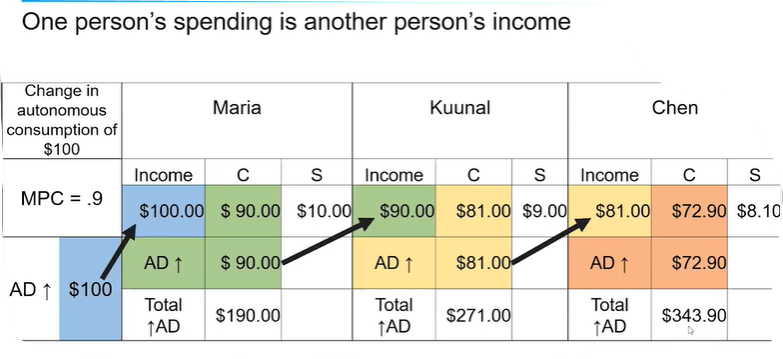
Explanation: So the MPC is .9, that means that individuals are going to spend 90% of their income.
Someone buys $100 worth of goods from Maria, so she earns $100, which she spends $90, thus causing the total aggregate demand to be $190 now. And the cycle continues as each subsequent spender also allocates a portion of their income to consumption, further amplifying the total demand in the economy.
The total change in AD that results from a change in autonomous expenditures depends on the MPC
The expenditure multiplier
MPC + MPS = 1
A $1 change in autonomous expenditures leads to a total change in AD greater than $1 because one person’s spending is another’s income.
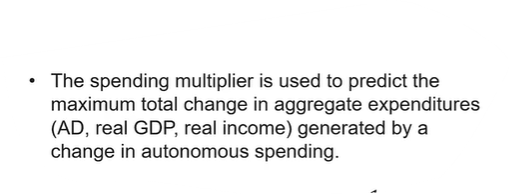
The expenditure multiplier quantifies the total change in AD that results from an initial change in autonomous spending.
The formula for calculating the expenditure multiplier is given by the equation: Multiplier = 1 / (1 - MPC) = 1 / MPS.
To find the total change in expenditures, you must take the initial change in expenditures and multiply it by the spending (expenditure) multiplier.
It could be asked in various ways like:
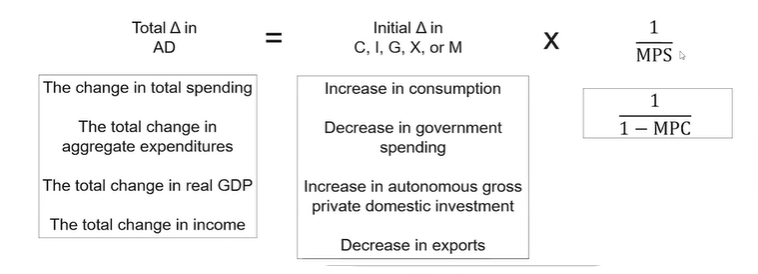
if C, I, G, and X increase, than AD increase, if M (imports) increases AD decreases
Example: When investment increases by $1, income increases by a maximum of $5, if MPC is 0.8. Because investment spending is part of AD, so a $5 increase in AD, which is equal to aggregate expenditure, which is equal to aggregate income.
Tax Multiplier
also is transfer multiplier
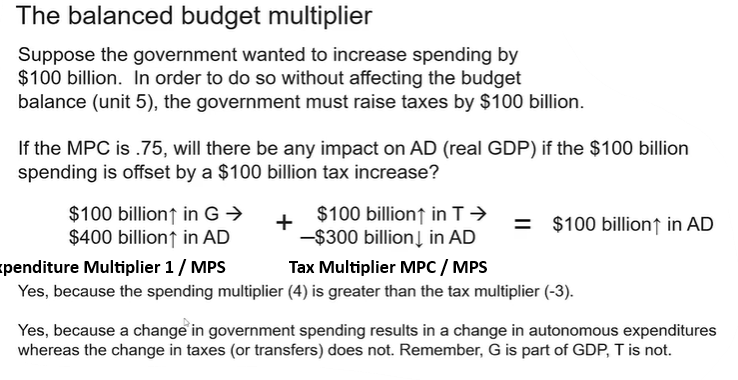
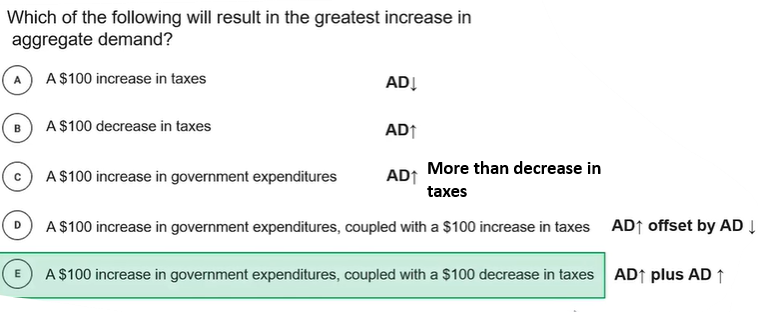
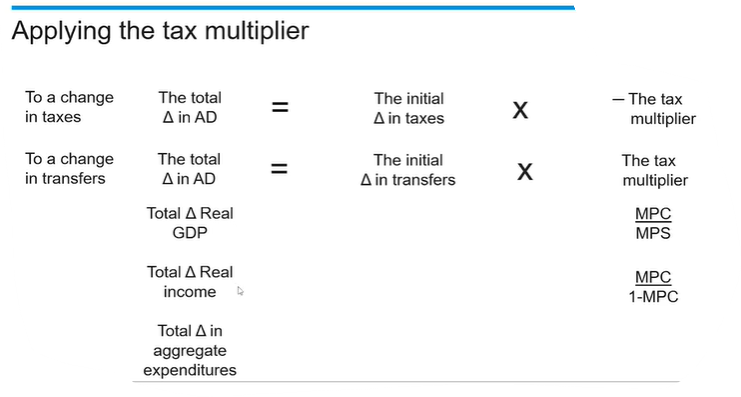
The tax multiplier measures the impact of changes in taxation on aggregate demand; for instance, if taxes decrease, disposable income rises, leading to increased consumption and thus a positive effect on AD.
tax multiplier is found by -(MPC / 1 - MPC) = -(MPC / MPS)
The negative sign is used to denote the inverse relationship between a change in taxes and a change in AD
However a transfer multiplier does not have the negative sign because they are in a direct relationship with AD.
The tax multiplier is linked to the spending multiplier through the MPC. due to the tax multiplier always being negative and 1 less than the spending multiplier, or when subtracted will equal 1