Module 2: Language Development Theories and Subdomains
Nature vs. Nurture
Nature
Plato, Chomsky — Sometimes referred to as nativists or rationalists
Fundamental language skills are innate and language capacity is present from birth; born to be communicators; genetics
Nurture
B.F. Skinner — Empiricists
Played a role in development of Piagetian theory
Language is a function of an individual’s environment; role of environment; culture
both play a role!
Theories of Language Development
How do we think children learn?
Used to guide our intervention planning
Behaviorist
Constructionist
Social Interactionist
Emergentist
Behaviorist Theory (B.F. Skinner)
Learning occurs when an environmental stimulus triggers a response or behavior
Increasing the frequency of desirable behaviors and decreasing or altering undesirable/maladaptive behaviors
Clinical implications:
Drill and practice activities (repetition); has influenced Naturalistic Development Behavioral Interventions (NDBI)
Focus on observable and measurable behaviors (can see numerical change but might not explain everything)
Limitations:
Not comprehensive theory
Only skill development/discrete skills
What does behaviorist theory NOT explain? It does not consider the dynamic nature of language.
Constructivist Theory (Jean Piaget)
Interaction with environment — learning through obstacle + trying to find a way to overcome it; motivated by interaction with environment
This emphasizes the importance of exploration and social interaction, leading to the development of language skills as children actively engage with their surroundings and others.
Sequence of progressively more sophisticated cognitive skills, from primitive thinking to advanced cognitive ability.
Proposes specific cognitive achievements are fundamental to linguistic development.
Linkages exist between children’s motor ability, play behavior, and language development.
We set up the context to give the child an opportunity to utilize a mode of communication
Observing Play Behavior to Determine Representational Thought
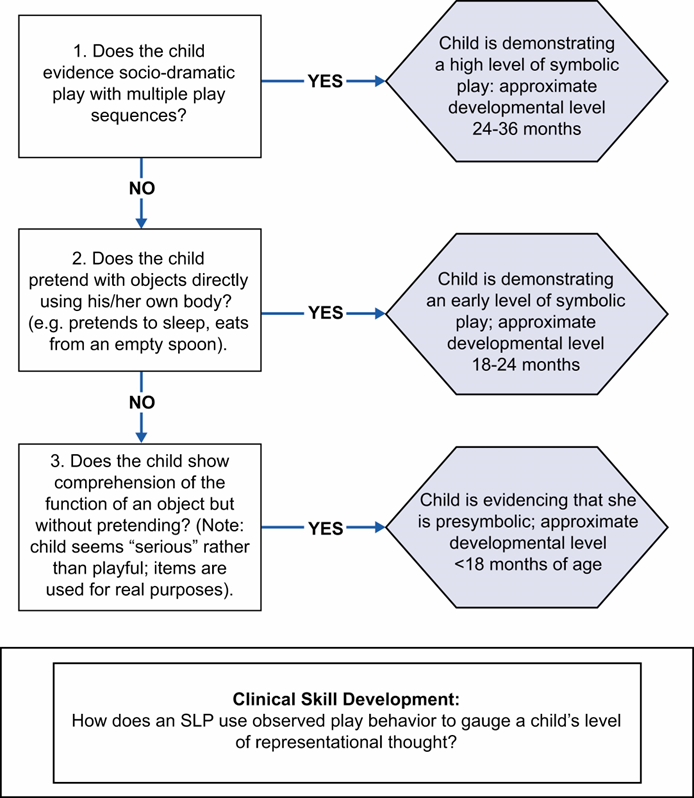
child’s engagement with the world — link between the way child is thinking and the way child is playing
the child’s level of representational thought can influence their ability to use symbols and language during play, which is essential for fostering language development.
Social Interactionist Theory (Vygotsky, Brunner)
Based on principle that communication interaction plays a central role in children’s acquisition of language; social connection = meaningful
The child and a more capable partner solve problems together, eventually the child internalizes the process and can solve problem independently
Important concepts:
Child-directed talk (motherese, infant-directed talk)
Coordinating attention (pointing)
Scaffolding/Mediation
Parent-child communication routines (scripts)
Set up scenario where there is a need for social interaction/facilitate an exchange of ideas/thoughts through language
Cognitive development is socially mediated
A child’s interactions with others influence his or her cognitive understandings.
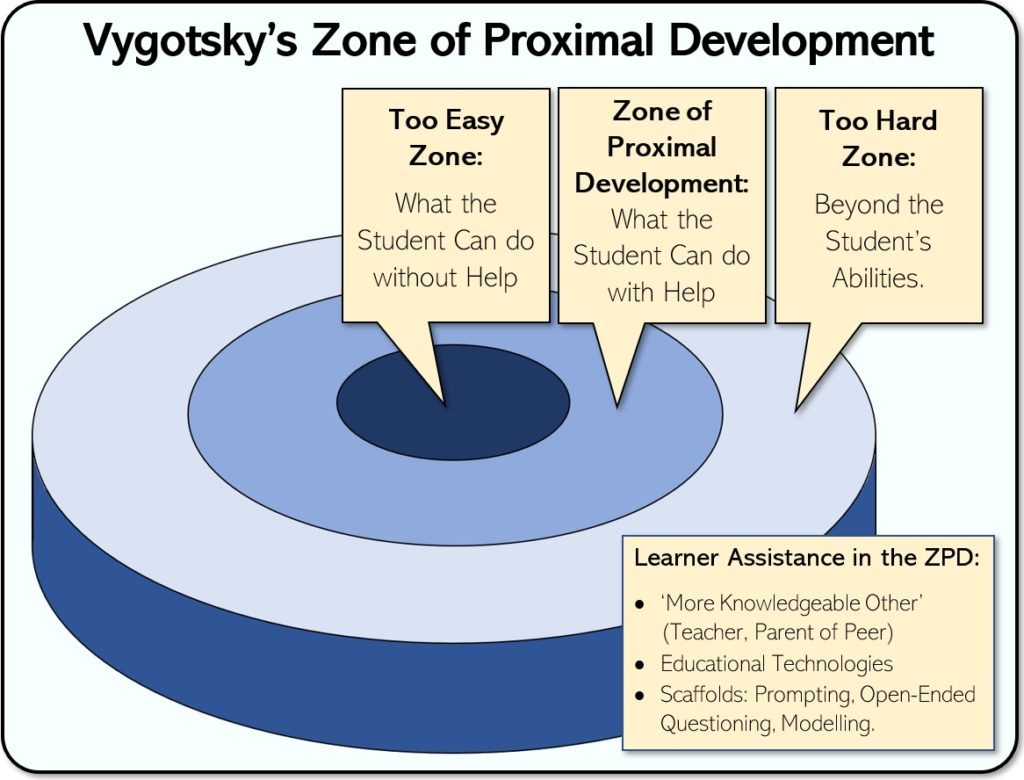
Zone of proximal development (ZPD) - Vygotsky
Next developmental stage that we expect the child to reasonably reach with our support; model what is reasonable for a child to understand and produce (important in goal-setting)
Can still go above ZPD in modeling, but can’t expect them to do it
Initially a child and a more capable partner solve problems together, but eventually the child internalizes the process and is able to carry out the function independently.
Language plays a critical role in shaping learning and thought.
Private speech plays a role in cognitive development
Private speech occurs when children speak aloud as they are engaged in play.
Emergentist Theory
Language is an inter-connected system, highly complex biological system
Child’s biology adapts to his/her environment
Middle ground between nature and nurture
Uses computer simulation and analysis of children’s language samples to understand language development
Influences clinical work in that practitioners….
Note inconsistencies in child’s language use
Note emerging patterns
Target linguistic features to promote system-wide change
less boundaries, no one direction that is acceptable
What are the patterns of the child’s communication?
within the context of the child’s culture
not considering milestones!
The Five Communication Subdomains
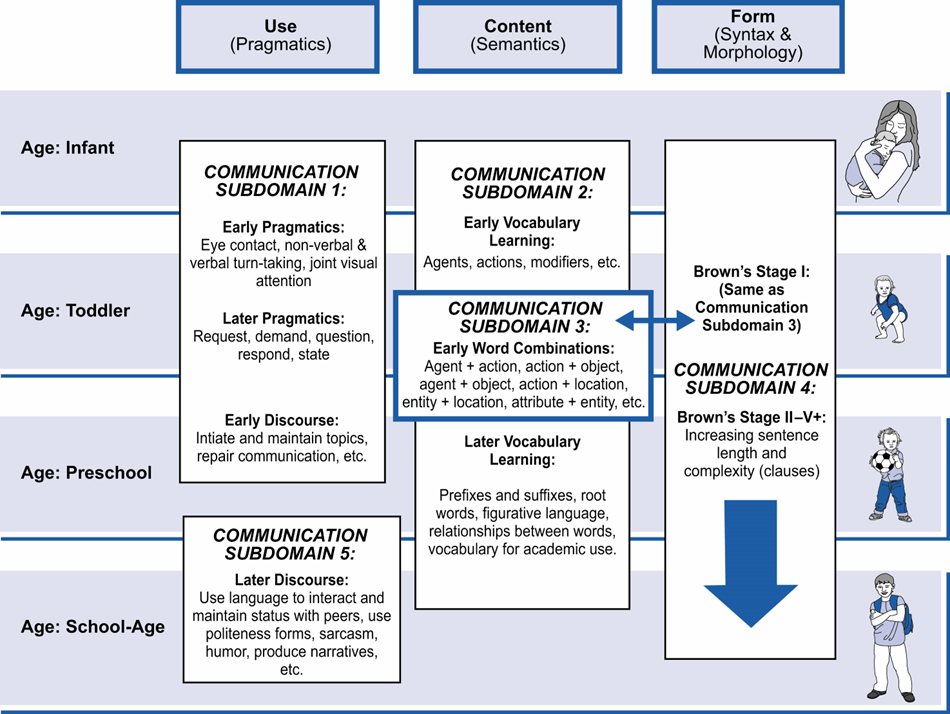
Subdomain 1: Early Pragmatic Skills
Prelinguistic communication
Joint visual attention (JVA) - between 10 and 12 months; child knows that you are paying attention to the same thing that they area — eye gaze to establish communication and intent
One of the first interactive communication acts
Early Development
8 and 15 months - Request objects or activities, refusal, comments (ability to label things)
16 and 23 months - Requesting information, answering questions, acknowledging a response.
Early Discourse Skills – begin in preschool and continue beyond; dialogue to exchange ideas
Initiating a conversation
Taking turns during a conversational exchange
Maintaining ongoing topic
Conversational topic switching
Making conversational repairs
Code switching (how to shift between ways to talk based on context; i.e., at home vs. at school)
Clinical Implications for Communication Subdomain 1
Underlie all later communication
First aspect of communication that is considered during observational process
requires us to be observant of child’s POV — why communicate or why not?
less focus on form, more on use in context
If the practitioner identifies a weakness in the individual’s ability in early pragmatic functions; Communication Subdomain 1 becomes the focus of intervention.
Subdomain 2: Vocabulary Development
Vocabulary development
Begins towards the end of the first year of life and continues to develop throughout one’s life (has no end!).
First words typically produced between 10 and 16 months.
By two years, children typically produce 200-500 words and understand many more words than they produce — can combine one with another
What is the child trying to communicate meaningfully?
Semantic deficits are characteristic of many language disorders including:
Intellectual disability
Autism
Hearing Loss
Developmental Language Disorder
Clinical Implications for Communication Subdomain 2
At early stages in vocabulary development, practitioners consider whether children’s word usage reflects a variety of semantic categories.
aim to diversify their semantic categories — linguistically vs. academically appropriate; consider overlap of academic and home context
The interventionist may coach caregivers to facilitate a variety of semantic forms.
Successful vocabulary interventions should:
integrate new word meaning with familiar words,
provide repeated, meaningful, and contextual opportunities to learn new words,
provide explicit and implicit learning opportunities,
aim for fluent and automatic understanding and use of new words, and
teach students to be more independent word learners (e.g., semantic mapping and word study)
Subdomain 3: Multiple Word Combinations
Once an individual produces approximately 50 individual words, word combinations begin to emerge.
At this early word combination level, children are not governed by adult syntax rules and do not use morphological forms.
child may be exposed to more than one form — what are they exposed to, and how are they represented/how does the child use them?
Children create combinations of words by:
naming objects or people of interest
stating the actions objects or people perform
describing the object’s or person’s characteristics
describing who owns or possesses the object.
Clinical Implications for Communication Subdomain 3
Once a child is able to demonstrate early pragmatic skills and has more than 50 single words practitioners engage children in early play activities to facilitate multiple word combinations.
A child’s parents and/or caretakers are coached to facilitate semantic combinations.
For older individuals with significant communication impairments, practitioners may incorporate an alternative communication approach (AAC).
Subdomain 4: Morphosyntax Development
Children’s utterances begin to demonstrate characteristics of syntax and morphological development (i.e., language form).
Occurs between 24 and 36 months for children developing typically.
Examples:
present progressive -ing verb
plural -s
By age 5, children’s sentences evidence complex syntax including the use of embedded phrases and clauses.
Clinical Implications for Communication Subdomain 4
Once an individual demonstrates the ability to use foundational pragmatic functions and produces multiword combinations using a variety of semantic categories practitioners typically evaluate a speaker’s use of morphosyntax using the framework developed by Brown (1973).
Used in language sample analysis
Demonstrated in students’ ability to read difficult texts and write at the level required for school success.
Not all dialects may express bound morphemes the same way; standardized tests biased, based on bound morphemes
Subdomain 5: Advanced Pragmatic & Discourse Development
Between the ages of 3 and 7 children’s developing pragmatic/discourse skills include the ability to use language to:
reason and to reflect on past experiences
predict events, express empathy
maintain status and interactions with peers
use and understand sarcasm and politeness forms
Students learn to modify discourse styles for different situations (code switch). Some forms of discourse are called narratives.
Engage in discourse across a lot of different contexts
abstract notions/beliefs (internal) get to be expressed
metalinguistics
Narrative forms — child is expected to be a storyteller
ability to tell a fictional story—symbolic play
Clinical Implications for Communication Subdomain 5
Skilled practitioners track children’s abilities to use vocabulary, produce sentences, and use advanced language within sophisticated discourse genres.
different genres of discourse and “reading the room”
Observe student:
in the classroom
with peers
producing narratives
Discourse analysis
quality of exchanges — successful exchange of ideas, narrative complexity, symbolic
Focus on intervention for students in peer-groups, etc.
The Cyclic Nature of Language “Building”
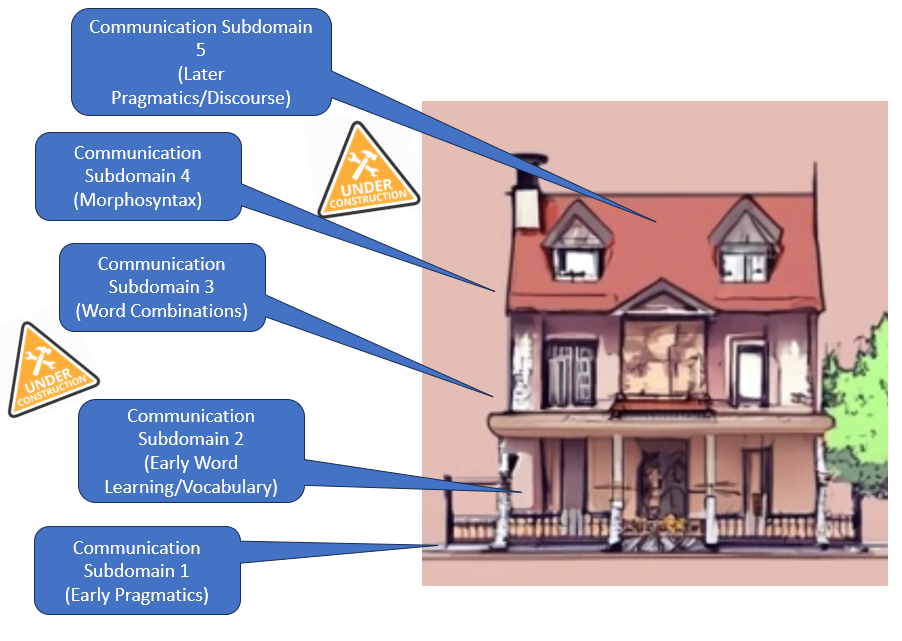
Higher-levels of language stimulate and place demands upon earlier developing language levels; interventionists recognize this cycle of development and adapt language goals to meet the needs of the communicator as the language system matures.