Magnetism and electromagnetism
Magnets
A magnet is any material or object that produces a magnetic field

Field lines go from north to south
The denser the field lines, the stronger the magnetic field
The closer to the ends of the magnet, the stronger
Compasses can be used to find magnetic fields
They interact with it’s filed and point to the south pole
Like poles of a magnet repel, and opposite poles attract
South attracts north, north repels north
Permanent and induced magnets
A magnet is any object that produces a magnetic field
A magnetic material is an object that can be influenced by a magnetic field, and has the potential to become a magnet
Nickel, cobalt, iron and steel are all magnetic materials
Permanent magnets can produce their own magnetic fields all the time
Induced magnets only have temporary magnetic fields
They are created when interacting with a permanent magnet, and they always attract
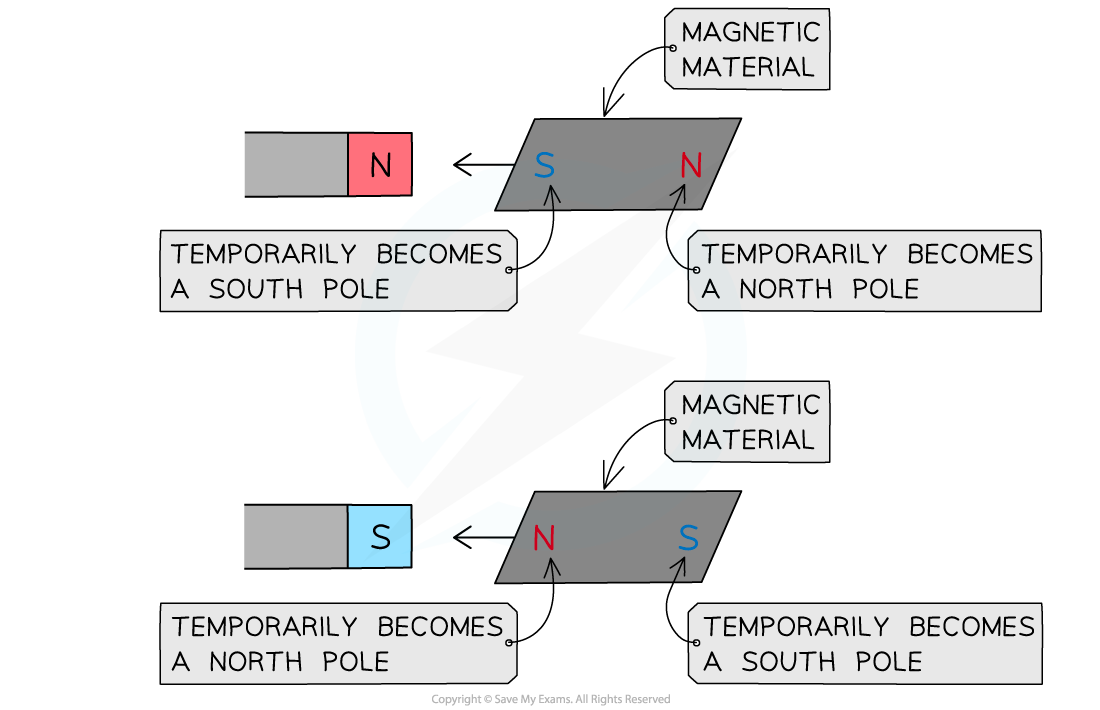
Some magnetic materials lose their magnetic fields slowly
Steel
Are magnetically hard
Some magnetic materials lose their magnetic fields quickly
Nickel and iron
Are magnetically soft
Electromagnetism
Electric currents produce their own magnetic fields
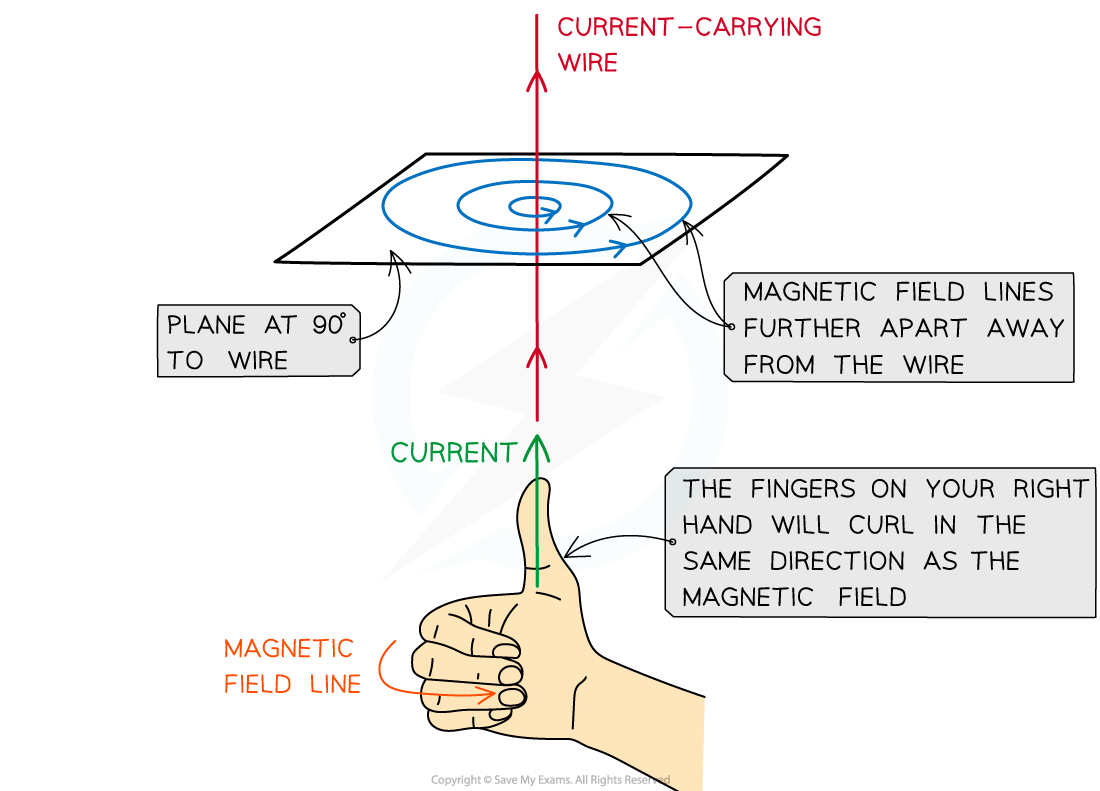
A current carrying wire has a magnetic field in concentric fields around it
The right hand rule shows the direction of the magnetic field relative to the direction of the current
In a circular coil of wire, there would be a concentric magnetic field around the wire, and a field directly through the centre as well
A solenoid is a coil of current carrying wire
A field generated acts as a bar magnet, and passes through the centre of the coil
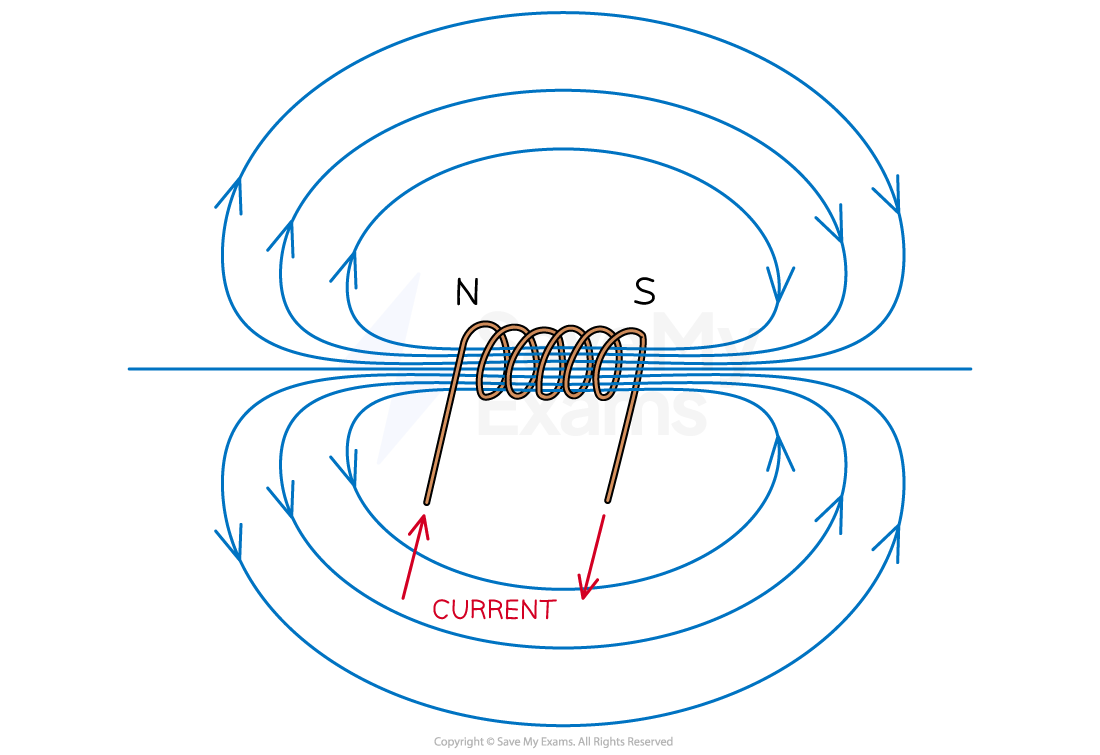
Solenoids with a current carrying wire make a magnet - electromagnets
Electromagnets only last as long as current flows
This means they can turn on or off
The direction of the magnetic field can change, when the current switches direction
The north and south would switch
A solenoid is weak, but its strength can be increased by:
Decrease length (denser coil)
Increase the current
Increase the number of coils
Add an iron core, which acts as an induced magnet and is magnetically soft so doesn’t stay magnetic after
Motor effect
A current carrying wire in the presence of a magnetic field will experience a force
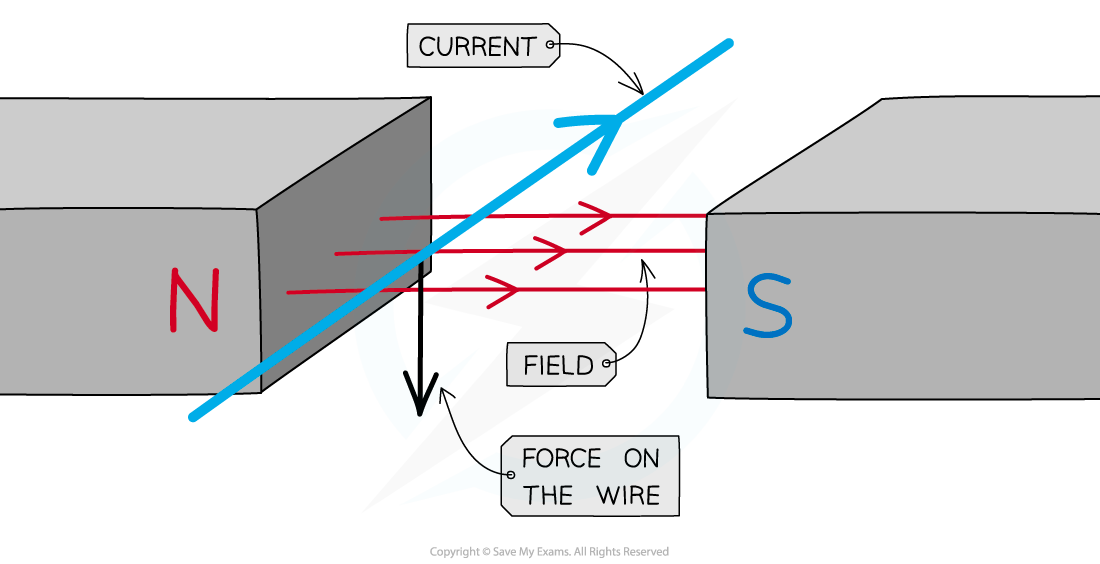
The two magnetic fields interact, and a force pushes the wire
The full force possible only acts at a 90 degree angle between the two fields
There is no force created if the fields go the same direction
To calculate the direction of the force, we need the magnetic field direction and the current’s direction
We use Fleming’s left hand rule
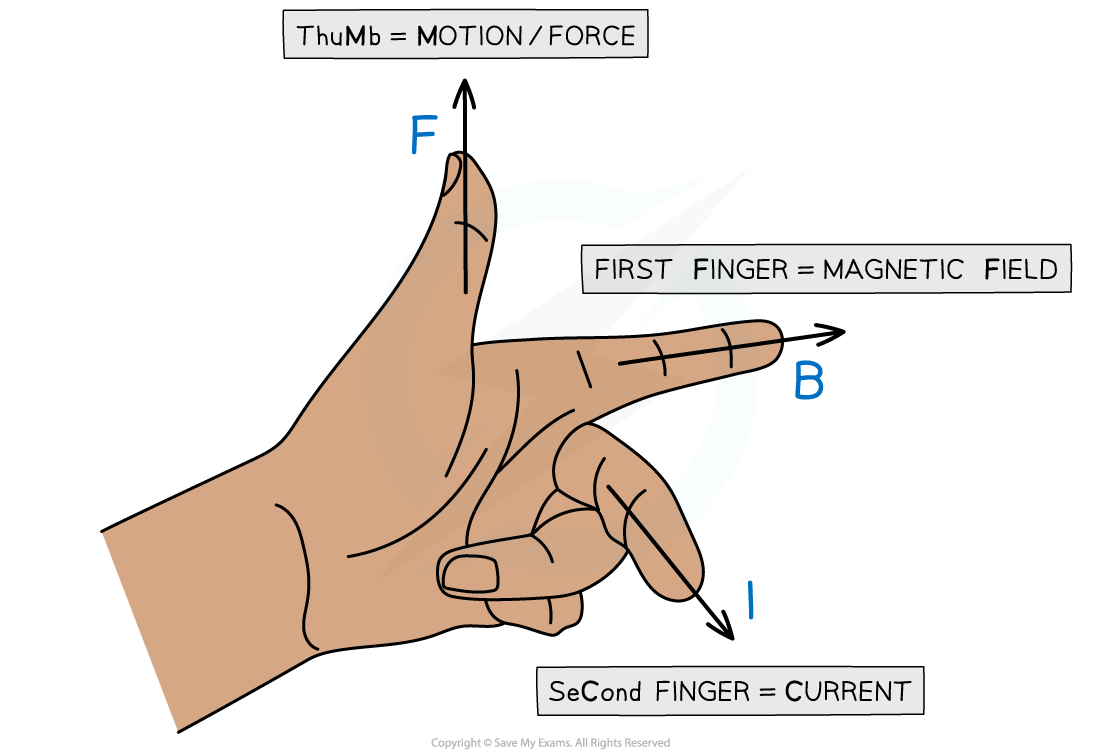
The strength of the force, when the magnetic fields are at a right angle, is equal to the magnetic flux density x current x length of wire
F = B(T) x I(A) x L(m)
T equals tesla’s, the unit for magnetic flux density
Electric motors
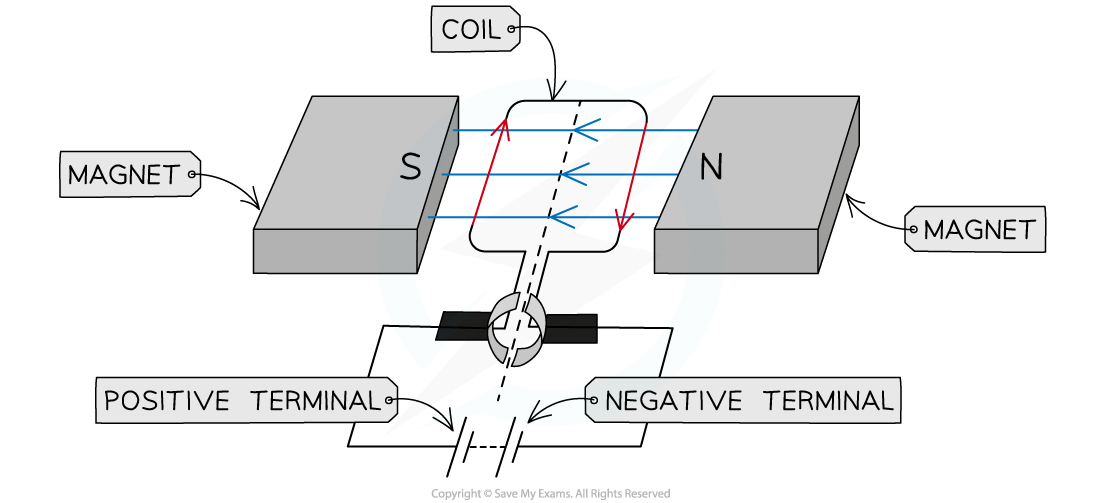
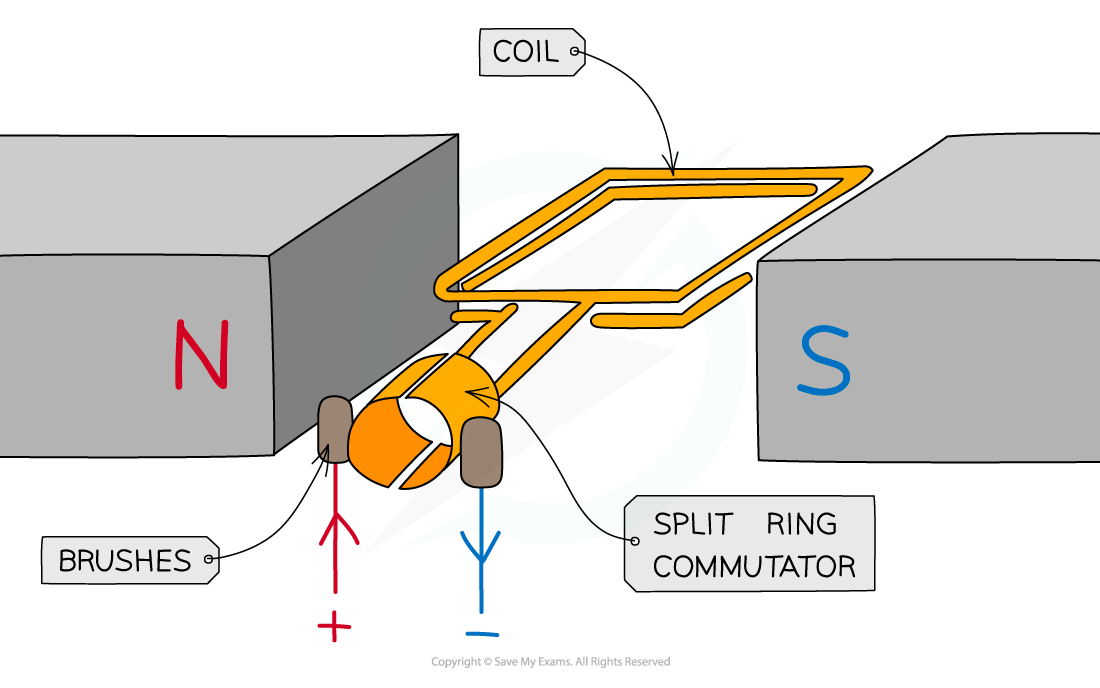
The coil of wire will rotate, turning clockwise in the diagram
Split-ring commutators swaps the positive and negative connections every half turn, so the direction of current swaps, and the force always acts in the same direction
This allows the motor to turn in a consistent direction, and not alternate direction every half turn
Increasing the speed of rotations can be done by:
Increasing the current, and therefore force
Increasing the magnetic flux density
Adding more turns to the coil
The generator effect
The generator effect is also called electric magnetic induction
If you move a wire through a magnetic field, a potential difference is induced
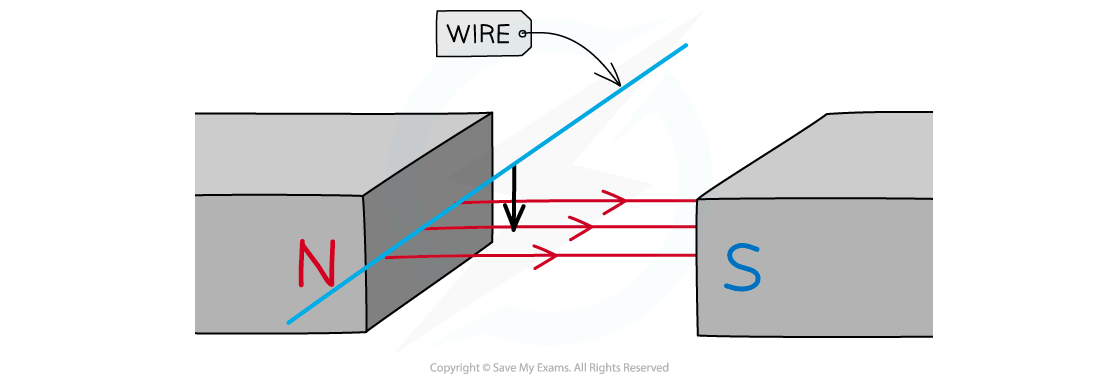
When the wire stops moving, the potential difference disappears, as there is no change
The direction of the potential difference swaps each time we change the direction of the wire
If a circuit was created, the potential difference would generate a current
It also works if the magnets are moved up or down
Changing the size of the induced potential difference (and therefore current):
The strength of the magnets
Moving the wire or magnets quicker
Shaping the wire into a coil (a solenoid) - a larger potential difference
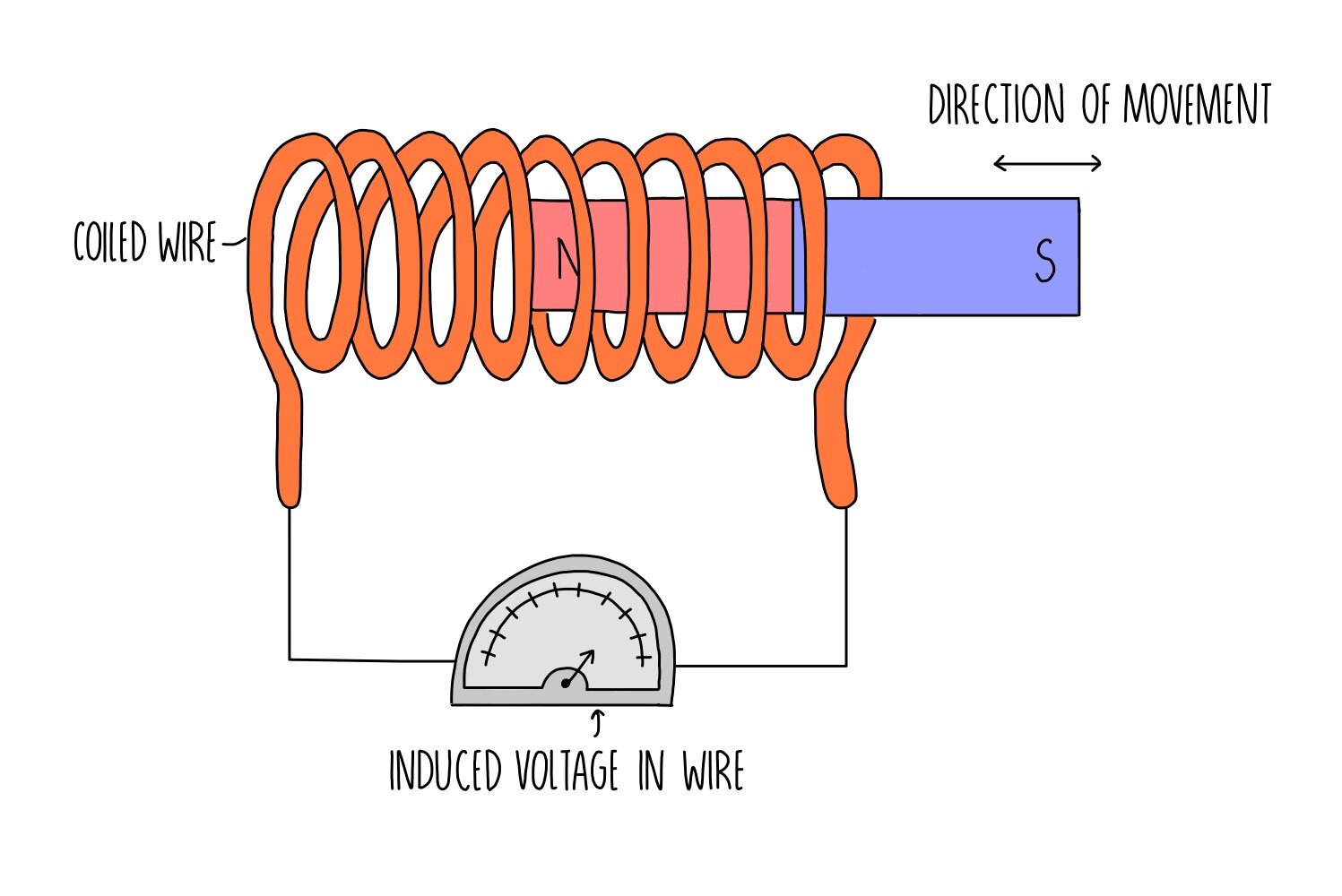
The movement of a magnetic field generates a current
Changing the direction of the movement, changes the direction of the current
Can also be done by flipping the magnet
Alternators and dynamos
The generator effect is the idea that we can generate an electrical current by moving a wire relative to a magnetic field
This is used in generator - either alternators or dynamos
Dynamos
They are used to create a direct potential difference, and current
The split ring commutator and brushes allows a constant connection that swaps the direction of the connection every half turn
As the coil turns, a magnetic field and hence a voltage and current are induced in the coil
The split ring commutators mean the contact swaps every half turn
Alternators
They are used to create alternating current - the faster the coil rotates, the larger the peaks of oscillations, and higher frequency
The slip rings and brushes keep a constant connection without changing the direction of current
The coil rotates relative to the magnetic field, which induces a magnetic field in the coil
The magnetic field then induces a voltage and current in the coil
The slip rings and brushes mean the contacts are always there and don’t swap every half turn

Loudspeakers and microphones
Loudspeakers and microphones both convert between sound waves and electrical signals
Loudspeaker convert from electrical signals to sound waves (vibrations), via the motor effect
The motor effect generates small movement - vibrations - which produce sound
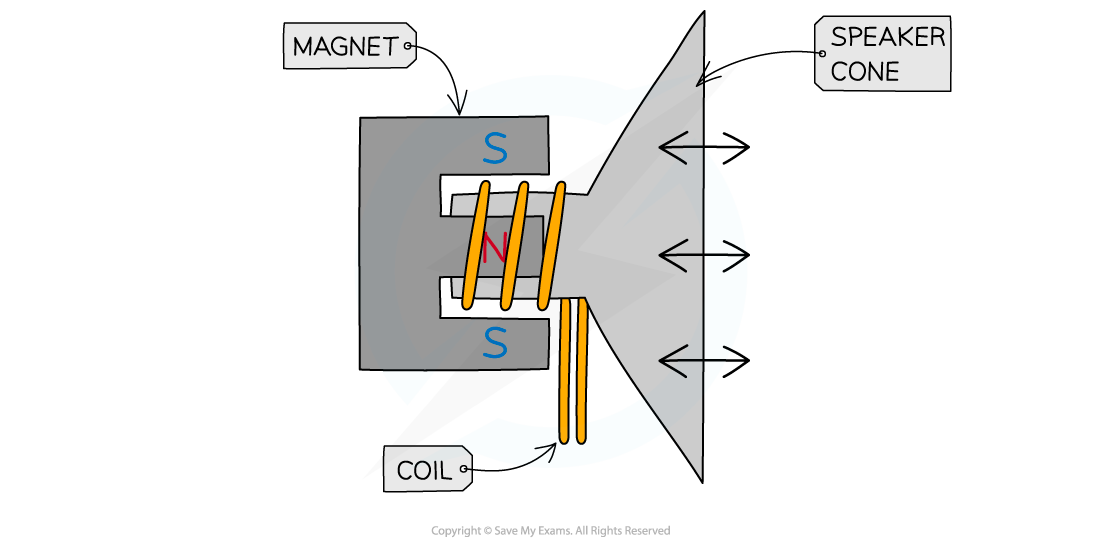
The coil of wire and cone are permanently attached, but can move back and forth along the magnet
An alternating current flows through the wire and create a magnetic field in the coil
This magnetic field interacts with the magnetic field of the permanent magnet
The interacting fields exert a force on the coil (the motor effect)
This causes the speaker cone to move back and forth
These vibrations move so fast that they cause pressure variations in the air - sound waves
Microphones convert from sound waves to electrical signals via the generator effect
The generator effect converts small vibrations (sound waves) into electrical signals
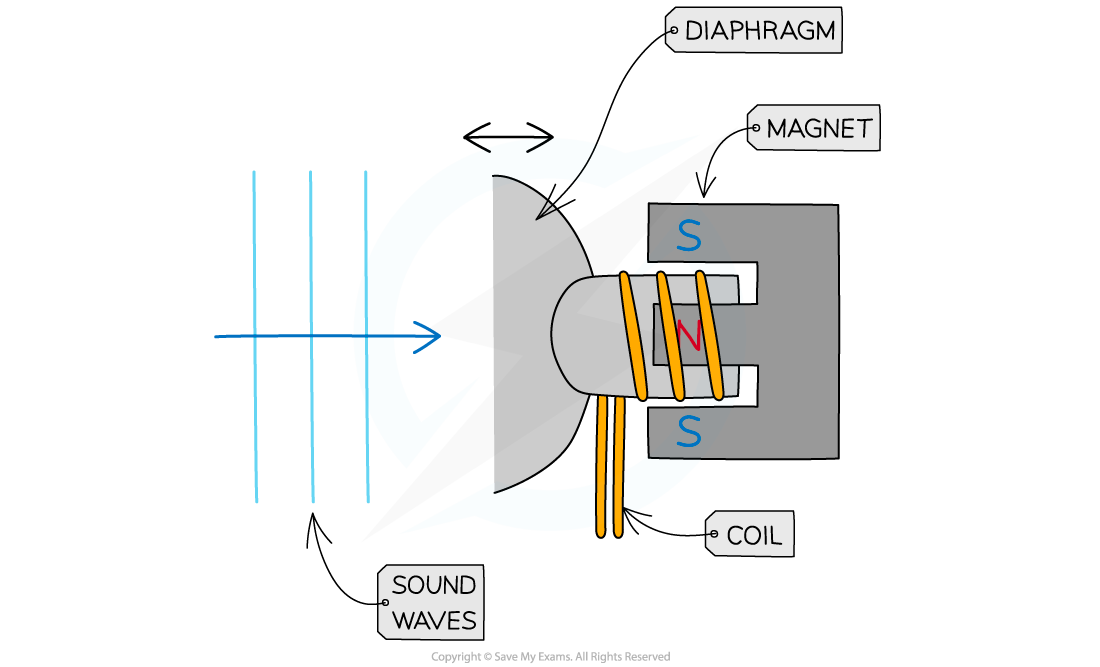
The sound waves move the diaphragm, which is connected to the coil that generates a potential difference, and therefore current, when moving through a magnetic field
Sound waves hit the diaphragm
This causes the diaphragm and coil of wire to move
As the wire moves through the magnetic field of the permanent magnet, it will generate a current (generator effect)
The frequency and amplitude of the sound waves will determine how much the diaphragm will vibrate and determine the frequency and amplitude if the current (A.C)
Both microphones and loudspeaker use an alternating current
Transformers
Most electricity in the UK is generated in power stations and transported across the country through transformers
Step up transformers increase the voltage to 40000v, which decreases the current and minimises energy loss
Step down transformers decrease the voltage to 230volts and 50 hertz, which is safe for domestic use

An alternating potential difference is applied across the primary coil
This causes a current to flow through the wire, which generates a magnetic field around the coil
The direction of the potential difference, current and magnetic field alternate constantly
This induces an alternating magnetic field in the iron core
A soft magnetic material, so becomes induced only while the magnetic field is present
The iron core’s magnetic field induces a potential difference in the secondary coil, and if it is part of a complete circuit, current will flow
Current is transferred across from the primary coil to the secondary coil
This allows us to change the size of the potential difference between the coils by changing the number of coils on either side
Step up transformers have less coils in the primary coil, so there is a lower potential difference in the primary coil
In the secondary coil, there are more coils, which increases the potential difference in the output
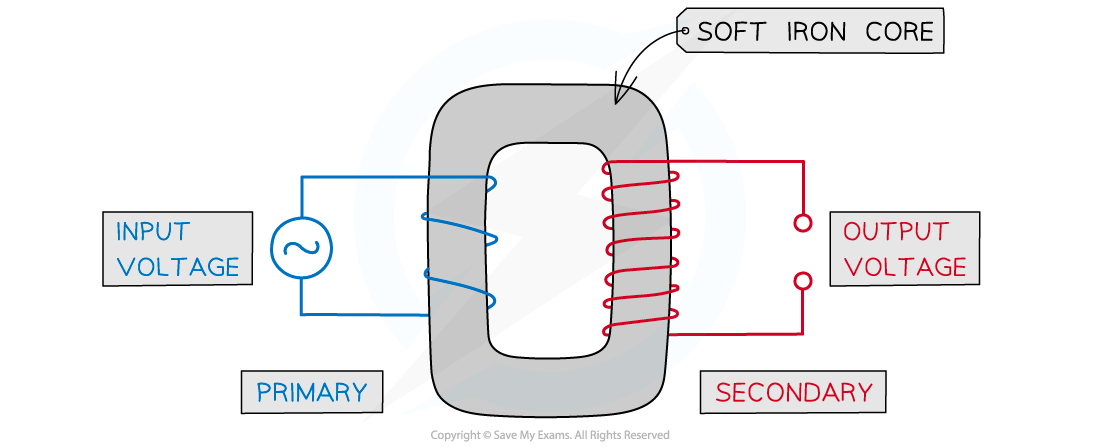
Step down transformers have more coils in the primary coil, so there is a higher potential difference in the primary coil
In the secondary coil, there are less coils, so a lower potential difference is produced

Vp/Vs = np/ns
Potential difference in the primary coil/ potential difference in the secondary coil = no. of turns in the primary coil/ no. of turns in the secondary coil
VpIp=VsIs
The potential difference in the primary coil x current in the primary coil = potential difference x current in the secondary coil
Is a constant
DONE!!!
QUESTIONS
What is a magnet?
Field lines go from…to…
The denser the field lines, the…
How do compasses help to find magnetic fields?
Like poles… and opposite…
A magnetic material is…
The magnetic materials are…
Permanent magnets are…
Induced magnets are…
They are created when… and they always attract/repel?
Magnetically hard materials lose magnetic fields…
For example, …
Magnetically soft materials lose magnetic fields…
For example,... and…
Electric currents produce…
A current carrying wire has a magnetic field in…
The right hand rule shows…
In a circular coil of wire, there is a… magnetic field and a field …
A solenoid is…
The field generated acts as a… and passes through…
Solenoids with a current carrying wire makes a…
This is an …
Electromagnetics last as long as…
They can…
The direction of the magnetic field depends on the…
Solenoids are …
Their strength can be increased by … (4)
A current carrying wire in a magnetic field experiences…
This is because the magnetic fields…
The full force only happens at…
If in the same direction…
Fleming’s left hand rule is used to…
The strength of the force (at right angles)=... x…x…
F=
Magnetic flux density is measured in…
In motors, a current carrying wire is placed… which causes a…
Split-ring commutators… every…
This causes the current to switch every… so the force…
The motor therefore turns in a … direction
The speed of rotation can be increased by… (3)
If you move a wire through a magnetic field,...
When the wire stops moving, the…
The direction of potential difference changes when…
If a circuit was created, potential diff would cause…
We can increase the potential difference created by… (3)
The movement of a magnetic field generates a…
Changing the direction of the movement causes…
This can also be done by…
The generator effect is the idea that…
The types of generators are… or …
Dynamos are used to create a… current
Split ring commutators and brushes allow… that ensures direction is…
As the coil turns, a… is induced in the coil so therefore a… and… are induced
Alternators are used to create… current
The faster the coil rotates, the oscillations become… with … frequency
Slip rings and brushes are used to ensure there is… so current is…
The coil rotates relative to the magnetic field, which causes… in the coil
This then induces a … and …
As rotation is constantly in … direction, the coils direction is… every…
This creates a …
Loudspeakers convert from … to… via the…
The motor effect generates… which produce sound
A current carrying wire and cone are permanently attached and can move back and forth along the…
As an … current flows, a … is generated around the wire
These interacting fields cause a…
The cone then …, which creates sound waves in the air through vibrations
Microphones convert from… to… via the…
The generator effect converts movement into…
The sound waves move the…, which is connected to the coil
This movement generates a… and therefore… when moving through the…
The frequency and amplitude of the sound waves determines …
Both microphones and loudspeakers use… current
Electricity in the UK is generated in… and transported across the country
Step up transformers increases… to… which decreases…
This minimises…
Step down transformers decrease… to…
The frequency is…
This is used as…
Transformers have… core and a … and… coil
An alternating potential difference is applied across the primary coil
This causes… which generates a… around the coil
The directions of the P.D, current and MF are…
This induces a… in the…
The … core is a … magnetic material so is induced…
The core’s magnetic field induces a… in the secondary coil which will flow if part of a complete circuit
Step up transformers have … coils in the primary coil, so there is a lower potential difference in the… coil
Step down transformers have… coils in the primary coil, so there is a lower potential difference in the… coil
The voltage x current is a constant on both sides of the core