ELECTRICITY
CHARGING BY FRICTION (FULL EXPLANATION + DIAGRAMS)
What it is
When two materials rub, electrons move from one to the other.
How to know who loses/gains?
Use the Triboelectric Series (given on test).
Higher on list → loses electrons → becomes positive
Lower on list → gains electrons → becomes negative
🔵 DIAGRAM: Charging by Friction
(Neutral objects → rubbed → one becomes +, one becomes –)
Before rubbing
Both objects neutral:
Code
Object A:  +  -  +  -  +  -
Object B:  +  -  +  -  +  -
During rubbing
Electrons move from the material HIGHER on the series → LOWER on the series.
Example: Glass (higher) rubbed with plastic wrap (lower)
Code
Glass:      +  -  +  -  +  -   → loses electrons
Plastic:    +  -  +  -  +  -   → gains electrons
After rubbing
Code
Glass:      +  +  +  +  +      (POSITIVE)
Plastic:    -  -  -  -  -      (NEGATIVE)
CHARGING BY CONTACT?
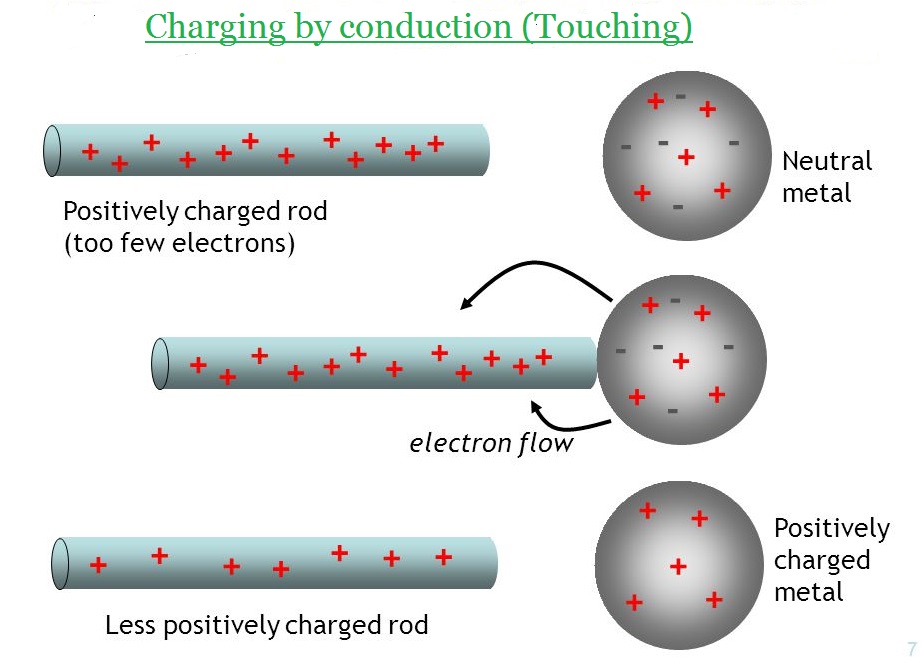
🧠 WHY does this happen?
Because electrons move, and they always move in the direction that makes things more balanced.
Negative object = has extra electrons
Positive object = has too few electrons
Neutral object = equal electrons & protons
When they touch, electrons move to fix the imbalance.
⚡ TWO CASES
We do BOTH with diagrams.
🔵 CASE 1 — NEGATIVE OBJECT TOUCHES NEUTRAL
(Electrons move into the neutral object)
Before contact
Code
NEGATIVE OBJECT:   - - - - - + + +
NEUTRAL OBJECT:    + - + - + -
During contact
Electrons flow from negative → neutral.
Code
NEGATIVE OBJECT:   - - - - + + + +
NEUTRAL OBJECT:    - - - - + - + -
After contact
Code
NEGATIVE OBJECT:   still negative
NEUTRAL OBJECT:    becomes negative
✔ Neutral becomes negative
✔ Electrons moved INTO it
🔴 CASE 2 — POSITIVE OBJECT TOUCHES NEUTRAL
(Electrons move out of the neutral object)
Before contact
Code
POSITIVE OBJECT:   + + + + - - -
NEUTRAL OBJECT:    + - + - + -
During contact
Electrons flow from neutral → positive.
Code
POSITIVE OBJECT:   + + + - - - - -
NEUTRAL OBJECT:    + + + - + -
After contact
Code
POSITIVE OBJECT:   still positive
NEUTRAL OBJECT:    becomes positive
✔ Neutral becomes positive
✔ Electrons moved OUT of it
⚡ SUPER SIMPLE SUMMARY
Touch with negative → electrons go into neutral → neutral becomes negative
Touch with positive → electrons go out of neutral → neutral becomes positive
CHARGING BY INDUCTION
🧠 WHAT IS INDUCTION? (Proper explanation)
From your notes:
“Induction is the movement/rearrangement of electrons within a substance caused by a nearby charged object, without direct contact.”

Meaning:
✔ The charged object NEVER touches
✔ Electrons inside the neutral object shift positions
✔ The object stays overall neutral
✔ The charge is temporary (only exists while the charged object is near)
This is the KEY difference from contact.
⚡ WHY DOES INDUCTION HAPPEN?
Because electrons move away from negative
and move toward positive.
Electrons are like scared little boiis:
They run away from negative charges
They run toward positive charges
So when a charged object comes close, electrons inside the neutral object rearrange.
🔵 CASE 1 — NEGATIVE OBJECT NEAR A NEUTRAL OBJECT
(Electrons get pushed away)
Before
Neutral object = electrons evenly spread.
During induction
Negative rod repels electrons → they move to the far side.
Result
Near side becomes positive
Far side becomes negative
Object is STILL neutral overall
Charge disappears when rod is removed
🔴 CASE 2 — POSITIVE OBJECT NEAR A NEUTRAL OBJECT
(Electrons get pulled toward the rod)
Before
Neutral object = electrons evenly spread.
During induction
Positive rod attracts electrons → they move to the near side.
Result
Near side becomes negative
Far side becomes positive
Object is STILL neutral overall
Charge disappears when rod is removed
1. PITH‑BALL ELECTROSCOPE
A tiny ball made of pith (light, non‑conductive material) hanging from a thread.

✔ HOW IT WORKS
The pith ball is neutral at the start.
A) Charged object brought NEAR (induction)
Electrons inside the pith ball shift
The pith ball becomes temporarily polarized
It gets attracted to the charged object
B) Charged object TOUCHES the pith ball (contact)
Electrons transfer
The pith ball becomes charged
Now it can repel from the same charge
✔ EXAMPLE: Negative balloon near pith ball
Balloon repels electrons inside the pith ball
Near side becomes positive
Pith ball is attracted
✔ EXAMPLE: Negative balloon touches pith ball
Electrons move into pith ball
Pith ball becomes negative
Now it repels from the balloon
2. METAL‑LEAF ELECTROSCOPE
This one is more sensitive and shows charge using two thin metal leaves.
✔ HOW IT WORKS
Inside the electroscope:
A metal knob
A metal rod
Two thin metal leaves
All connected → electrons can move freely.
✔ WHAT HAPPENS WHEN A CHARGED OBJECT COMES NEAR?
A) Induction (NO touching)
Electrons shift inside the electroscope
Leaves get the same charge
Leaves repel and spread apart
B) Contact (TOUCHING)
Electrons transfer
Electroscope becomes charged
Leaves stay apart even after the rod is removed
🧠 KEY IDEA
Leaves spread apart = electroscope is charged.
Leaves collapse = electroscope is neutral.
PART 1 — CIRCUITS (SERIES + PARALLEL)
🔵 SERIES CIRCUIT
Only ONE path for electrons.
Rules
Current is the SAME everywhere
IT = I1 = I2 = I3Voltage SPLITS
VT = V1 + V2 + V3Resistance ADDS
RT = R1 + R2 + R3If one bulb breaks → ALL go out
🔴 PARALLEL CIRCUIT
Electrons have multiple paths.
Rules
Voltage is the SAME on each branch
VT = V1 = V2 = V3Current SPLITS
IT = I1 + I2 + I3Resistance DECREASES
1/RT = 1/R1 + 1/R2 + 1/R3If one bulb breaks → others stay on
PART 2 — OHM’S LAW (V = IR)
Using GRASP properly
Formula
V = I × R
I = V ÷ R
R = V ÷ I
✔ Example 1 — Find Voltage (V)
A current of 4 A flows through a 40 Ω resistor.
G: I = 4 A, R = 40 Ω
R: V
A: V = IR
S: V = 4 × 40 = 160 V
P: The voltage is 160 V.
✔ Example 2 — Find Resistance (R)
V = 240 V, I = 20 A
G: V = 240 V, I = 20 A
R: R
A: R = V ÷ I
S: 240 ÷ 20 = 12 Ω
P: The resistance is 12 Ω.
✔ Example 3 — Find Current (I)
V = 30 V, R = 15 Ω
G: V = 30 V, R = 15 Ω
R: I
A: I = V ÷ R
S: 30 ÷ 15 = 2 A
P: The current is 2 A.
Current (I)
⚡ SUPER SUMMARY TABLE
Feature | Series | Parallel |
|---|---|---|
Paths | 1 | Many |
Current | Same | Splits |
Voltage | Splits | Same |
Resistance | Adds | Decreases |
If one bulb breaks | All off | Others stay on |