18.5 Anaerobic respiration
Aerobic respiration was not possible when life began, there was no O2 present. It is a relatively new process in evolutionary terms.
Aerobic respiration produces around 38 molecules of ATP per glucose molecule whereas fermentation (form of anaerobic respiration) only produces 2 molecules of ATP net.
Anaerobic respiration in eukaryotic organisms
Eukaryotic cells respire aerobically if enough oxygen is available. Anaerobic respiration results in the synthesis of smaller quantities of ATP, occurs in the absence of oxygen and is also used when oxygen cannot be supplied fast enough to respiring cells. It is a temporary emergency measure to keep vital processes functioning.
Organisms fall into different categories determined by their dependance on oxygen or not
Obligate anaerobes - cannot survive in the presence of oxygen. almost all obligate anaerobes are prokaryotes e.g Clostridium (bacteria that causes food poisoning) although there are some fungi as well
Facultative anaerobes - synthesis ATP by aerobic respiration if oxygen is present, but can switch to anaerobic respiration in the absence of oxygen e.g yeast.
Obligate aerobes - can only synthesis ATP in the presence of oxygen e.g mammals. The individual cells of some organisms, such as muscle cells in mammals can be described as facultative anaerobes because they can supplement ATP supplies by employing anaerobic respiration in addition to aerobic respiration when the oxygen concentration is low. However this is only for short periods and oxygen is eventually required. The shortfall of oxygen during the period of anaerobic respiration produces compounds that have to be broken down when oxygen becomes available again, so the organism as a whole is an obligate aerobe.
Fermentation (form of anaerobic respiration)
- this is the process by which complex organic compounds are broken down into simpler inorganic compounds without the use of oxygen or the involvement of an electron transport chain.
The organic compounds like glucose, are not fully broken down so fermentation produces much less ATP than aerobic respiration.
The small quantity of ATP produced in synthesised by substrate-level phosphorylation alone.
The end product of fermentation differ depending on the organism.
Alcoholic fermentation occurs in yeast and some plant root cells.
Here the end products are ethanol (an alcohol) and carbon dioxide.
Lactate fermentation results in the production of lactate and is carried out in animal cells.
When there is no oxygen to act as the final electron acceptor at the end of the electron transport chain in oxidative phosphorylation, the flow of electrons stop. This means the synthesis of ATP by chemiosmosis also stops.
As the flow of electrons along the electron transport chain has stopped, the reduced NAD and reduced FAD are no longer able to be oxidised because there is nowhere for the electrons to go.
This means that NAD and FAD cannot be regenerated and so the decarboxylation and oxidation of pyruvate and the Krebs cycle comes to a halt as there are no coenzymes available to accept the hydrogens being removed.
Glycolysis would come to a halt due to the lack of NAD if it were not for the process of fermentation.
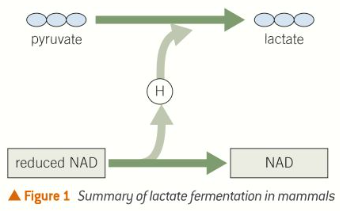
Lactate fermentation in mammals
In mammals, pyruvate can act as a hydrogen acceptor taking the hydrogen from reduced NAD, catalysed by the enzyme lactate dehydrogenase.
The pyruvate is converted to lactate (lactic acid) and NAD is regenerated. This can be used to keep glycolysis going so a small quantity of ATP is still synthesised. In mammals, in particular, anaerobic respiration in the muscles is often supported by ATP from aerobic respiration, which is still being produced as fast as oxygen can be delivered in other parts of the body.
Lactic acid is converted back to glucose in the liver but oxygen is needed to complete this process. This is the reason for oxygen debt (and need to breathe heavily) after exercise.
Lactate fermentation cannot occur indefinitely for two main reasons
The reduced quality of ATP formed would not be enough to maintain vital processes for a long period of time
The accumulation of lactic acid causes a fall in pH leading to proteins denaturing. Respiratory enzymes and muscle filaments are made from proteins and will cease to function at low pH.
Lactic acid is removed from muscles and taken to the liver in the bloodstream. One of the main aims when improving physical fitness is to increase the blood supply and flow through the muscles. This increases the rate of lactic acid removal allowing the intensity and duration of exercise to be increased.
Alcohol fermentation in yeast (and many plants)
Alcoholic fermentation is not a reversible process like lactate fermentation. Pyyruvate is first converted to ethanal, catalysed by the enzyme pyruvate decarboxylase. Ethanal can then accept a hydrogen atom from reduced NAD, becoming ethanol. The regenerated NAD can then continue to act as a coenzyme and glycolysis can continue.
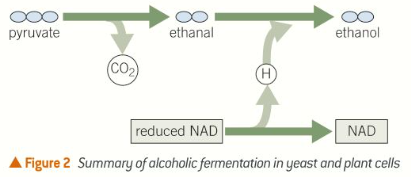 This is not a short-term process and can continue indefinitely in the absence of oxygen. Ethanol is a toxic waste product to yeast cells and they are unable to survive if the ethanol accumulates above approximately 15%. This is allowed to happen during the production of alcohol in brewing or wine making.
Practical - Investigation into respiration rates in yeast
This apparatus could be used to measure the rate of carbon dioxide production of a yeast suspension, this will be equivalent to the rate of anaerobic respiration of alcoholic fermentation of the yeast cells.
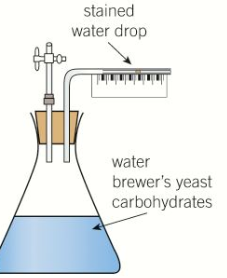
The glucose in solution provides a respiratory substrate, the flask is sealed during the experiment to ensure anaerobic conditions.
As the yeast respires carbon dioxide is released increasing the volume of gas in the flask. As the volume of gas in the tube increases the pressure will increase causing the coloured liquid to move along the capillary tube. The distance moved by the liquid together with the diameter of the tube can be used to calculate the increase in volume of gas (carbon dioxide) in the flask over a certain time. This is a measure of the rate of respiration.
Data logging
Respiration is not 100% efficient and energy is lost as heat when organisms respire.
When yeast respires it produces heat which will increase the temperature of a solution containing yeast. Sensors can be used to measure changes in temperature.
Small-scale and large-scale adaptations to low oxygen environments
Many animals live in or around water and spend time underwater to hunt for food, these animals animals to survive periods of anaerobic respiration while they cannot breathe air. Many bacteria also live in low oxygen environments.
Bacterial adaptations
Different groups of bacteria have evolved to use nitrate ions, sulphate ions, and carbon dioxide as final electron acceptors in anaerobic respiration. This enables them to live in very low, or zero oxygen environments.
Anaerobic bacteria present in the digestive systems of animals play an essential role in the breakdown of food and absorptions of minerals. Methanogens are a type of bacteria found in the digestive system of ruminants such as cows. They digest cellulose from grass cell walls into products that can be further digested, absorbed and used by ruminants. The final electron acceptor in the respiratory pathway of these bacteria is CO2 and methane and water are produced. The methane builds up builds up and eventually has to be released - it has been estimated that cows produce around 500L of methane per day.
Mammalian adaptations
Marine mammals that dive for long periods, such as seals and whales have adaptations for when they cannot take oxygen in.
Biochemical adaptations
Greater concentration of haemoglobin and myoglobin than land mammals, particularly in the muscles used in swimming. This maximises their oxygen stores delaying the onset of anaerobic metabolism. Whales have a higher tolerance to lactic acid than human beings, so they can respire anaerobically much longer without suffering tissue damage. They also have a greater tolerance of high carbon dioxide levels - they have very effective blood buffering systems that prevent a catastrophic rise in pH.
Physiological adaptations
Include a modified circulatory system. When they dive they show peripheral vasoconstriction, so blood is shunted to the brain, heart and muscles. The heart slows by up to 85% - this is known as bradycardia and reduces the energy demand of the heart muscle.
Whales also exchange 80-95% of the air in the lungs when they breathe- in humans, that figure is around 15%, in some species dives can last up to two hours.
Physical adaptations
Streamlining to reduce drag due to friction from water while swimming, therefore reducing the energy demand during a drive. The limbs of marine mammals are fin shaped to maximise the efficient use of energy is propulsion.