8 - Money Growth and Inflation Notes
The Quantity Theory of Money
The quantity theory of money (Classical Theory of Inflation) explains one of the 10 Principles of Economics:
Prices rise when the government prints too much money
Most economists view this theory as a reliable explanation of inflation in the long run.
Suppose that the quantity of money determines the value of money
Study this theory using 2 approaches: A supply-demand diagram and an equation
The Money Supply-Demand diagram
The value of money
P = the price level (the CPI or GDP deflator)
P is the price of a basket of goods in terms of money.
is the value of a unit of money, measured in goods.
Example: If a basket contains one candy bar
P = $2 , the value of $1 is 1/2 candy bar.
P = $3, the value of $1 is 1/3 candy bar.
Inflation increases prices and reduces the value of money.
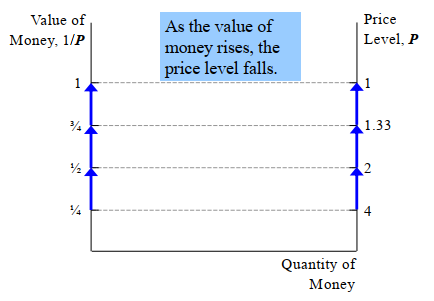
The value of money is inversely related to the price level; as the value of money increases, the price level decreases.
The demand for money reflects how much wealth people want to hold in liquid form for transactions. People hold money because it is the medium of exchange
Higher price levels increase the demand for money (people need more cash to maintain their purchasing power)
Effects of a Monetary Injection
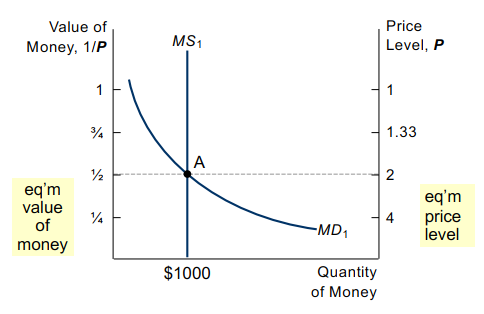
Increasing the money supply (MS shifts right) causes the price level () to rise and value of money to fall (inflation)
Increasing the money demand (MD shifts right) causes the price level to fall and value of money to rise
Real vs. Nominal Variables
Definitions
Nominal variables are measured in monetary units (e.g., nominal GDP, nominal interest rate - rate of return in $, nominal wage - $ per hour worked) (measured in $)
Real variables are measured in physical units (e.g., real GDP, real interest rate - measured in output, real wage). (measured in output)
Relative Prices
Relative prices is the price of one good relative to (divided by) another.
Example: If a CD costs $15 and a pizza costs $10, the relative price of a CD is 1.5 pizzas (1.5 pizzas per CD)
Relative prices are expressed in physical units, making them real variables.
Real vs. Nominal Wage
The real wage is a crucial relative price, calculated as:
is the nominal wage = price of labour ($15/hour)
is the price level = price of goods & services ($5/unit of output)
Eg: If the nominal wage is $15/hour and the price level is $5/unit of output, the real wage is 3 units of output per hour.
Classical Dichotomy and Neutrality of Money
Classical Dichotomy
Classical dichotomy is the theoretical separation of nominal and real variables.
Classical economists believed that changes in the money supply affect nominal variables but not real variables.
If the central bank doubles the money supply, classical thinkers contend:
nominal variables, including prices, will double
real variables, like relative prices, will remain unchanged.
Monetary Neutrality
Monetary neutrality suggests that changes in the money supply do not affect real variables.
Doubling the money supply doubles all nominal prices, but relative prices remain the same.
Real wage remains unchanged, so the quantity of labor supplied and demanded, and total employment, do not change.
Since employment of all resources is unchanged, total output is also unaffected by the money supply.
In the long run…
Most economists believe that the classical dichotomy and monetary neutrality hold in the long run.
Monetary changes can have short-run effects on real variables.
The Quantity Equation
Velocity of Money
Velocity of money is the rate at which money changes hands.
Formula: , where is nominal GDP = (price level) x (real GDP - quantity of g&s produced), and is the money supply.
Quantity Equation
is stable (constant? in short tun)
A change in causes nominal GDP () to change by the same percentage.
A change in does not affect (money is neutral; is determined by technology and resources).
Reminder:
changes by the same percentage as and .
Rapid money supply growth causes rapid inflation.
Quantity Theory of Money: Example
Scenario
Economy produces corn: bushels.
Velocity () is constant.
2008: Money Supply (MS) = $2000, Price () = $5/bushel.
2009: Central Bank increases MS by 5% to $2100.
Calculations
a. Compute the 2009 values of nominal GDP and P. Compute the inflation rate for 2008-2009.
b. Suppose tech. progress causes Y to increase to 824 in 2009. Compute 2008-2009 inflation rate.
Summary and Lessons about the Quantity Theory of Money
If real GDP is constant, then the inflation rate equals the money growth rate.
If real GDP is growing, then inflation rate equals money growth rate minus economic growth rate.
Economic growth increases the number of transactions.
Some money growth is needed for these extra transactions.
Excessive money growth causes inflation.
Some Related Issues
Hyperinflation
Hyperinflation is defined as inflation exceeding 50% per month.
Excessive growth in the money supply always causes hyperinflation.
Inflation Tax
Governments may print money to cover spending, causing inflation, which acts as a tax on those holding money.
In the U.S., the inflation tax accounts for less than 3% of total revenue today.
The Fisher Effect
The Fisher effect states that an increase in inflation causes an equal increase in the nominal interest rate, leaving the real interest rate unchanged.
The real interest rate is determined by saving and investment in the loanable funds market.
Money supply growth determines the inflation rate.
The nominal interest rate adjusts one-for-one with changes in the inflation rate:
The Costs of Inflation
The Inflation Fallacy
Most people believe inflation erodes real incomes; however, inflation is a general increase in prices of both what people buy and sell.
In the long run, real incomes are determined by real variables, not the inflation rate.
Costs of Expected Inflation
Shoeleather Costs
Resources wasted when inflation encourages people to reduce their money holdings.
Includes the time and transaction costs of frequent bank withdrawals.
Menu Costs
Costs of changing prices (printing new menus, mailing new catalogs, etc.).
Misallocation of Resources from Relative-Price Variability
Firms do not all raise prices at the same time, leading to variations in relative prices and distorting resource allocation.
Confusion & Inconvenience
Inflation changes the yardstick used to measure transactions, complicating long-range planning and comparisons of dollar amounts over time.
Tax Distortions
Inflation causes nominal income to grow faster than real income.
Taxes are based on nominal income and may not be adjusted for inflation, causing people to pay more taxes even without real income increases.
A Special Cost of Unexpected Inflation
Arbitrary Redistributions of Wealth
Higher-than-expected inflation transfers purchasing power from creditors to debtors.
Lower-than-expected inflation transfers purchasing power from debtors to creditors.
High inflation is more variable and less predictable, making these redistributions more frequent.