(3) Dietary fats & dietary proteins
Dietary fats
Sources of Cholesterol
Derived from:
Diet (animal products only)
Endogenous synthesis (main source). Hypercholesterolemia is mainly due to endogenous cholesterol synthesis, not dietary intake, and is associated with increased CHD risk.
Plasma cholesterol is transported as lipoproteins LDL, HDL & VLDL.
LDL=atherogenic
HDL=anti-atherogenic
Fatty acid composition of triacyclglycerols (TAGs)
TAGs are the most important of dietary fats. Their effect on blood lipids depends on the type of fatty acids.
Effects of Different Fatty Acids in TAGs:
Myristic (C14) & Palmitic (C16) (saturated FAs) → ↑ Plasma cholesterol
Stearic acid (C18) → Minimal effect on cholesterol
Monounsaturated Fatty Acids (MUFA)
Usually plant-based oils. Ex, olive oil, nuts, etc. They help to ↓ total cholesterol, ↓ LDL and maintains or ↑ HDL.
Mediterranean populations (with high olive oil intake) show lower CHD incidence.
Polyunsaturated FA (PUFA)
Omega-6 (ω-6 PUFA)
Mainly the linoleic acid (18:2 = 18 carbons, 2 double bonds). Sources: vegetable, sunflower, or corn oil, nuts, avocadoes.
Effects
↓ LDL cholesterol
↓ HDL cholesterol
Because of the possible peroxidation of PUFA, and subsequent release of free radicals, MUFA are often more recommended/preferred.
Omega-3 (ω-3 PUFA)
Includes α-Linolenic acid (ALA)(18:3), found mainly in plant oil & nuts. EPA (Eicosapentaenoic acid 20:5) and DHA (Docosahexaenoic acid 22:6) mainly in fish oil.
Although it has little effect on LDL & HDL, the benefits of omega-3 PUFA in diet include:
Anti-inflammatory
↓ Plasma TAG
↓ Blood pressure
↓ Thrombosis risk
↓ Cardiac arrhythmias
↓ Cardiovascular mortality
Essential FAs (EFA)
Include linoleic & α-linolenic acid, which are imp. for membrane fluidity and eicosanoid synthesis. Also, DHA in infant formula is imp. for brain development.
As such, 2 fatty fish meals/week are recommended (e.g., salmon, sardines, mackerel).
EFA deficiency, caused mostly by fat malabsorption, results in scaly dermatitis due to skin ceramides depletion.
Trans fatty acids
Unsaturated fats that behave like saturated fats metabolically.
They’re formed by hydrogenation of vegetable oils (never naturally from plants) and are found in margarine, fried foods and commercial baked goods.
Health Effects
↑ LDL
↓ HDL
↑ CHD risk
Mediterranean diet
It is high in MUFA (olive oil: main fat source, nuts), moderate PUFA (fish, plant oils), low saturated fat, high plant and fresh foods, and low red meat.
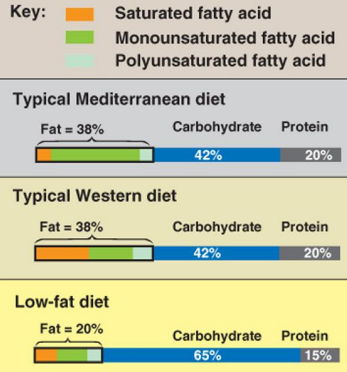
Compared to Western diet, the health effects of this diet are:
↓ Total cholesterol
↓ LDL
↓ TAG
↑ HDL
Dietary proteins
They provide amino acids and are the major source of nitrogen. Protein requirements can be determined by measuring nitrogen balance, which is the difference between nitrogen intake and nitrogenous compounds’ output (urea in urine, feces, sweat).
Protein (g) = Nitrogen (g) × 6.25
(Protein ≈ 16% nitrogen)
Calculation of nitrogen balance:
N balance= Protein(g)/6.25 - (UUN+4)
Types of Nitrogen Balance
Type | Definition | When Seen |
|---|---|---|
Nitrogen Equilibrium | Intake = Output | Healthy adults |
Positive Balance | Intake > Output | Growth, pregnancy, recovery |
Negative Balance | Output > Intake | Illness, burns, trauma, malnutrition |
Average Daily Protein Requirement
Adults require 0.66 g/kg/day
High protein intake does NOT create a positive nitrogen balance. It increases both protein synthesis and breakdown (protein turnover). The protein catabolism is ATP costly and increases diet-induced thermogenesis.
Consumption of excess protein
Shows no physiologic advantage. The metabolic fate of excess protein consumed is:
Deamination of excess amino acids—→ Carbon skeleton metabolized into→ energy or acetyl coA for fat synthesis.
Health Risks:
Loss of urinary nitrogen—→ ↑ Urinary calcium loss—→ ↑ Kidney stones (nephrolithiasis)—→ ↑ Osteoporosis risk
Protein-sparing effect of carbohydrates
Low Carbohydrate Intake (<130 g/day) —→ Gluconeogenesis from amino acids—→ Muscle protein breakdown.
Thus, adequate carbohydrate intake is protein sparing.
Protein Quality: Animal vs Plant
Protein quality refers to its ability to provide essential amino acids (EAAs).
Animal Proteins (Complete proteins)
In meat, fish, egg, milk.
They:
Contain all EAAs
Have high biological value
Easily digested
Exception: Gelatin (low biological value)
Plant proteins (Incomplete proteins)
They:
Deficient in one or more EAAs
Have lower biological value
Thus, require complementary proteins:
Example:
Wheat (low lysine, high methionine)
Beans (low methionine, high lysine)
→ Together = High-quality protein
Protein-Energy Malnutrition (PEM)
In developed countries: most commonly seen in patients with medical conditions that cause malabsorption or cases of injury, trauma, infections. The patients become highly catabolic.
In developing countries: inadequate intake of protein and/or calories is the primary cause of PEM. It’s where the two severe PEM forms occur.
Effects
Weak immunity
Increased infections
Growth failure
Severe forms of PEM include:
Feature | Kwashiorkor | Marasmus |
|---|---|---|
Main Deficiency | Protein > Calories | Calories > Protein |
Age | After weaning (~1 year) | <1 year |
Edema | Present (due to low albumin) | Absent |
Body Appearance | Edematous, fatty liver | Severe wasting (emaciation) |
Muscle Loss | Masked by edema | Severe muscle wasting |
Adaptation | Non-adapted malnutrition | Adapted malnutrition |
Balanced Diet & Meal Composition
A balanced diet can be defined as one that contains a variety of foods in quantities and proportions which adequately fulfil an individual’s needs.
The body requires >40 different nutrients
Needs vary by:
Age
Gender
Lifestyle
Health condition
The United States Department of Agriculture (USDA) has designed a food
guide called MyPlate for providing nutritional advice. It’s a food-group based guidance (not nutrient-based like RDA). Region and culture specific. Focused on balanced food portions.