World History unit 3
🗺 Unit 3: Land-Based Empires
Brief Overview:
Unit 3 explores the rise of powerful land-based empires between 1450 and 1750, when gunpowder and centralized governments transformed global power structures. This period saw European states emerge as major forces while Islamic gunpowder empires, African kingdoms, and East Asian dynasties competed for dominance across interconnected continents.
📜 Major European Developments (300‑Year Overview)
Political: Shift from feudal fragmentation to centralized nation‑states.
Economic: Rise of a merchant middle class, expansion of global trade routes, and the birth of capitalist enterprises.
Cultural: Four intertwined revolutions (Renaissance, Protestant Reformation, Scientific Revolution, Enlightenment) that reshaped self‑identity, authority, and worldview.
Geopolitical: European powers competed for faster trade routes, colonial possessions, and key resources, eventually eclipsing Asian land‑based empires and the declining American empires.
🎨 The Renaissance: Rediscovering Classical Civilization
Humanism – A cultural movement that placed human achievement, individual potential, and secular concerns at the center of art, literature, and philosophy.
Economic backdrop: Post‑Black Death population growth spurred demand for goods; a burgeoning middle class financed the study of antiquity.
Artistic revival: Patrons such as the Medici funded masters like Michelangelo, Leonardo da Vinci, and Brunelleschi, who emphasized realistic anatomy, perspective, and chiaroscuro.
Printing boom: Gutenberg’s movable‑type press (mid‑1400s) democratized knowledge, allowing books in vernacular languages and fueling literacy.
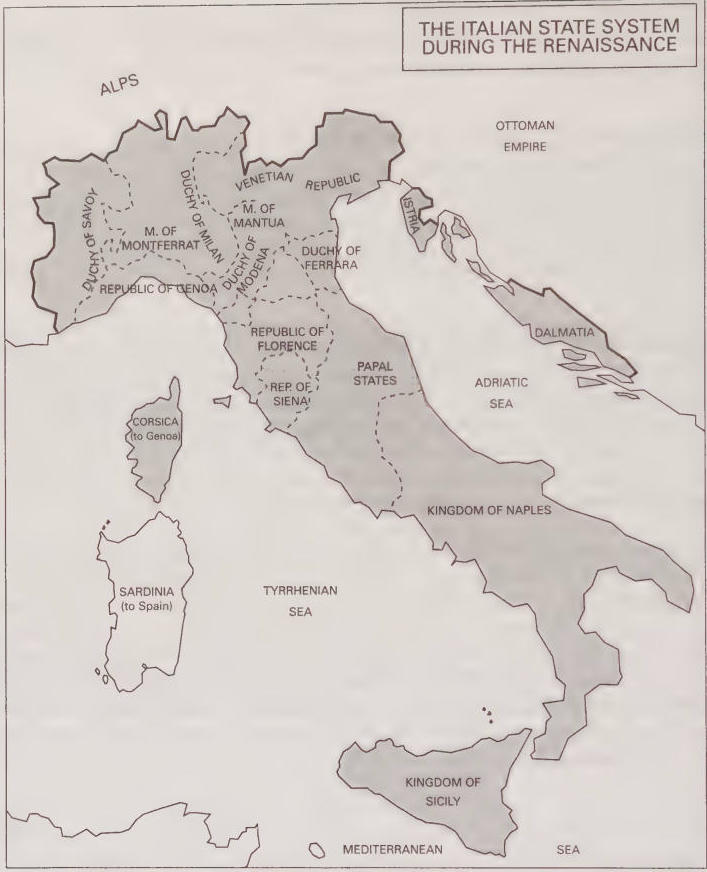
The map illustrates the fragmented Italian city‑states (Florence, Venice, Milan, etc.) whose rivalries created a fertile environment for patronage of the arts and humanist scholarship.
✝ The Protestant Reformation: Redefining Salvation
Indulgence – A papal document that, for a price, reduced a soul’s time in purgatory; widely seen as a corrupt revenue source.
Key grievances: Sale of indulgences, Latin‑only liturgy, papal overreach.
Martin Luther (1517): Posted 95 Theses; translated the Bible into German; asserted sola fide (salvation by faith alone).
Spread: The printing press accelerated distribution; Luther was excommunicated but gained protection from local nobles.
Offshoots:
Lutheranism (Germany, Scandinavia)
Calvinism (Switzerland, Scotland, parts of France) – doctrine of predestination.
Anglicanism (England) – Henry VIII’s break with Rome over annulment.
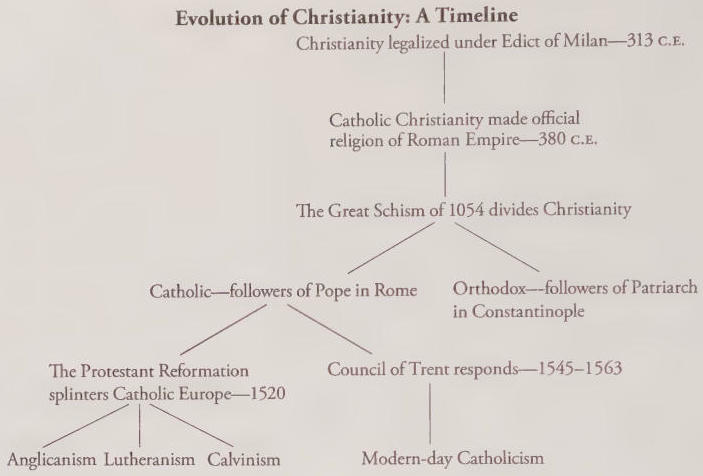
This timeline shows the major splits—from the 313 Edict of Milan to the 1520 Reformation—highlighting how doctrinal disputes reshaped the religious map of Europe.
Counter‑Reformation: Council of Trent (1545‑1563) reasserted papal authority, banned indulgences, and launched the Jesuit order (Ignatius Loyola) to revitalize Catholic education and missionary work.
🔭 The Scientific Revolution: From Authority to Evidence
Scientific method – A systematic process of observation, hypothesis, experimentation, and mathematical verification used to test natural phenomena.
Copernican heliocentrism (1543): Proposed a sun‑centered solar system, challenging Ptolemaic geocentrism.
Galileo’s telescopic discoveries (1610s): Moons of Jupiter, lunar craters, sunspots; published Dialogue (1632) in Italian to reach a broad audience.
Institutional pushback: The Catholic Church tried Galileo for heresy; his works remained banned until 1822.
Key contributors & milestones:
Scholar | Contribution | Date |
|---|---|---|
Tycho Brahe | Precise planetary observations (observatory on Hven) | 1576‑1601 |
Johannes Kepler | Laws of planetary motion (elliptical orbits) | 1609‑1619 |
Francis Bacon | Inductive reasoning, empirical methodology | 1620 |
Isaac Newton | Calculus, law of universal gravitation | 1687 |
Impact: Shifted intellectual authority from scripture to nature, paving the way for deism, the Enlightenment, and eventually the Industrial Revolution.
🏰 European Rivals and Empire Building
🇪🇸 Spain & Portugal
Spain: Unified under Ferdinand & Isabella (1469); financed Columbus (1492) and built a global empire; later overextended, leading to fiscal strain.
Portugal: Focused on African coast, Indian Ocean, and Spice Islands; acted as “middleman” in the early Atlantic slave trade; lost many holdings to the Dutch and British.
🏴 England
Henry VIII (1509‑1547): Established the Church of England (Act of Supremacy, 1534).
Elizabeth I (1558‑1603): Golden Age—arts, exploration (Drake, Roanoke), defeat of the Spanish Armada (1588).
Civil War & Commonwealth (1642‑1660): Roundheads vs. Cavaliers; Oliver Cromwell as Lord Protector.
Glorious Revolution (1688): William & Mary accepted the English Bill of Rights, cementing constitutional monarchy.
🇫🇷 France
Bourbon centralization: Cardinal Richelieu & Mazarin strengthened royal bureaucracy.
Louis XIV (1643‑1715): “Sun King,” absolutist ruler; built Versailles; revoked Edict of Nantes (1685).
Mercantilism: Colbert’s policies aimed to enlarge the French overseas empire, leading to frequent wars (e.g., War of Spanish Succession, 1701‑1714).
🇩🇪 Holy Roman Empire & German States
Fragmented polity: Numerous autonomous city‑states and principalities; weak imperial authority.
Thirty Years’ War (1618‑1648): Devastated the region (≈ 1/3 population loss); Peace of Westphalia affirmed state sovereignty and set the stage for the rise of Prussia.
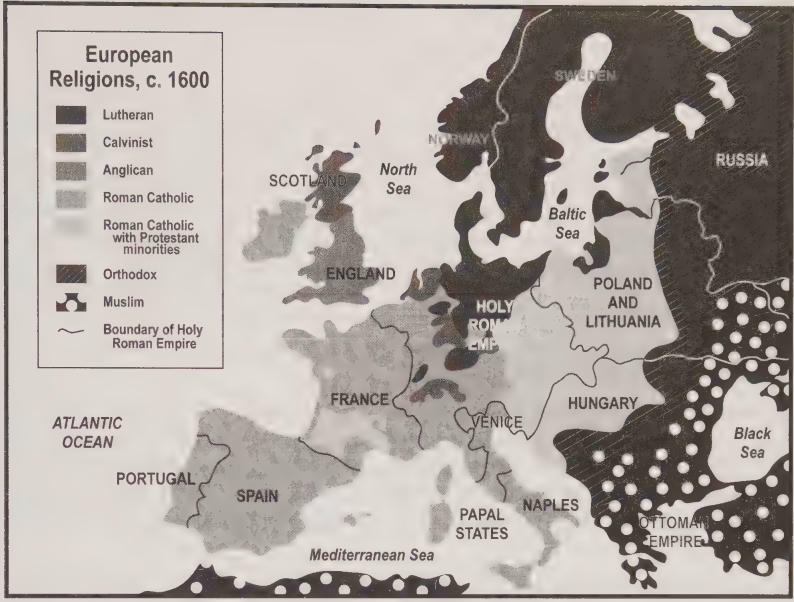
The map visualizes the patchwork of confessions—Lutheran, Calvinist, Anglican, Catholic, Orthodox, Muslim—highlighting the sectarian landscape that fueled wars and alliances.
🇷🇺 Russia
Ivan III & Ivan IV (the Terrible): Ended Mongol tribute, centralized autocracy, expanded eastward with Cossack colonists.
Time of Troubles (1604‑1613): Dynastic crisis resolved by the Romanov dynasty (Michael Romanov, 1613).
Peter the Great (1682‑1725): Westernization—navy, St. Petersburg, reforms of dress and administration.
Catherine the Great (1762‑1796): Continued westernization, territorial gains (Poland, Black Sea), but reinforced serfdom.
🕌 Islamic Gunpowder Empires
1. Ottoman Empire
Rise: Osman Bey founded the state; captured Constantinople (1453), renamed it Istanbul.
Administrative system: Timar land grants to military elites; relative religious tolerance for Christians and Jews.
Military innovation: Janissary corps (devshirme system).
Peak under Suleiman the Magnificent (1520‑1566): Cultural flourishing, expansion into Hungary, siege of Vienna (1529) – the high-water mark of Ottoman power.
2. Safavid Empire (Shia Persia)
Founded: 1501; rival to the Sunni Ottomans.
Religious policy: State‑endorsed Shia Islam, creating a lasting sectarian divide in the region.
3. Mughal Empire (India)
Founder: Babur (1526) – Genghis‑Khan lineage, Muslim ruler.
Akbar (1556‑1605): Religious tolerance, abolition of the jizya, promotion of arts (Taj Mahal under Shah Jahan).
Aurangzeb (1658‑1707): Re‑imposed orthodox Islam, reviving jizya and expanding militarily, setting the stage for later colonial penetration.
🌍 Africa: State Formation and the Slave Trade
Songhai (c. 1464‑1493): Controlled Niger River trade; fell to Moroccan musketeers.
Asante (1670‑): Gold‑rich, militarily organized kingdom that resisted European incursions.
Kongo (late‑15th c.): Early conversion to Catholicism; later destabilized by Portuguese demand for slaves.
Angola & Queen Nzinga (1645‑1663): Skilled diplomat and military leader who resisted Portuguese domination for decades.
🏯 East Asia: Isolation vs. Expansion
1. China (Ming → Qing)
Ming (1368‑1644): Restored Han rule, built massive fleets (Zheng He) that sailed to East Africa; later turned inward, halted naval expeditions.
Economic strain: Inflation from influx of New World silver; internal rebellions.
Qing takeover (1644): Manchu dynasty adopted Confucian bureaucracy, expanded into Taiwan, Mongolia, Tibet, and Central Asia while restricting foreign trade (Canton System).
2. Japan (Tokugawa Shogunate)
Early contact: Portuguese trade (1542) introduced firearms and Christianity.
Tokugawa Ieyasu (1600): Established a rigid class hierarchy (samurai, farmers, artisans, merchants) and the sakoku (national seclusion) policy (1635‑1853), effectively closing Japan to most foreign influence for two centuries.
✊ Resistance Movements
Rebellion | Region | Years | Primary Opponent |
|---|---|---|---|
Ana Nzinga’s Ambundu | Angola | 1641‑1671 | Portugal |
Cossack Revolts | Ukrainian steppes | 17th‑18th c. | Russian Empire |
Haitian Slave Revolt | Saint‑Domingue | 1791‑1804 | France |
Maratha Resistance | India | 1680‑1707 | Mughal Empire |
Maroon Societies | Brazil & Caribbean | 17th‑18th c. | Portuguese/Spanish colonists |
Metacom’s War | New England | 1675‑1678 | British colonists |
Pueblo Revolt | New Mexico | 1680 | Spanish colonizers |
These uprisings illustrate how local populations challenged expanding imperial powers, often reshaping colonial policies and, in some cases, achieving autonomy.