Permit Test Notes
A flashing yellow light means slow down and proceed with caution. Flashing yellow lights are at locations with higher-than-normal hazardous conditions.
Lane-use signals indicate lanes where you can and cannot drive during different hours of the day.
A flashing red light means come to a complete stop and yield to oncoming vehicles and pedestrians. When the way is clear, you may go. At a railroad crossing, you must come to a complete stop even if you don’t see a train.
Before turning on a red light you must come to a complete stop.
Traffic Signs
Sign Colors and their meanings:
- Red w/ white conveys stop, yield, do not, and no.
- Black w/ white conveys regulatory information. Speed limit, do not pass, and no turns are examples where the operation is regulated by law, and where the black and white sign would be found.
- Yellow w/ black conveys a warning. Curve ahead, stop ahead, overhead clearances, and slippery when wet are all examples of warning signs. Optic yellow signs advise of school zone, pedestrian, and/or bicyclist activities.
- Green/Blue/Brown with White signs are used to provide helpful information. Green for Destination information (Cities and distances), Blue for Motorist services (311 signs, etc.) and Brown for cultural, historical, and recreational areas e.g. Manassas Battlefield, Splashdown Waterpark
- Orange and Black = construction signs.
- Pink and Black = incident signs
Sign Shapes and their meanings
- Octagon represents Stop.
- Triangle represents Yield.
- Rectangle represents Regulatory or Guide signs, with Vertical signs tending to be Regulatory/Instructional, and Horizontal signs tending to be Directional/Informational.
- Diamond signs represent a Warning
- Pentagon signs represent School warnings
Regulatory Signs
- Red circle with slash = NO
- Speed limit signs tell you the max legal speed you can drive on a road with good weather. During rain, snow, and ice, you can drive at the posted the speed and still get a ticket because it is unsafe to drive that fast in those conditions\
- Do Not Enter or Wrong Way signs mean DON’T DRIVE IN THIS DIRECTION (or you might crash)
- One way signs tell you traffic only flows in the direction of the arrow.
- No Left Turn signs tell you where left turns are against the law.
- U-turns are also illegal at these signs because they count as double left turns in Virginia
- No Right Turn signs tell you where right turns are against the law.
- No U-Turn signs tell you where U-turns are illegal
- No Turn on Red signs tell you where you can’t make turns while the light is red. You must wait for the signal to turn green before you can make a turn.
- Do Not Pass signs mark the beginning of a no passing zone, where you may not pass cars ahead of you in your lane, even if the way is clear.
- Left Turn Yield on Green signs are used with a traffic signal (usually next to the one for the left turn lane[s]) to tell you that the traffic turning left at a green light DOES NOT have the right-of-way and must YIELD TO TRAFFIC coming from the other direction. What you need to do is Stop and look for oncoming traffic, then proceed with caution
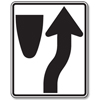
- Keep Right signs look like this and convey that a traffic island, median, or barrier is ahead and that the driver must keep to the side indicated by the arrow, in this case THE RIGHT
- Lane Use Control signs are used where turns are required or where special turning movements are permitted for specific lanes. Traffic in the lane must turn in the direction of the arrow.
- High Occupancy Vehicle signs indicate lanes reserved for buses and vehicles with a driver and 1 or more passengers (specified on the sign)
- Disabled Parking (I know these as handicapped) are reserved for people with disabled parking permits
- Advisory Speed signs indincate the maximum safe speed for a highway exit, small rectangle saying EXIT with square with speed limited below it
- Reduced Speed Limit Ahead is a diamond with an up arrow and a speed limit sign in the middle letting the driver know that the speed limit is changing ahead.
- Stop Ahead/Yield Ahead signs have an up arrow and the corresponding sign below it. They mean you must slow down and be ready to stop.
- Signal Ahead signs warn that traffic signals are ahead. They mean you should slow down and be ready to stop.
- No Passing Zone signs can apparently be yellow triangles as well
- Merge signs look like an up arrow with a curved line coming in from the sign, and they mean that drivers in both lanes are responsible for merging safely, as both lanes of traffic moving in the same direction are about to become one.
- Lane Reduction signs show that the right lane ends soon and that drivers in the right lane must merge left when space opens up, while drivers in the left lane should allow other vehicles to merge smoothly.
- Divided Highway Begins signs look like this
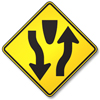 and mean that the highway ahead is split into two separate roadways by a median or divider, and that each roadway is one-way. They tell the driver to keep right.
 - Divided Highway Ends signs look like the one from above but flipped, and they mean that the highway does not have a median or divider ahead: Traffic ahead goes in both directions instead of two separate one-way roadways. They tell the driver to keep right.
- Roundabout signs are a circle of counter-clockwise arrows. They indicate that a circular intersection with an island in the center known as a roundabout or traffic circle is ahead. A driver should know that traffic entering the roundabout must yield the right-of-way to traffic already in the circle.
- Slippery When Wet signs indicate that drivers should reduce their speed when pavement is wet, and should not brake hard or change direction suddenly. Additionally, drivers should increase the distance between their car and the one ahead of them
- Low Clearance signs tell the driver that the overpass they’re about to drive under has low clearance aka their vehicle needs to be below the posted height or they can’t drive under it.
- A hill sign tells you that the road ahead is steep and that you should check your brakes.
- Bicycle signs tell drivers that bicycles regularly cross or ride next to traffic in the are and to drive with caution.
- Open Joint signs tell motorists to slow down as there are open joints on the bridge or ramp that might cause a motorcyclist to lose control of their motorcycle
- Expansion Joint signs tell motorists that joints across lanes create a bump, or are wide enough to cause loss of traction in wet weather
- Intersection signs look like tetris pieces and tell motorists that an intersection is ahead and to be alert for vehicles entering the road on which they travel.
- Y intersection signs tell the motorist that they must turn right or left at the fork. THEY ARE CALLED Y-Intersections
- T Intersection signs tell the motorist that the roadway they are driving on ends ahead at a stop sign, and that they must turn left or right AFTER yielding to oncoming traffic and pedestrians.
- Right Curve - Side Road signs signal that the road ahead curves right, and that a side road joins from the left within the curve. A motorist must be alert for vehicles entering the roadway they are traveling on.
- Sharp Right Turn signs indicate to the driver that they must slow down and be prepared for a sharp right turn in the road ahead.
- Sharp Right and Left Turns signs tell the the driver to slow down, be prepared for the road ahead to turn sharply right, then turn sharply left.
- Right and Left Curves signs tell the driver that the road ahead curves right, then left, and to slow down to properly drive through the curves.
- Right Curve with Safe Speed Indicator signs tell the driver to slow down to the safe speed indicated in order to drive through the road ahead which curves right.
- Winding Road signs signify that the road ahead has a lot of turns and curves and that the driver should slow down at the curves to better control their vehicle.
- Low Ground Railroad Crossing signs signify that a steep slope where railroad tracks cross the road can cause the bottom of low vehicles to get caught or drag on the tracks
- Railroad Crossing signs (yellow circle w/ black cross and two Rs on the left and right) warn you to watch out for trains and prepare to stop if you hear/see any signs of them
- Railroad Crossbuck signs mean the same thing but are shaped differently
- There is a version with flashing lights STOP IF THE LIGHTS ARE FLASHING
- and a version with the crossbuck, flashing lights, and gate
- There are orange signs used when certain road conditions e.g. loose gravel, road construction affect the roadway surface and create potentially difficult conditions for motorists. Examples include ROUGH ROAD, BUMP, and UNEVEN LANES
- Road Construction Ahead signs indicate a change in the traffic pattern or route ahead, and that unusual or potentially dangerous conditions are ahead. Drivers must slow down.
Pavement markings
- Red markings = no parking zones but they are rarely used
- Red reflectors on pavement show areas not to be entered or used, positioned so that only traffic flowing in the WRONG DIRECTION would obeserve them.
- if there are no markings on a two lane road, you may pass a slow moving vehicle on the left side if there are no signs prohibiting passing.
- You may cross double solid yellow lines to make a left turn.
This is the only thing you may cross the lines for.