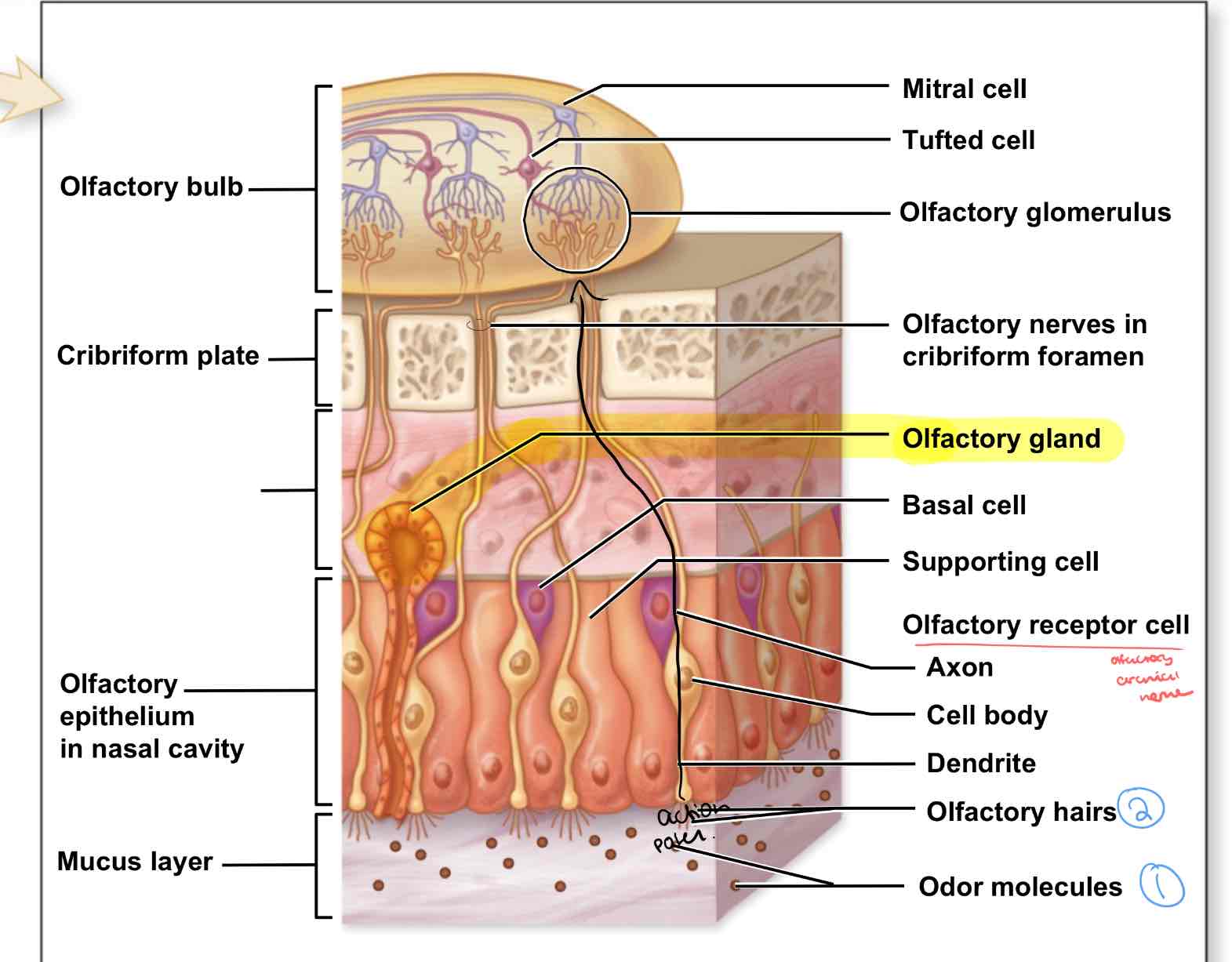
Olfaction
1. Introduction to Olfactory Sensory Mechanisms
The sense of smell (olfaction) begins when odor molecules (odorants) enter the nose and interact with specialized cells in the olfactory system. This process involves the following steps:
Olfactory Mucus Layer: Odorants must first dissolve in the mucus layer lining the nasal cavity to be detected. Without this mucus, smell would not be possible because the odorants need to be in a dissolved form to bind to receptors.
2. Olfactory Receptor Cells and Olfactory Hairs
Olfactory Receptor Cells: These are specialized neurons responsible for detecting smells. They are bipolar neurons that have extensions called olfactory hairs (or cilia), which project into the mucus layer. These hairs are not "hair" in the traditional sense but are actually cell extensions that interact with the odorants.
Olfactory Hairs: The extensions of the olfactory receptor cells that contain G-protein coupled receptors (GPCRs), which are sensitive to odorants. These receptors play a crucial role in the detection process.
3. Binding of Odorants to Receptors
Step 1: Odorants Bind to Olfactory Receptors: The process begins when odorants (odor molecules) bind to G-protein-coupled receptors (GPCRs) located on the olfactory hairs. These receptors are highly specific to different types of odorants.
Step 2: GPCR Activation: When an odorant binds to its specific receptor, the GPCR is activated. This leads to a cascade of intracellular events, involving the activation of a G-protein within the olfactory receptor cell. The alpha subunit of the G-protein is responsible for triggering further processes inside the cell.
4. Signal Transduction and Action Potential Generation
Step 3: Activation of Ion Channels: The G-protein's alpha subunit activates ion channels in the olfactory receptor cell membrane. This causes an influx of ions (e.g., sodium and calcium), leading to depolarization of the receptor cell.
Step 4: Depolarization and Action Potential: The depolarization of the olfactory receptor cell triggers the generation of an action potential, which is an electrical signal that travels along the olfactory nerve. This action potential is what ultimately carries the olfactory signal to the brain.
5. Transmission of Olfactory Signal to the Olfactory Bulb
Step 5: Signal Travels to the Olfactory Bulb: The action potential travels up the olfactory receptor cell's axon and reaches the olfactory bulb, a structure located at the base of the brain. The olfactory bulb acts as a relay station for olfactory information.
Neurotransmitter Release: At the synapse between the olfactory receptor cells and the neurons in the olfactory bulb (called mitral and tufted cells), neurotransmitters are released. This occurs through the opening of voltage-gated calcium channels at the synaptic terminals. Calcium ions enter the neuron, triggering the release of neurotransmitters that activate the mitral and tufted cells.
6. Processing in the Olfactory Bulb
Step 6: Glomeruli and Odor Patterns: The olfactory bulb contains structures called glomeruli, which are clusters of synapses where olfactory receptor cells converge. Each glomerulus is activated by a specific pattern of receptor cell activity, depending on which odorants bind to the receptors.
Pattern Coding: The pattern of glomeruli that are activated determines the perception of different smells. For instance, the activation of glomeruli 1 and 200 might represent one scent, while activation of glomeruli 2, 5, 10, and 1000 could represent another. This pattern coding is essential for distinguishing between a wide variety of smells.
7. Propagation of Olfactory Signals to the Brain
Step 7: Mitral and Tufted Cells: These neurons in the olfactory bulb receive neurotransmitters from the olfactory receptor cells. They have receptors that bind the neurotransmitters, causing depolarization and the generation of action potentials.
Transmission to the Brain: The action potentials from mitral and tufted cells travel along their axons to various regions of the brain for further processing.
8. Olfactory Processing in the Brain
Once the action potentials from mitral and tufted cells reach the brain, the olfactory signals are processed in different regions:
Primary Olfactory Cortex: This region is responsible for the conscious perception of smell. It allows you to recognize and become aware of specific odors.
Hypothalamus: The hypothalamus is involved in visceral responses to smells, such as the sensation of hunger or nausea. It processes smells that may trigger bodily responses without conscious awareness (e.g., a smell making your stomach growl).
Amygdala: The amygdala is part of the limbic system, which is associated with emotion and memory. Smells can trigger strong emotional responses and vivid memories, as certain scents are often tied to past experiences.
9. Summary of the Olfactory Process
Odorants dissolve in the mucus layer of the nasal cavity.
Olfactory receptor cells (bipolar neurons) have olfactory hairs that contain GPCRs.
Odorants bind to GPCRs, activating the receptor and triggering a G-protein signaling cascade.
The G-protein causes ion channels to open, leading to depolarization of the cell and the generation of an action potential.
The action potential travels along the olfactory nerve to the olfactory bulb.
In the olfactory bulb, neurotransmitters are released, and the signal is passed to mitral and tufted cells.
These cells propagate the signal to the brain, where the information is sent to the primary olfactory cortex, hypothalamus, and amygdala.
The pattern of activated glomeruli encodes the information for specific smells.
10. Key Concepts to Remember
Olfaction requires the mucus layer for odorants to dissolve.
GPCRs on the olfactory hairs are activated by specific odorants, triggering a G-protein signaling cascade.
Ion channels open, leading to depolarization and the generation of action potentials in the olfactory receptor cells.
Glomeruli patterns in the olfactory bulb encode different smells.
The signal is processed by the primary olfactory cortex (conscious perception), hypothalamus (visceral response), and amygdala (emotion and memory).