Federalism
Federalism is a system of government in which power is divided between a central authority and constituent political units, allowing for a balance of governance that respects regional autonomy while ensuring national unity.
Examples of Federalism of state rights:
- The 10th Amendment: Printz v. United States (1997)- Supreme court struck this down because the government cannot “commandeer” state officials to carry out federal laws.
The Role of Local Governments: Home Rule Amendments in various states
Examples of Supremacy Clause
McCulloch v. Maryland (1819)
Ogden v. Gibbons
Examples of 14th amendment:
Civil rights act (1965)
Voting Rights Act (1965)
Americans with Disability act (1990)

Responsibility of National Government:
Conducts Foreign Policy- This manages the united states relationships with other countries.
Regulate Commerce- Manages businesses and trade.
Provides for the common defense overseas the armed forces
Responsibility of the State Government:
Promotes Public Health- Manages the flu, outbreaks, pandemics and more.
Promotes Public Safety- Oversees fire departments, emergency services, and law enforcement agencies to ensure community safety and emergency responsiveness.
Promotes Public Welfare

Provides social services including housing assistance, food programs, and mental health support to improve the quality of life for citizens.
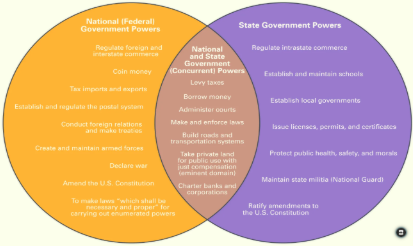
Powers:
Federal powers: Establishing national standards for social services, coordinating across state lines, and providing funding for state and local welfare programs.
Enumerated/ Expressed: Granted by national government
Exclusive Power-
Inherent Powers- Sovereignty and implied powers (Louisiana Purchase)
Prohibited (limited power)
Concurrent Powers: Shared by both national and state governments, such as the power to tax and establish courts.