CH 3
Prokaryotes have no nuclei and histones. Cell wall contain peptidogylcan, lack emebran bound organells. The cell wall provides sahpe, support, and resistance to osmotic pressure. Its strength and rigidity is due to peptidoglycan.
Sturcture of bacteria cell
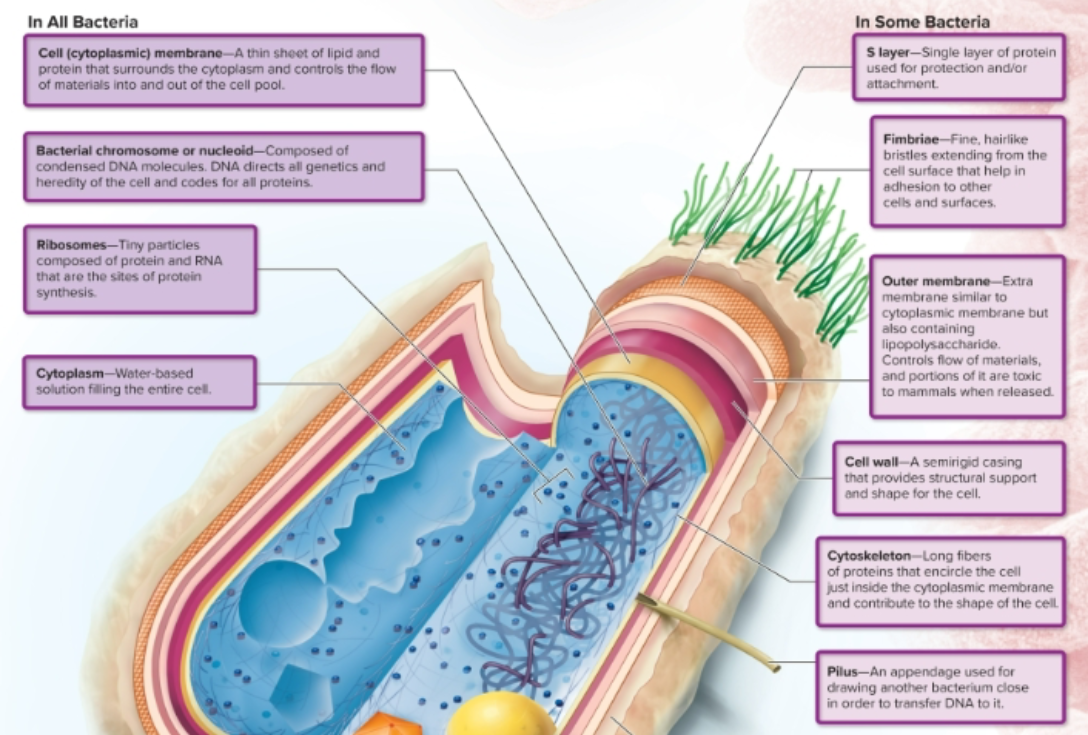
Cytoplasmic membrane - to form a barrier between the internal and external contents of the cell. So it acts as a selective barrier. Also provides a site for nutrient processing, and site for energy reactions.
Cytoplasm fluid metrix - allows metabolic to occur, all the fluid inside the cell, and hold things. Makes up 70-80% of the internal gelatinous solution
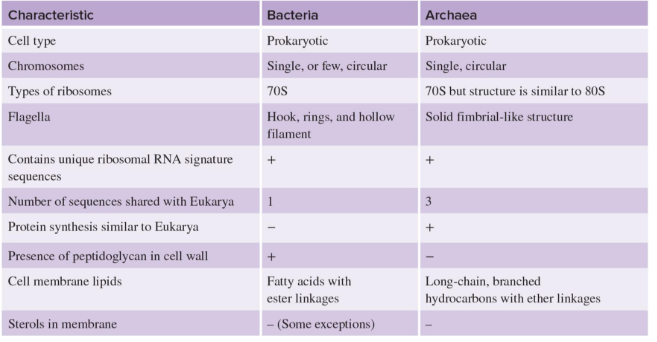
Ribosomes - responsible for protein synthesis. Density of it in bacteria is 70s. Fromed by protein and RNA. Bacterial ribosomes are different from eukaryotic ribosomes bc the ribosome inhibtors as antibiotics without interfering with oen protein synthesis. Eukaryotic ribosomes have 80s density. Archaela ribsome has similar structure to eukaryotic ribsome. Eukarya
Cytoskeleton - give structor in the inside of the cell
One/few chromosones- nucleoid region w/dna
Most bacteria cells possess
Cell wall
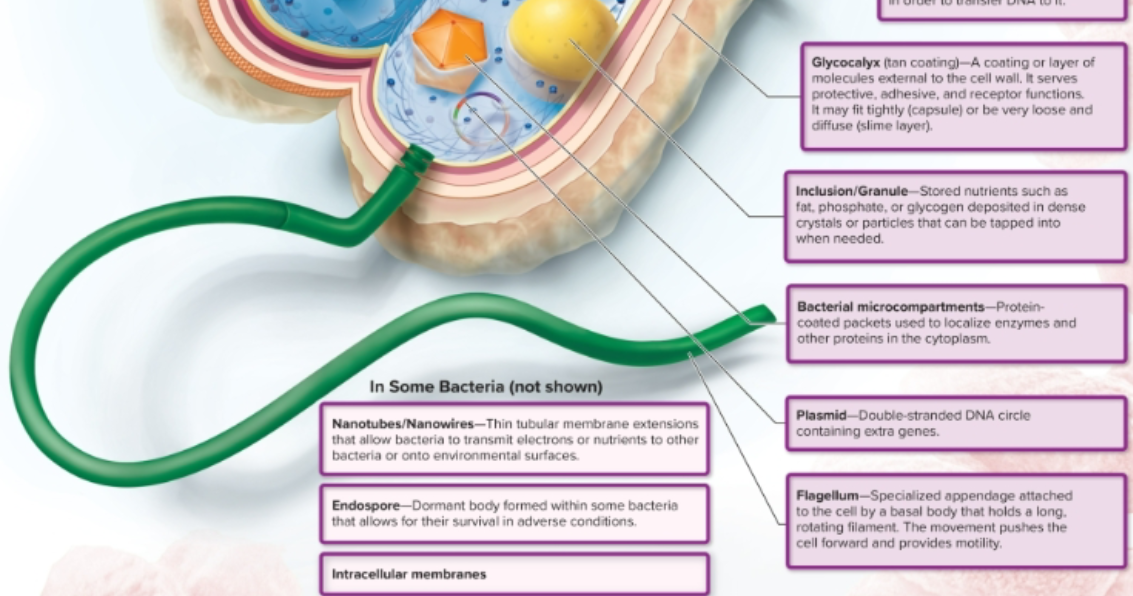
Surface coating called glycocalyx (SOME)
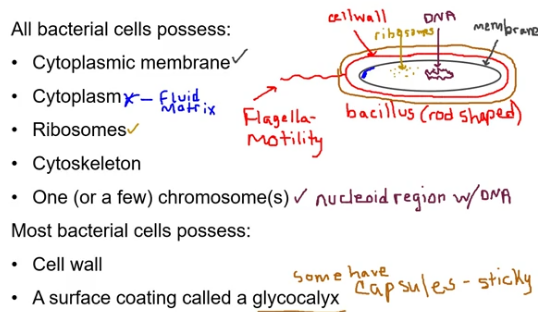
All cells have DNA
Flagella-motlity
Capsules-stickyy
Some but not all bacterial cells possess
Flagella, pili, and fimbriae
Plasmids
Endospors
pilis is a way to pass on infromation conjuncntion
fimbrami-
Bacterial structure for adhesion: Fimbriae, capsole
Pleomorphism some cells dont have strucure cell wall
Staph-cluster coccus
Strept-chain
Tetrads-four
Diplo-pair
Flagella some migh have this but NOT all prokaryotes have this
Ribosomes, cell membrane, one or more chromosone ALL prokaryotes have this
Arrangement of Flagella
Mono
Lopho
Amphi
Peritichouse
Chemotaxis: movement of bacteria in response to chemical
All of theses bacterial appendages ARE used for attchment: Slime layer, pilus, fimbriae
This bacterial appendage is NOT used for attachment: Flagellum *this is for momvement)
Cell envolope is talking about the cell wall and membrane
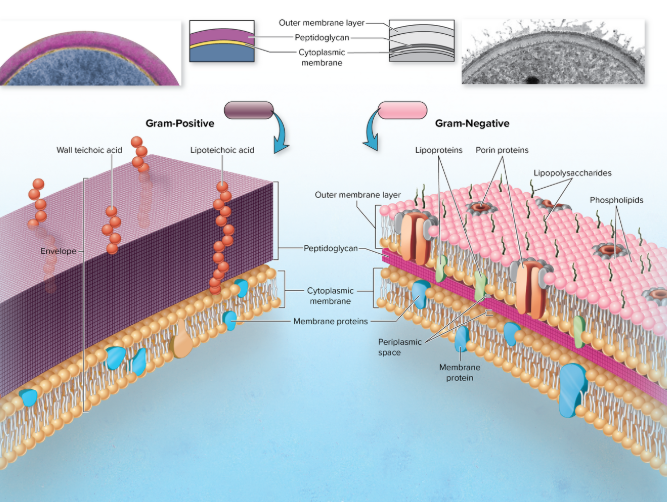
Gram postive (p for purple) and have more peptidoglycon is thick (cell wall). NO outer membrane
Lipotechoic acid is an endotoxin which causes an alrm in our system to alret the immune system this lipotechoic acid is found in gram postive cell.
Telchoic acids and lipoteichoic acids are linear carbohydrates that bind within the peptidoglycan and also anchor the peptidoglycan to the cytoplasmic membrane. They also contribute to charge of cell surface, maintenance of cell wall, enlargment of cell wall during cell division.
Gram negative redish/pink. EXTRA membrane, thin layer of peptidoglycon (cell wall). LPS is an endotoxin which is of complexed sugars. More difficulot for antibiotics. The outer membrane is a phospholipid bilayer that from the most exterior layer in gram negative bacteria. ONLY have outer membrane.
Space between the cytoplasmic membrane and the outer membrane is the periplasm.
Besides phopholipids, the outer membrane of a gram negative cell wall contain lipopolysaccharides that function as antigens and receptors and lipoproteins that anchor the phospholipids into the peptidoglycan layer.
The lipid portion of lipopolysaccharide is known as endotoxin because it can cause fever and shock.
Gram negative bacteria are more impervious to action of antimicrobial chemicals because they have an outer membrane
Cell wall
Acid fast bacteria has mycolic acid
mycoplams
No cell wall
transport
plamsa membrane regulates what comes in and out thats way its also call something
Most critical step of gram stain technique deoclorization with alcohol
Examples
Eukaryotes have a true nucleus while bactiera and Archaea do not. Eukarhyotes have organeels while, bacteria and archaea do not.
Eukaryotic cell DNA is contained in the nucelus, membranes and porse protect and allow access to DNA inside. Have organells which are membrane bound compatments iside the cell membrane.
Bacteria and Archaea do NOT have a nucleus, DNA in cell membrane. Do NOT have organelles.
Both eukaryotes and bacteria/archaea have cell membrane composed of phospholipids and proteins, and chemicial strucutre of DNA nucleotide A,C,T,G all the smae in all species.
The difference between eukaryotes and bacteria/archaea is the presence of organelles and cell wall composition.
Strucutes that ALL bacteria have: Cell membrane, chrmonsones, ribosmomes, cytoplasm, plasma membrane,cytoplasmic membrane
The folllowing are true about bacterial cells but not eukaryotic cells: Cell wall made of peptiodglycan, no membrane bound organelles within the cell, free DNA within the cell
Bacteria function as a unicellular organisms/single cell.
Mycoplasmas are pleomorphic because they do not contain a cell wall for shape. Pleomorphisms means various shapes.
Streptococci have cells arranged in chains of a few to hundrededs of cells.
Diplococci: cocci in pairs
Streptococci: cocci in long chains
Staphylococci: Clusters of coci
Tetrades: four cells
Appendage that providedes ability to attach to surfaces and other cells: Fimbriae
Appendages that provide motlility: Flagella, axial filaments
Hace one single flagellum arrangement: monotrichous
Has more than one flagellum: amphitrichous (flagella at both poles of cell), peritrichous, lophotrichous (small bunches/tufts of flagella)
Peritrichous: rnadomy over surface of cell
Semisolid is the best way to detect motlity or with handing drop slide
Chemotaxis: flagellated bacteria move in reponse to chemical signals. Postive move in direction of favorable chemical stimulus such as a nutrient while negative move away from harmful compound.
Flagelum: clusters of receptors located in the cytoplasmic membrane that bind specific molecules coming from immediate environment. Sufficient numbers of molecules transmits signals to the flagellum and set it into rotary mtion. Fuel for the flagellum : gradient of protons (hydrogen ions) generated trhough metabolicm of the bacterium and bind to and detach from parts of the flagellar motor within the cytoplasmic membrane causing the filament to rotate.
Fimbria: small brisle sibres sporouing off the sruface of many bacteria. Most contain protein. Stick to each other and other surfaces, mutual clining of cells that leads to biofilms, microbial colonization.
Pilus, protein pilin conjugation of pili are for mating process between cells which is conjugation: partial transfer of DNA from one to another.
Appendages that provide attachment points or channels: nanotubes, fimbriae, pili
Cell envolpe in most bacteria: Cell wall, cyoplasmic membrane
Peptiodglycan composed of short peptides, sugar chains
Lysis: Cell breaks or ruptures
Lysozyme is an enzyme that tears and saliva contain. It catalyzes the hydrolyzing of peptide chains in peptidoglycan.
Antibiotis of the penicillin class target the peptide corss-links in the peptidoglycan of the cell wall, causing it to disintegrate.
Steps for staining gran:
Crystal violet
Grams iodine (the mordant) causes dye to from large complexes that become traped in gram postive cell wall
alchohol
safranin
Stainint technique allows differentiation of mycobacterial cells: Acid-fast stain
Mycobacterial cell wall is reinforcesed with mycolic acid.
Purpose of mycolic acid in the mycobacterial cell wall: Reinforces cell wall and makes the bacterium resistant to certain chemicals and dyes
Mycoplasma: Bacteria that has no cell wall, but has cytoplasmic membrane that is stablized by sterols. And antibiotic penicillin is not effective against this because it does not have cell wall therefore no peptidoglycan which pencililin needs.
Cytoplasm: intracellular gelatinous solution
Nucleus is surrounded by a membrane but a nucleoid is not.
Nucleiod regions are aggregation of DNA and NOT surrounded by a membrane instead is a region of the cytoplams that contains the chromosone. The chromoson contains DNA, amlost all of theses chrmosones are cicular molecules. Most specifes have a single chromosome. The DNA is densely packed mass, its compacted and coiled by nucleoid-associated proteins which are postively charged and organize the negativley charged chrmosone.
Bacterial chromosone is a long molecule of double stranded DNA that is fromed into a circle with no loose ends.
Bacterial chromosme cosists of one circular, double stranded DNA.
Bacterial chromosone is compacted to fit into the cell by coiling around basic protein molecules.
Many bacteria hace smaller DNA molecules called plasmids that reside in the cytoplams and carry few non-essential genes.
DNA is deoxyribonucleic acid, chemical compostiion of genetic material.
Chromosone a large DNA molecule.
Gene: small segment of a chromosone that encodes a particular protein or RNA.
Genome: Complete set of DNA molecules in an organsim.
Plasmids: extrachromosomal peice of DNA that contains genes not essential for cell growth and antibiotic resistance. Spread through bacteria because the tranfer horizontally from cell to cell and vertycally in cell divtion.
Eukaryotic cells have multiple linear chrmones in the nucelous.
Viruses may have DNA or RNA genomes, have no nucleus or nucleoid. Just a genome wrapped in a protein shell.
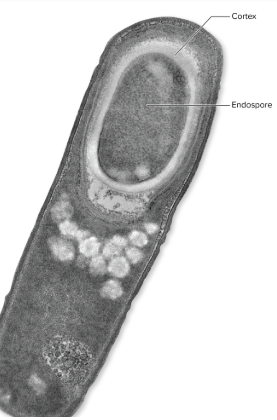
Endorspores: dormant boides prodcued by bacteria for survival rather than reporductive purposes.
Sporulation is the process of endospore fromation.
Endospores produced by bacteria in the following genera: Clostridium, bacillus, sporocarcina
Endospores are more resistant to antimicrobial agents, radiation and heat, and provides protection in dry condition.
Endospores require water, a specific chemical or environmental stimulus to germinate. Depletion of nutrients is the stimulus for fromation of endospores.
Endospores break dormancy in presence of a germination agent and water.
A vegetabtive cell: bacteria that has the ability to form endospores have a metabolically active growting cell
Food sterile and free from bacteria and endospor, steam pressurization is used.
Bacteria have peptidoglycan in cell wall.
Collection of bacterial cells, all of which chare an overall similar pattern of traits, in contrast to other groups whose patterns differ significantly is called a bacterial: Species
Diffcult to group bacteria into species because does not use a typical mode of sexual reporduction, can alter their genetic makeup, can accept genetic material from other, sometimes unrelated cells
Bacteria can hybridize, which is a charactersitic of sexually reproducing organims which rules out the prokaryotes
Archaea and eukarya domain are close related because of share RNA sequences and similar ribosomal structure.
Archaea have unique cell wall composition. Many archaea are termed extremophiles (high heat/high salt) because they are able to live in harsh environments.
Group of archaea that grows in low temperture: psychrophiles
Archea that are adapted to grow in high temperatures: hyperthermophiles.
Archea is isolated from the colon, mouth and vagina.