Cardiac Cycle
Arial Systole
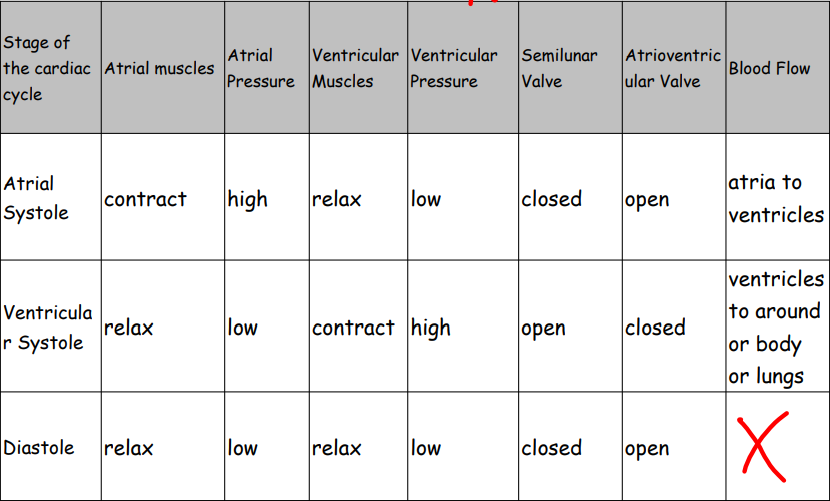
Both atria contract which forces blood from the atria into the ventricles causing them to fill.
The atrioventricular valves are open to allow blood to the fill the ventricles from the atria. The semi-lunar valves are shut to prevent the backflow of blood from the pulmonary artery and aorta into the right and left ventricles.
During atrial systole the pressure in the atria increases due to contraction of the heart muscle. After a short delay the pressure in the ventricles also increases as more blood enters the chamber.
Eventually the pressure in the ventricle exceeds that in the atria and the atrioventricular valves shut. This marks the end of atrial systole
Ventricular Systole
Both ventricles contract which forces blood from the ventricles into the arteries causing blood to leave the heart.
The semi-lunar valves are open to allow blood to leave the ventricles and enter the pulmonary artery and aorta. The atrioventricular valves are shut to prevent the backflow of blood from ventricles into the atria.
During ventricular systole the pressure in the ventricles increases due to contraction of the heart muscle. After a short delay the pressure in the aorta (and pulmonary artery) also increases as more blood enters this artery.
Eventually the pressure in the aorta (and pulmonary artery) exceeds that of the ventricles and the semi-lunar valves shut. This marks the end of ventricular systole.
Diastole
The heart muscle is relaxed during diastole to allow the passive filling of the chambers.
The atrioventricular valves are open to allow blood to fill the ventricles from the atria, and the semi-lunar valves are shut to prevent the backflow of blood from the pulmonary artery and aorta into the right and left ventricles.
During diastole the pressure in the heart is reduced due to the heart muscle being relaxed.