Sensation & Perception
Sensation & Perception
- Sensation: process by which stimulated receptors make a pattern of neural messages (brain stimuli) and makes our experience of the stimulus
- Bottom up processing (sensation): analysis of the stimulus begins with sense receptors → brain
- Perception: a mental process that gives meaning to incoming sensory patterns
- Muller-lyer illusion
- Top down processing (perception): we use our experiences to construct perceptions
- Perceptual set: mental predisposition to see one thing, not another, due to top down processing
- Cocktail party effect: shows selective attention
- Inattentional blindness
- Change blindness
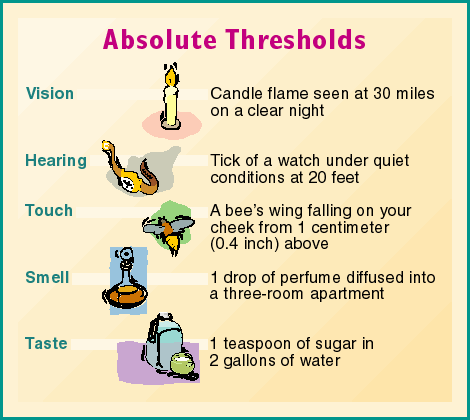
- Absolute threshold
- Subliminal threshold: you would identify it being there <50% of time
- Difference threshold: smallest amount which a stimulus can change and the difference is detected.
- AKA Just noticeable difference: minimal amount of change in the signal that is recognizable.
- Weber's law: to perceive as different 2 stimuli must differ by a constant minimum percentage
- Light intensity- 8%
- Weight- 2%
- Tone frequency- 0.3%
- Signal Detection Theory (SDT): predicts how and when we detect a faint stimuli in a background of noise
- Assumes there is no absolute threshold
- Detection depends on:
- Experience
- Expectations
- Motivation
- Fatigue
- SDT matrix: observed decides whether to heat or not, based on signal being present or not
- Subliminal messaging:
- Works by priming
- Unconsciously activating associations
- Sensory adaptation: diminished physical sensitivity as a result of constant stimulation
- We no longer receive stimuli
- Habituation: when one no longer attends to something after a long period of time
- Transduction: conversion of stimulation into a neural message
- Brain does not interact w/ world directly, sense organs do
- All senses tap into a diff form of stimulus
- All processed in own brain region
- Vision:
- Most complex
- How eye works:
- Retina takes light and makes it a neural signal
- Color:
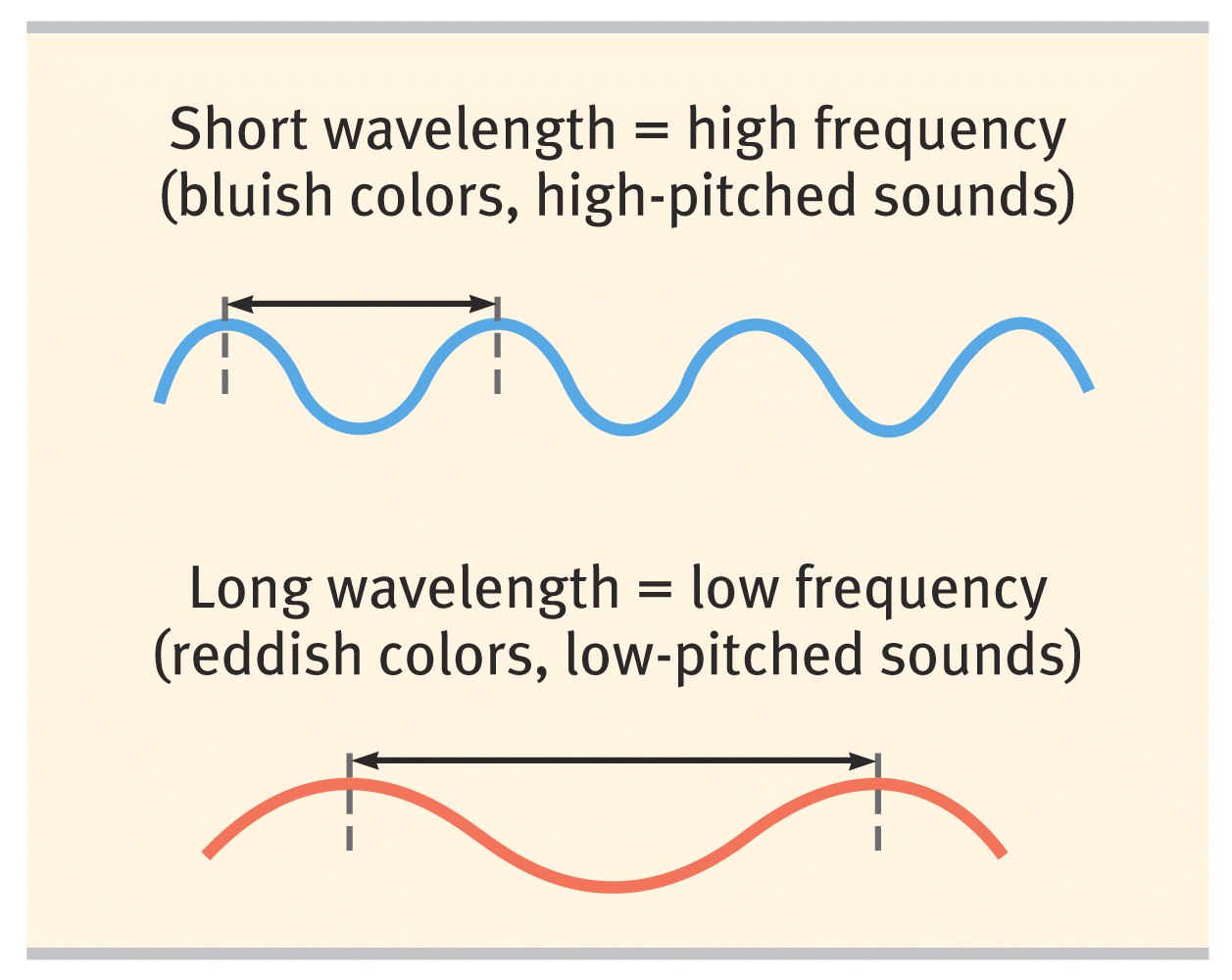
- Hue: dimension of color determined by wavelength of light
- Wavelength: distance between peak of one wavelength to next
- Intensity: brightness
- The eye:
- Cornea: outer covering of eye
- Pupil: adjustable opening in center of eye, where light enters
- Iris: ring of muscle tissue that forms colored portion of eye
- Dilates & constricts in response to changing light intensity
- Lens: behind cornea, changes shape to help focus image
- People w/ glasses: faulty lens
- Accommodation: eyes lens changes shape to focus image
- Nearsighted: nearby objects are more clear
- Farsight: far objects are more clear
- Acuity: sharpness of vision
- Retina: light sensitive inner surface, has rods & cones, layer of cells, where transduction takes place
- Blind spot: where optic nerve leaves eye, can’t see here
- Fovea: best part of vision, cones clustered
- Optic nerve: carries nerve impulses from eye to brain
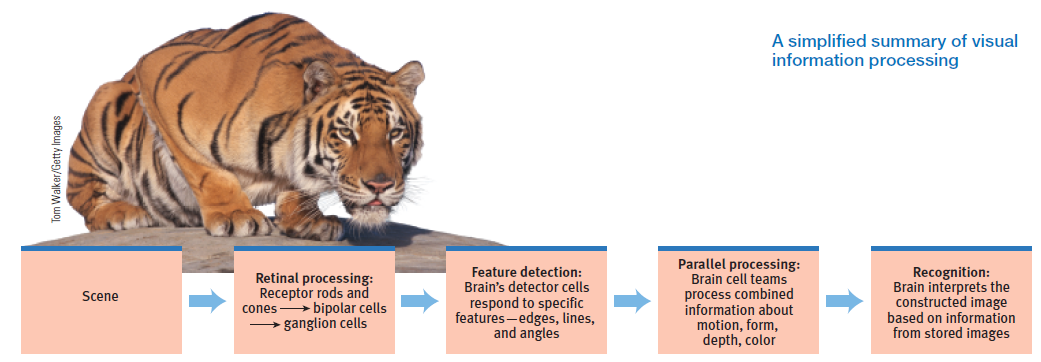
- Processing visual info
- LGN: in thalamus
- Feature detector cells: respond to specific features
- Parallel processing: all done at the same time
- Scene → parallel processing: bottom up processing
- Recognition: top down processing
- Theory of color vision:
- Trichromatic theory: retina has 3 receptors sensitive to red, blue, green
- Color blindness: ishihara test, people are blind to green & red colors
- Opponent processing: some aspects of color perception are hard to explain by trichromatic theory
- We have 4 primary colors combined in pairs
- Red-green
- Blue-yellow
- Black-white
- Green → red
- Black → white
- Yellow → blue
- Visual organization
- Gestalt (form or whole)
- Whole is more than sum of its parts
- Figure ground
- Grouping
- Group by proximity
- By continuity
- Closure
- Law of pragnanz: whatever is easiest to see us what we will see
- Depth perception
- Visual cliff
- Binocular depth cues
- Retinal disparity: 2 diff images in each eye
- Convergence: when eyes move inward, this gives depth cues that something is coming at you
- Monocular depth cues:
- Relative size: closer objects are larger
- Interposition: somethings closer
- Linear perspective: lines converge in distance
- Relative motion: objects near you seem to move quicker than far away objects
- Texture gradient: more texture when closer
- autokinetic effect - stationary beam of light is projected on a wall in an otherwise completely dark room If you stare at the dark light long enough the light appears to move
- Stroboscopic movement = flip book
- Color constancy: colors are the same, even though they look diff in diff lighting
- Brightness constancy
- Shape constancy:
- Size constancy: when something goes far from us it gets smaller
- Moon illusion: moon appears bigger when it's just above the horizon.
- Visual interpretation:
- Restored vision
- Critical period
- Perceptual adaptation: we change something about our visual system, we can adapt
Hearing:
- Energy of vibrational objects, transferring the surrounding air as vibrating objects
- Frequency: number of cycles completed by a wave in a given amount of time
- Determines pitch
- Amplitude: how loud it is, strength of wave
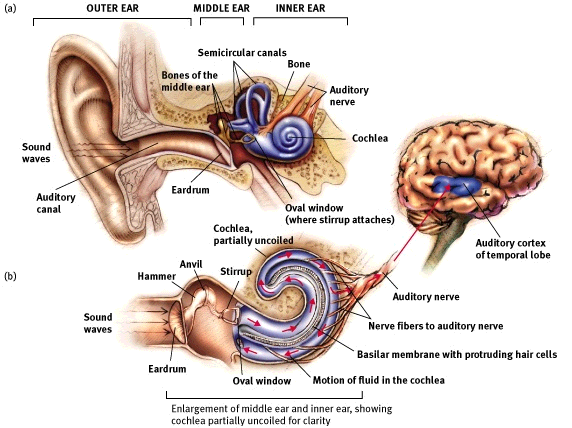
- Outer part of ear- pinna
- Cochlea is where transduction occurs
- Wave → neural signal
- Ear:
- Middle ear: transmits drum vibrations
- Audition (hearing)
- Place theory: links the pitch we hear to where the cochlea’s membrane is stimulated
- Works good w/ high pitch sounds
- Frequency theory: brain identifies pitch of sounds according to how rapid neural impulses fire
- Hair cells will volley (fire alternately)
- Deafness
- Conduction: not able to hear bc of damage to structures of middle ear, or a blockage (wax)
- Nerve: inability to transmit impulses from cochlea to brain, transduction is impaired
- Can get cochlear implant
Position & movement:
- Vestibular sense: body orientation & balance.
- Kinesthetic sense: ability to track your own body movements/parts
Smell
- Olfaction
- Odors interact w/ receptor proteins associated w/ hairs in the nose- olfactory cells (in temporal lobe)
- Hairs convey info to olfactory bulbs
- Anosmia- loss of smell
- Pheromones: chemically produced odors that send messages
- *does not go to thalamus
Taste
- Gustation
- main qualities
- Sweet
- Savory
- Sour
- Bitter
- Salty
- Chemical sense
- Nerves carry taste messages to brain in frontal lobe
- Frequently replaced
- Can be damaged (smoke, alc, hot foods)
Touch
- Somatosensory cortex
- Skin is sensitive to:
- Pressure
- Pain
- Gate control theory
- Gate that can block/allow pain signals
- Temp (warm/cold)
- Synesthesia: combo of senses