Chapter 4
Disorders of perception and attention
Introduction
Damage to the brain can impair processes, with sometimes devastating consequences
Understanding the different ways these systems can be compromised can be useful to patients and may help us develop strategies to offset some of the difficulties
Example) A person can identify pictures of inanimate objects, but struggles to identify pictures of living things, it may suggest that the internal representations of these two categories are separate (i.e. one can be damaged by a particular brain injury while the other is left intact).
Most of the disorders discussed in this chapter result from brain injury, which leaves the affected individual with a noticeable loss of ability (‘impairment’ or deficit’)
Synesthesia - A condition in which individuals presented with sensory input of one modality consistently and automatically experience a sensory event in a different modality (for example, seeing colour on hearing musical notes.
Synaesthesia
Synesthesia - to perceive together
Synesthete - A person who has the condition synaesthesia
A synesthete will consistently and automatically experience another sensory event, sometimes in the same modality (both in vision)
Triggers of synaesthetic experience are called inducers, and the experience is sometimes referred to as the "‘concurrent’.
Example) colors being induced by familiar faces or days of the wee, but also feeling sounds, seeing musical notes, seeing tastes, and tasting colours.
First known report of synaesthesia
in 1812 dissertation of Geoge Sachs (Austrian doctor)
Brought to greater prominence
Galton 1883
With the rise of behaviorism and its scepticism about subjective reports
In the 1980s
Landmark paper by Baron-Cohen et al. (1987) brought the topic back into mainstream cognitive psychology
Baron-Cohen responded to an ad in a psychology journal by a synaesthete who described herself as ‘an artist who has experienced the life-long condition of hearing words and sounds in colour’. First, Baron-Cohen tested the reliability of the artist’s experiences.
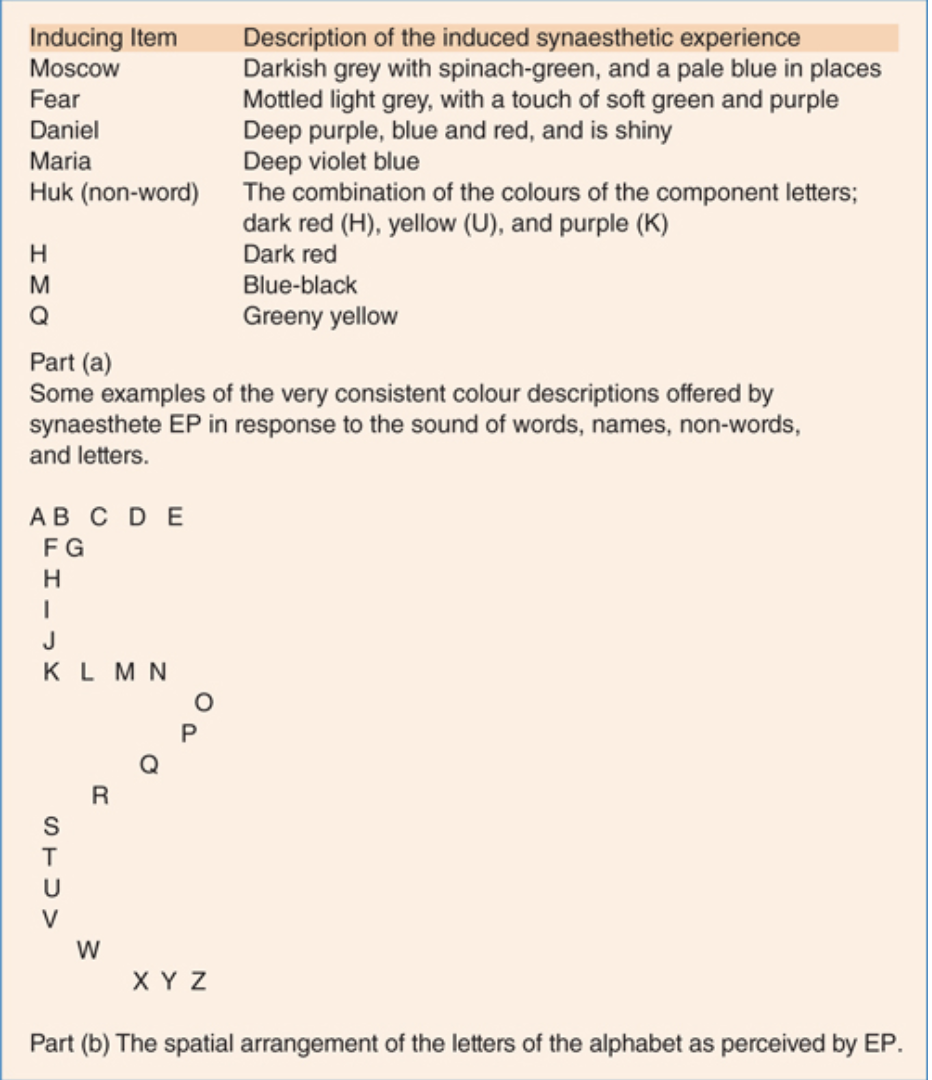
This high level of consistency over time is not unique to the artist they studied.
Mattingley et.al. (2001)
reported accuracy levels of 80-100 percent in a group of 15 synaesthetes, compared with 30-50 percent in 15 non-synaesthete controls
Synaesthetes’ reports were significantly more consistent over a three-month interval than the controls after a delay of just a month
For some classes of items (Arabic numerals) the synaesthetes achieved a mean consistency of more than 90 percent
it was less than 30 percent in the control participants
Synaesthesia is usually an unidirectional process
Letter A may give rise to the perception of red, but seeing red does not induce A
For most syntesthetes, simply imagining the inducer can be enough to produce the response
Synesthetic experiences are limited to fairly low-level percepts such as colour or spatial location rather than the appearance of a face or an object
Almost all synesthetes report that they have had the condition for as long as they can remember, and many have strong memories of the moment at which they discovered that they were different to other people
Two types of synesthetic experience
Projectors - experience the color as if it were "‘out there’ in the physical world, superimposed on the inducer
Associators - those who see the color in their “mind’s eye”
Not typically confused about the actual color of a letter
Many have strong memories of the moment at which they discovered that they were different to other people
The synaesthete’s interpretation, rather than it’s physical properties of the stimulus, induces their synaesthesia
Functional magnetic resonance imaging (fMRI) - a medical technology that uses very strong magnetic fields to measure changes in the oxygenation of the blood in the brain and thus map levels of activity in the brain
fMRI and other brain-imaging techniques allow researchers to examine changes in various measures of brain function
example) areas that are working harder during a given task require more oxygen and this arrives via the blood a few seconds after the work is done and takes a few more seconds to dissapte.
not looking at direct brain function, but a blurry map
Electroencephalography (EEG) - Recording the brain’s electrical activity via electrodes placed against the scalp. Can be used to continuously record rhythmic patterns in brain function or particular responses to events (event-related potentials
EEG is another functional brain-imaging technique that records minute changes in voltage detectable from electrodes harmlessly resting on the scalp.
Measures are sensitive (millisecond-to-millisecond)
gives crude idea about which parts (or combination of parts) the signals are coming from
IT IS POSSIBLE TO OCCASIONALLY DIRECTLY RECORD ELECTRICAL ACTIVITY FROM A SMALL GROUP OF BRAIN CELLS
More observational-correlational than actual causal relationship
Event-related potentials (ERP) - Systematic changes in the brain’s electrical responses linked to the presentation of a stimulus. Typically the stimulus is presented numerous times with the electroencephalographic (EEG
Summary
Damage to different brain regions can result in a variety of perceptual and attention disorders that can display a surprising degree of specificity
The pattern of disorders observed suggests a highly modular system in which a series of independent processes each contribute towards the goal of perception
Synaesthesia tells us that information in one modality, such as the sound of a letter, can reliably induce activity in another modality (such as colour vision) in some people
Blindsight provides an example of a dissociation between conscious experience (which may be absent) and the ability to respond quite accurately to the location and some other features of visual objects.
Prosopagnosia also provides evidence of this dissociation, as does unilateral neglect, where some patients show evidence of knowledge about familiar faces, or of neglected objects, of which they are not conscious
There is some evidence that the nature of the representation formed might be dependent on the task to be performed and, in particular, an important distinction between the perceptual processes that support action and those that result in object recognition.
Two broad patterns of impairment in visual agnosia have been identified and these were originally termed apperceptive agnosia (now generally known as form agnosia) and associative agnosia (now known as integrative agnosia).
In form agnosia patients are unable to discriminate between objects and cannot copy line drawings. Integrative agnosia is characterized by an ability to perceive the individual shapes and elements of objects with an inability to integrate these elements into a representation of the whole object
Prosopagnosia involves an impairment of face processing. It can be aquired or it can emerge early in development. In all forms of prosopagnosia there is considerable variation in the severity of impairment, associated deficits, and types of face-processing skills.
In acquired prosopagnosia there is variability in the location and type of lesion, although impairment in areas such as the fusiform face area seems to be particularly important
Modular system - a system in which different types of processing are carried out by separate and relatively independent sub-systems