6. Representation & Manipulation of Knowledge
Types of Knowledge
Declarative Knowledge: Facts and information that can be stated or declared
Example: "Paris is the capital of France."
Procedural Knowledge: Knowing how to perform tasks
Example: "To tie shoelaces, make a loop with one lace, wrap the other lace around it, and pull it through."
External Representation: Pictures and Words
External representation can take various forms:
Pictures:
Analogous to concrete attributes (e.g., "What is it? A plane or a box?")
Words:
Requirement of rule application (e.g., spelling C-A-T)
Representational flexibility through different constructs
Comparison of External Representations
Picture vs. Words: Pictures depict concrete objects, while words can address abstract concepts
Example: VATWO (Visual, Auditory, Textual, Written, and Oral) representation using both forms
Internal Representation
Concepts of mental imagery
Internal cognitive processes for representing information not currently sensed
Influenced by past experiences and various sensory modalities
Example: When you think of the taste of chocolate, you may not have chocolate in front of you, but your brain creates a mental image and evokes the sensation based on past experiences of eating it. This process involves internal cognitive functions that recall the texture, flavor, and smell associated with chocolate, illustrating how mental imagery represents information not currently sensed.
Dual-Code Theory
Integration of images and symbols for information representation:
Mental images as analog codes; verbal information as symbolic codes
Processing differences between pictorial and verbal forms.
Example: when learning a new word like "tree," an individual might visualize a tree (analog code) while also remembering its spelling and meaning (symbolic code).
Empirical Evidence of Dual-Code Theory
Research indicating separate processing of spatial and verbal information:
Easier verbal recall of diagrams than pointing to objects and vice versa
Disruption of recall linked to concurrent task types
Reference: Brooks, Lee R. (1968) "Spatial and verbal components of the act of recall."
Propositional Theory of Knowledge Storage
The Propositional Theory of Knowledge Storage posits that knowledge is stored as abstract concepts and propositions rather than just as images or words.
Propositions contain relationships and inherent meanings that go beyond simple representations.
Epiphenomena: Secondary effects or phenomena that occur as a result of, but do not directly influence, a primary phenomenon. In philosophy of mind, epiphenomenalism suggests that mental events or states (such as thoughts and consciousness) are byproducts of physical processes in the brain but do not themselves affect physical actions.
Example: The sensation of hunger could be seen as an epiphenomenon: it arises from physical processes in the body (like low blood sugar or hormonal changes) but does not directly influence the physiological cues that signal the need for food. Instead, the body is responding naturally to biological needs, while the awareness of hunger (the feeling) is just a byproduct of that process.
Propositional Representations
Example of representations:
Actions: "A mouse bit a cat."
Attributes: "Mice are furry."
Spatial positions: "A cat is under the table."
Class membership: "A cat is an animal."
Limitations of Mental Images
Visual images subject to distortion through verbal influences
Example: If someone hears the phrase "a large dog," they might imagine a big, fluffy dog based on their experiences or preferences. However, if later told that the dog is actually a Great Dane, their original image might not align with this new information, leading to a distorted or vague mental representation
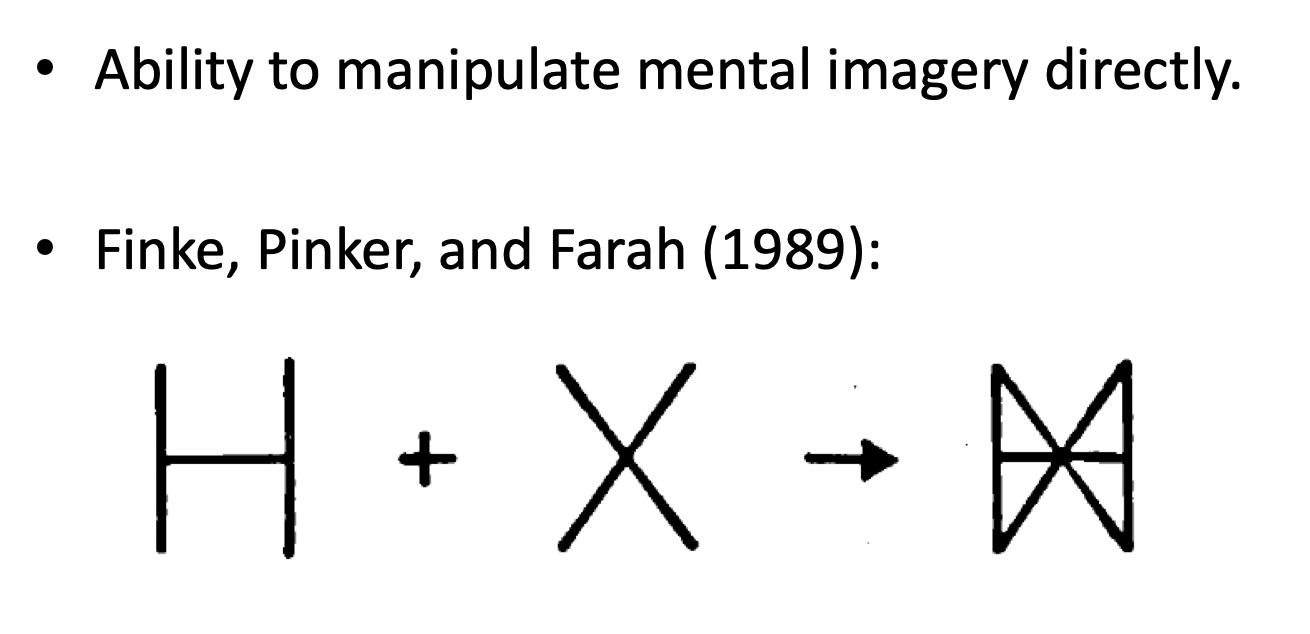
Mental Manipulations of Images
Functional-equivalence hypothesis: Mental operations performed on imagery reflect the same processes as those applied during actual perception
As such, this hypothesis indicates that we often rely on visual imagery for cognitive tasks rather than merely abstract propositions. It supports the idea that mental images can benefit understanding by providing a direct visual representation that facilitates reasoning and problem-solving tasks, which might be less intuitive when relying solely on abstract, propositional language.
Mental Rotations: Functional-equivalence Hypothesis
Cognitive process of imagining an object being turned or rotated in space.
The Functional-Equivalence Hypothesis posits that the way we mentally manipulate images of objects is similar to how we physically perceive and rotate them in real life. This means the mental processes involved in visualizing an object at different angles are comparable to the actual perception of that object as it changes orientation.
Reaction times for recognizing figure similarity based on rotation angles.
Studies have shown that the greater the angle of rotation between the figures, the longer it takes for individuals to accurately determine their similarity. This reaction time is indicative of the mental effort required to visualize and mentally rotate the figures in order to arrive at a conclusion.
Example: When participants are shown two shapes, such as two letter "R" shapes, which are identical but one is rotated by 180 degrees, they demonstrate differing reaction times based on the rotation angle. If the rotation is just 0 degrees, they can identify them as the same almost immediately. However, if one shape is rotated by a larger angle, such as 90 degrees, it takes them significantly longer to respond because they have to mentally visualize and rotate the shape to confirm that they are indeed the same. This longer reaction time indicates the cognitive effort required to perform mental rotations.
Impact of Mental Tasks on Neural Activity
Overlap in brain activation for perception and mental rotation tasks
The impact of mental tasks on neural activity refers to how engaging in different cognitive activities activates specific areas of the brain. When individuals perform mental tasks, such as solving mathematical problems, visualizing objects, or recalling information, different neural circuits are recruited, leading to observable changes in brain activity. This suggests that our cognitive processes are closely linked to the physical actions occurring in the brain, where distinct tasks require the engagement of various regions to facilitate the necessary mental operations.
Image Scaling in Mental Images
Prolonged time to describe smaller objects relative to larger ones
Example: Comparing a picture of a rabbit next to an elephant. It would be easier to describe the elephant and would take longer to notice the details and describe the rabbit.
Importance of size in detail recognition
Image Scanning in Mental Imagery
Longer scanning times for greater distances in mental representations
Example: When mentally scanning a map, it takes longer to visualize the distance between two cities that are far apart compared to two nearby cities.
Supportive evidence for functional-equivalence during image processing
Synthesizing Theories: Images and Propositions
Combination of Dual-Code Theory and Propositional Theory
Understanding how mental models are formed:
Three forms of knowledge representation:
Propositions: These are declarative statements that express relationships between different concepts or ideas. For example, "The cat is on the mat" conveys a relationship between the cat and the mat.
Images: This form refers to visual representations that evoke mental pictures and can help in understanding concepts. For instance, picturing a cat sitting on a mat can aid in recalling the information about the relationship described in the proposition.
Mental Models: These are internal representations of external reality that help individuals understand and predict how things work. For example, envisioning the layout of a room based on the arrangement of furniture illustrates how mental models can guide everyday interactions and spatial reasoning.
Mental models structured by individual’s own understanding.