Diffraction
Diffraction is the spreading out of waves as it passes though gaps.
A wavefront is an imaginary surface that represents a wave.
Conditions for diffraction
Conditions | Results |
Wavelength similar to gap / object width | Maximum diffraction |
Object width less than wavelength | Little diffraction |
Object width much smaller than wavelength | No diffraction |
Wavelength smaller than gap | Little diffraction |
Wavelength larger than gap | No diffraction |
Diffracting through a single slit
Using monochromatic light
Has a central maximum that is wider and brighter than the other fringes.
As we move away from the central maximum, the bright fringes get smaller and dimmer.
Notes
Increasing the slit width will increase the number of bright fringes and cause the central maximum to be brighter and narrower.
Increasing the wavelength causes the central maximum to get wider, decreases the number of fringes and increases the distance between the fringes increases.
Using white light
The central maximum is always white in colour and is brighter and whiter than other fringes.
Red is diffracted most and violet is diffracted least. Violet is closer to the central maximum than red is.
Diffraction through a double slit (Youngs' double slit)
Produces bright and dark fringes with equal width
No central maximum
w = fringe spacing (m), λ = wavelength (m), D = distance between slit and screen (m), s = distance between slits (m)
Notes:
Increasing the number of slits: causes brighter and narrower bright fringes, darker dark fringes.
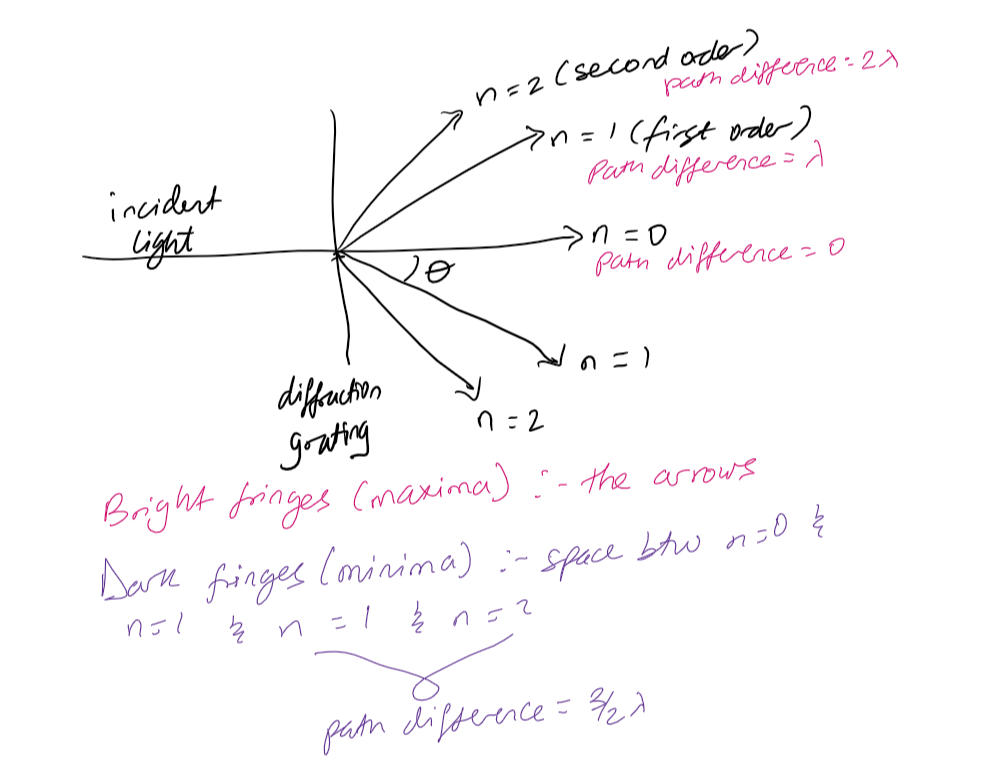
Diffraction grating equation
n = order number, d = distance between slits (m), sinθ = angle of order
For N lines per mm:
Maximum number of orders (n): set sinθ = 90°. Always round DOWN
Maximum number of bright fringes, 2n + 1