Point Prescriptions
Step 1: Always start from a Diagnosis and Differentiation
Step 2: What is the Location of the Disease? Internal or External. If external, Where by
body area and Meridian.
Step 3: What Channels and Points are appropriate? The Channel comes before the
point.
Step 1: Different ways to Differentiate
-8 Principles: Internal/External, Excess/Deficiency, Hot/Cold, Zang-Fu
-Zang-Fu Organs
-Qi, Blood and Body Fluids
-6 Stages, 4 Levels and 3 Jiaos
-Pathogenic Factors: Hot, Cold, Damp, Dry, Wind, *Summer-Heat
-Meridians
-5 Elements
-Extraordinary Channels
-More? Daoist Astrology, Constitution, Ghosts, etc.
8 Principles:
Internal? Zang-Fu.
External? 6 level/4 level/3 Jiao and or by meridian
Excess/Deficiency? Nature of individual points: Source, Connecting etc plus THERAPEUTIC TECHNIQUE- Tonify/Reduce, Moxa/Bleeding etc.
Hot/Cold? Nature of points ie; clearing heat points, tonifying yin points and warming points = Moxa/heat lamp.
Zang-Fu: See Zang-Fu section.
-Zang Fu organs:
Massive topic, most of herbal medicine based on this. Choose the appropriate Meridian and then the appropriate point type.
-Qi, Blood, Body fluids
Qi Deficiency: Ren 6 lower sea of Qi, 12 middle sea, 17 upper sea, Yangming Channel points like St 36, Li 4 etc.
Qi excess: See Bi syndrome.
Blood Deficiency: Treat earth ie; St 36, Sp 6, 10, Ren 12, Li 10, Sp 4/P6, Bl17.
Blood excess: See Bi syndrome.
Body Fluids:
Dryness: Lu7, K6, K3, St 36, Ren 4, 10, Bl 23.
Phlegm: St 40, Lu 5, Lu7, Bl 21.
Dampness: Sp 9, 6, Ren 9, Bl 22 & 23, Ki3 & 7.
6 Stages:
Taiyang- Release the Exterior: Bl 12, 13, Gb 20, Te 5, Lu 7, Li 4
Yangming, Clear Heat: Li 11, 4, St 44, Du 14, Sp 6.
Shaoyang, Harmonize: Te 5, Gb 41
Taiyin: ZF
Shaoyin: ZF
Jueyin: ZF
4 Levels:
Wei: See Taiyang
Qi: Du 14, Lu 5/10/1, Li 4/11, St 44,/37, St 25, R12
Ying: Shixuan, P9/8/3, K6
Xue: Bl 17, Sp10/4, Lr 2/3, Li 11, St 36, K6, R4.
3 Jiaos:
Upper Jiao: Heat in the Lungs or Pc. See Wei
Middle Jiao: Heat in Sp/St. See Qi
Lower Jiao: Heat in Kidney/Liver. See Ying/Xue
Pathogenic Factors:
Hot/Heat: Du 14, Li 4 & 11
Cold: R4, R6, St 36
Damp: Sp 6 & 9, R10
Dry: Lu 7, K6, St 36
Wind: Gb 20, Te 5, Gb 41, Gb 31, (Bl 12/13 if external)
*Summer Heat: Du 14, Sp 6/9, P6, GB 20
Meridians: See step 2 on Location
Extraordinary Channels:
Your confluent pairs are:
Ren: Lu 7, K6
Du: Si 3, Bl 62
Chong: Sp 4, P6
Dai: Gb 41, Te 5
YinQiao: K6, Lu7
YangQiao: Bl62, Si3
YinWei: P6, Sp4
Yangwei: Te5, Gb 41
5 Elements:
Generating and Controlling sequence. Mother Tonifies, Child Reduces, Grandparent “controls”.
Chinese 3 needle technique and Korean 4 needle techique are examples of 5E Recipes
6 Channel pair, Zang Fu pair
8-10 needles
Example:
headache from LR Qi stagnation → heat
pick a LR point, shu stream are best to move. Balance hand and foot, can be from hand jueyin + foot jueyin
LR3 + PC7 → hand/foot, LI4 + ST36 → hand/foot yangming for heat clearing, GB41 shu-stream
“few needles as possible, but enough as needed”
Example:
SP Blood Deficiency
“where is the problem” SP so we will pick one that tonifies
Front-mu reduces, back-shu tonifies
luo connecting disperse accumulation which is a form of reducing. ST40 disperses phlegm accumulation. LU7 disperses water through passages
deficient organ = stream + he-sea
disharmony = source + zang-fu pair
hand/foot
Earth builds blood
SP3 (source/shu-stream) + SP9 (he-sea) treat the middle to build blood, ST36, LU5 (he-sea of hand taiyin), R12, R4
Example:
Damp-Heat in Lower Jiao = fu organs, KI, LR
Painful urination - burning urination is a small intestine pattern
Dampness is mainly Spleen, so pick a spleen point
Zang fu pair for spleen
pick a hand taiyin
major clear heat are yangming points - large intestine + stomach
local point - R3 front mu of bladder
SP6, ST40, LU7, LI8, R3, ST28
=
SP6/LU7
ST40/LI8
Local R3 + ST28
Me:
Wind Cold Invasion, cough, phlegm
LI4, LU7, Taiyang, yintang, ST36, R4, R17
LI4, LU7, ST40 (phlegm), LI11 (Fever), R4 (warming, spleen), R22 (cough, throat), Yintang (nose)
Step 2: Location and Nature of Disease:
Is the Problem Internal or External?
Internal? See Step 1. External Wind? See step 1.
External pattern manifesting as Bi Syndrome:
2 types: Qi and Blood Stagnation
Qi pain: Wandering and changing pain- diagnose affected Meridian(s)
Blood pain: Localized and intense- Diagnose affected Meridian and structure ie; knee, shoulder, bone, joint etc.
Pain: Treating locally, treating adjacently, treating distally, treating by image on opposite limbs.
Locally: Self-explanatory. Is it appropriate or inappropriate by nature of injury?
Adjacent: What anatomical structures support the pain area?
Distally: What is the Meridian, muscle and nerve pathway?
Opposite Limbs: Image the disease area on an opposing arm or foot or both. For muscle treat muscle, vessel treat vessel, tendon treat tendon, bone treat bone etc. Use 6 Channel pairs together with Ashi points to get started.
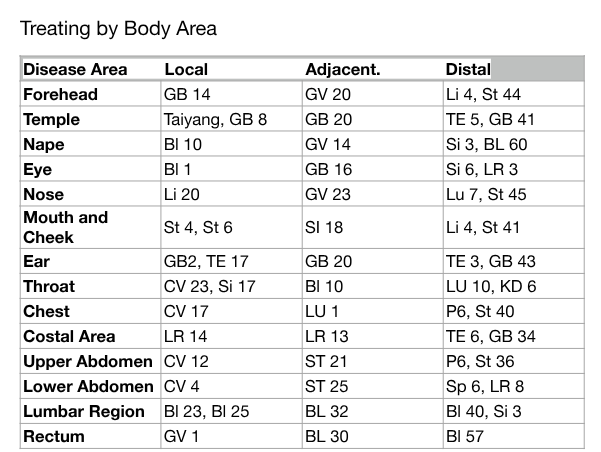
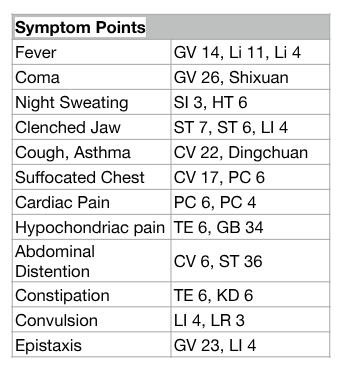
Don’t have to memorise:
Step 3: Channels and Points:
Treating by nature of classification of points:
Source: Tonifies
Connecting: Disperses and connects
Mu: Regulates and Reduces
Shu: Regulates and Tonifies
5 Shu (Water transporting points): Well, Spring, Stream, River, Sea: See lecture notes
5 Elements: Generating and Controlling sequences, Parent, Child and Grandparent effects.
Treating by Modality:
Moxa: Tonifies and warms
Bleeding: Moves and reduces
Cupping: Moves and disperses
Treating by Body Area and/or Symptom: (See Charts Above)
Combining points:
Always combine Hand and Foot, Left and Right and Inside and Outside. The treatment does NOT have to be symmetrical to be balanced.
A treatment should be as few needles as possible and as many as necessary. 8-10 needles is good for an internal diagnosis. Bi syndromes can sometimes require more. Can a problem be fixed with 1 needle? Can you light a fire using only your mind?
Hand and Foot: 6 Channel pairs (Chinese name pair) Taiyin, Shaoyang, Shaoyin, Jueyin, Taiyin, Yangming.
Inside and Outside: Zang-Fu Pairs
Left and Right: Always treat the whole body unless you’re a physiotherapist. TCM treats person, not just disease.
Point pairs:
Host/Guest: this is combining the Source of affected with the Connecting of it’s ZF pair- works best in ZF patterns
Stream/Sea of ZF pairs: Combine Stream of affected with Sea of ZF to harmonize.
Stream/sea same Channel: Effective to Tonify.
Point prescriptions should have Yin and Yang Channels and combine Hand and Foot Channels. How that is done is up to the Acupuncturist- like how combining ingredients is up to a chef. There are many different and effective styles of acupuncture such as TCM style, Orthopedic/medical, Balance, Microsystem, 5 element, Korean hand/japanese abdominal etc. The more tools in your box, the more effective you may be. Mastering a style is also better than dabbling in everything however.
Example: Lr Qi Stagnation
TE, 6, GB 34, Lr 3, P6, R 17.
This has ZangFu pair, 6 Channel Pair and a Local symptomic/Qi moving point.