testing and metal finishes
TESTING METALS
tensile testing is used to see if a material can withstand pulling forces. you can use a load and clamp method in a workshop or a tensometer in an industrial setting - their lower the deflection the higher the tensile strength
toughness testing sees how much force a metal can absorb. first clamp a piece of metal and than impact it with a hammer and measure how far it bends after 3 strikes or whether it breaks completely. in industry use a charley or izod test to measure energy absorption (see wood testing and finishes)
hardness tests can be done for abrasive resistance and indentation resistance. either scratch with a file or sandpaper and count the scratches or drop a centre punch through and aluminium tube and measure the depth and area of indentation. industrial testing uses the Janka, Rockwell, Brinnel or Vickers test to measure indentation (see wood testing and finishes)
to measure malleability and ductility bend a piece of metal to 90 degrees in a vice. then count number of cracks on the outside and inside. the more on the outside the less ductile it is, the more cracks on the inside the less malleable it is. a plunger loads the bend test machine to do the same thing
corrosion testing can be done to predict how. a metal puts up with environmental effects such as rain. use similar size pieces and leave them outside for a set period of time and visually check or spray them with water and chemical mixes. a salt spray or humidity test can be done for corrosion testing in industry
NON-DESTRUCTIVE TESTING
non destructive testing is normally used on finished products and expensive/hard to replace materials, it can also be used during component check ups
the liquid penetration test can be done where a penetrant is sprayed then it is lightly washed and a developer is sprayed on this leaves a colourful marked of all the indentations allowing for easy spots of impure and damaged parts
electrical conductivity can be done using a multimeter connected to two ends of a price of metal. the higher the resistance the lower the conductivity of the metal. in industry four point probes test can be used to measure both voltage and current for a more accurate result
thermal conductivity can be tested by using a grease based paste on a metal bar with a ball bearing or nut at one end and a heat source at the other - the longer it takes from the ball to fall off the lower the electrical conductivity. in industry heat flow meters can be used with temperature controls and flow sensors
other non destructive testing includes ultrasonic and x ray testing for inside defects that couldn’t be seen by the human eye
STRUCTURE CHANGING
metal enhancement is important to improve qualities such as hardness and ductility. metal is made from a grain structure. if it is pure the grains are the same size - it can also be affected by the rate of cooling, radiation and how it is worked
when a metal is cold worked ; hammered or beaten without heat it can affect the metal grains (crystals) making it more brittle and susceptible to cracking as the crystals cannot move around as easily
quenching seals the surface making it tougher while no affecting the core of the metal by dunking hot metal into water or oil to rapidly cool
annealing can be done to relieve stress by heating ferrous metals to 725 celsius (cherry red) or 350-400 for aluminium and soap. copper and brass are heated to dull red and then left in the air or quenched. in industry this is down in a controlled furnace and in a brazing hearth in a school workshop
hardening metals is when you heat steel (under 0.4%) to red and then quenching it, the higher the carbon percentage the harder the metal.
case hardening makes the surface harder and more indentation resistant and can improve ability to resist daily wear and tear. suitable for gears and valves it is done by carburising, dipping the metal with a low carbon content into a carbon powder which diffuses into the metal , then heating it and then finally quenching it
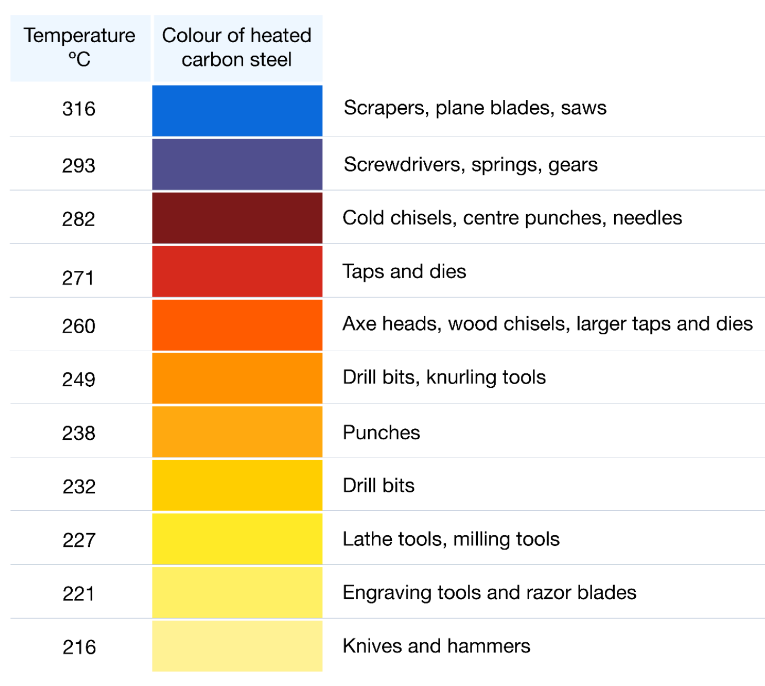
tempering metals is done to make a metal less brittle and more tough after it has been hardened. medium or high carbon steel is heated to the critical temperature for its use. once it changes to the right colour it is left to cool in the air, it makes metals less hard but tougher
 normalising metal is a type of annealing for metals with iron that has the benefit of having a shorter cooling time. it removes internal stress and increase strength in the structure without softening. it occurs when metal is soaked at 700-900 celsius and then air cooling
DEFINITIONS
work hardening - increasing the tensile and hardness strength of a metal in an area that is cold worked
annealing - heating work hardening metals and slowly cooling it to make it more ductile
case hardening - hardening the surface of steel with less than 0.4% carbon content
carburising - dipping a heated metal into carbon power to increase surface hardness in case hardening
quenching - quickly cooling a metal
hard ending and tempering - heating medium or high carbon steel to a temperature and quenching it, the heating to remove excess hardness
tempering colour - the colour that indicates a heat of metal when brittleness is removed
critical point - the temperature when carbon and steel a can mix freely