Lecture 4: Igneous Rocks
Granite
Dominant minerals:
quartz
plagioclase (na-rich)
muscovite
Rarer minerals:
biotite
amphiboles
Diorite
Dominant minerals:
Amphiboles
Plagioclase (Ca+Na)
biotite
Rarer minerals:
Pyroxene
Gabbro
Dominant minerals:
Pyroxenes
Plagioclase (Ca-rich)
Amphiboles
Rarer minerals:
Olivine
Amphiboles
Peridotite
Dominant minerals:
Olivine
Pyroxene
Certain minerals are often found together
K-Feldspar and Quartz
Pyroxenes and Olivine
Certain minerals are NEVER found together
Quart and Olivine
Bowen’s reaction series
8 minerals (or mineral groups) in the discontinuous series
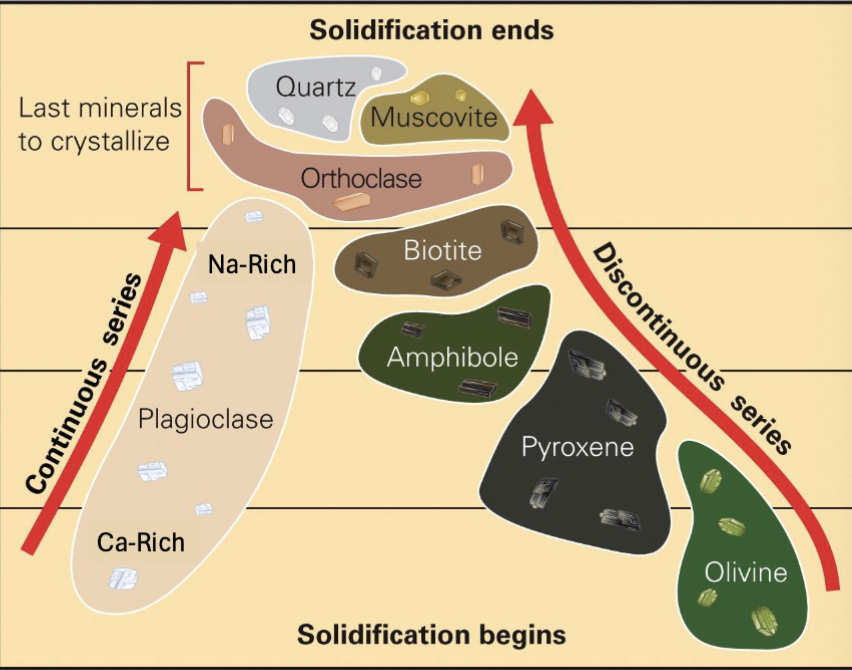
Crystallization Temperature
Olivine at 1,400 C → quartz at 650 C
Elemental Composition
Rich in iron (Fe), calcium (Ca), Magnesium (Mg) ←→ rich in silicon (Si), Oxygen (O), aluminum (Al)

Continuous series and solid solution
Albite (NaAlSi3O8) ←→ Anorthite (CaAl2Si2O8)

Mafic
Fe, Ca, Mg rich
Denser
darker color
higher Crystallization temperature
VS.
Felsic
Si, O, Al rich
less dense
lighter color
lower Crystallization temperature
Igneous rocks
Igneous comes from the latin ignis - fire
all igneous rocks come from the solidification (freezing) of a melt - magma (belowground) or lava (aboveground)
Igneous rocks solidify (freeze) between 650 C and 1100 C depending on their composition
they get categorized based on where they freeze (above or below earth’s surface)
Extrusive Igneous rocks
Form from lava
forms from both pyroclastic debris and solidified lava flows
Intrusive igneous Rocks
form from magma
forms when magma intrudes into existing rock underground
Why does magma form?
some of the heat that creates magma is relic heat from the formation of the earth, including heat released by decaying radioactive elements
however, most of the crust and mantle remain solid due to pressure
certain conditions can allow pre-existing rock to melt
Flux melting
Volatiles such as water and CO2 mix with hot rock, they react and cause melting
the addition of these impurities lowers the melting temperature of rock

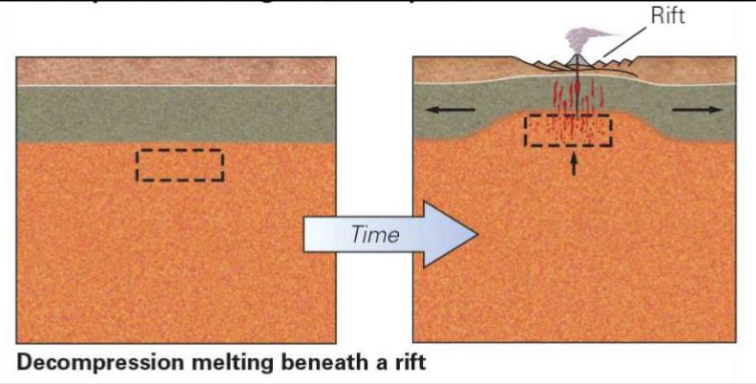
decompression melting
when mantle rock rise upward they experince less pressure, but remain at basically the same temperature
lower pressure causes the rocks to go from solid to liquid
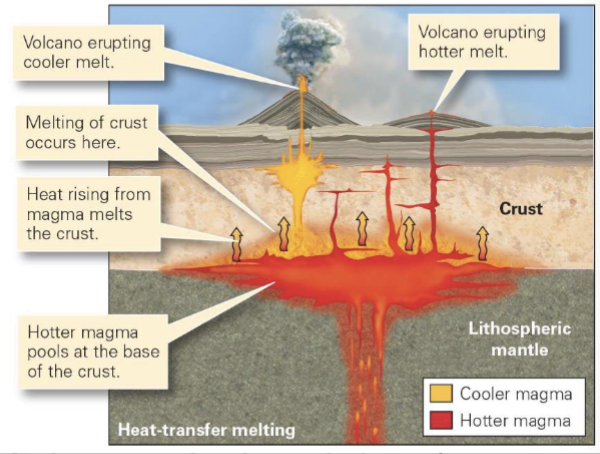
Heat transfer melting
when magma rises into the crust, its heat raises the temperature of the surrounding rocks
this can cause the surrounding rocks to melt
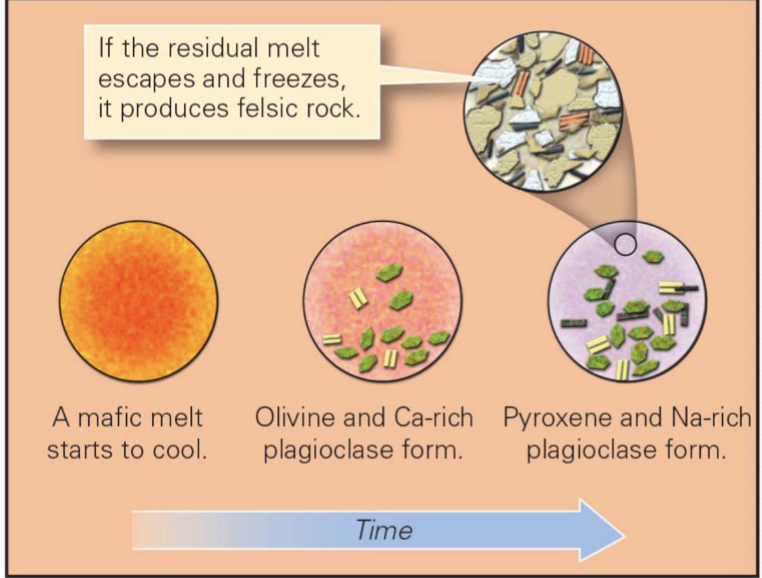
Fractional Crystallization
as magma cools, Fe and Mg-rich (mafic) minerals crystallize first
the remaining melt becomes more felsic
Partial melting:
if only part of an original rock melts at a given time, the melt that forms will be more felsic than the source rock

Where do melts cool?
Intrusive (below ground)
Intrusions (magma moving into existing rock) produce different shapes
Extrusive (above ground
volcanos
extrusive lavas cool relatively quickly compared to intrusive magmas
Igneous rock classification
How big are the crystals

Mineral/Chemical Composition
rock that are felsic (high in silica) tend to be light-colored and low density
rock that are mafic (low in silica, high in magnesium and iron) tend to be dark colored and high density
Rocks can have the same composition but different names due to different rates of cooling a grain sizes
bulk chemically speaking a basalt is the same as a gabbro

The proportions of iron and magnesium rich vs. silica rich minerals varies with the composition of igneous rocks

Glassy igneous rocks are categorized based on their composition and the presence of gas bubbles (vesciles)
