Topic 21: Social Movements
Social Movements and Activism
Social Activism
How to Ignite a Movement
Understanding the framework and strategies behind initiating collective actions.
Principles of Social Justice
Key concepts that underpin social justice movements:
Justice: Fair treatment and the equitable distribution of resources.
Understanding: Acknowledging and empathizing with diverse experiences.
Participation: Engaging community members in decision-making processes.
Inclusion: Ensuring all voices are represented.
Diversity: Recognizing and valuing differences among individuals.
Access: Providing opportunities for all individuals to participate fully in society.
Equity: Fair allocation of resources considering individual needs.
Class, Race, Gender, Power: Key dimensions influencing social justice.
Opportunity: Equal chances for all individuals to thrive.
Collaboration: Working together towards common goals.
Women's Rights and Abortion Access
Strong feminist advocacy encapsulated in slogans like "A Woman's Place is in Your Face!"
Pro-Choice vs. Pro-Life debate illustrated by contrasting views on abortion rights. Pro-choice advocates emphasize keeping abortion safe and legal.
Black Lives Matter Movement
"YES, ALL LIVES MATTER BUT WE'RE FOCUSED ON THE BLACK ONES RIGHT NOW"
This expresses the current focus on racial injustices faced by Black individuals, highlighting systemic issues within the judicial system.
B. Types of Social Movements
Definition: Collective and organized activity that attempts to bring about or resist social change.
Actions taken outside social institutions based on discontent and dissent.
Types of Social Movements
Proactive vs. Reactive:
Proactive: Initiating social change.
Reactive: Responding to changes already happening.
Amount of Change:
Partial vs. Total: Scope of change being pursued.
Individual vs. Society:
Individual: Focus on personal behavior changes.
Society: Emphasis on social structures and systems.
Types of Movements Explained
Alternative Movements (Individual/Partial)
Aim to alter a specific behavior.
Redemptive Movements (Individual/Total)
Seek total change of the individual.
Reformative Movements (Society/Partial)
Reform specific aspects of society.
Transformative Movements (Society/Total)
Aim to transform the entire social order.
Related Phenomena
Coup d'état, rebellion, and terrorism defined as extreme forms of social movements characterized by unlawful use of force to intimidate or coerce for specific objectives.
C. Characteristics of Social Movements
Historical Rise
Movements often emerge during periods of social unrest.
Rational Objectives
Goals are typically well-defined and thought out.
Interaction with Social Environment
The environment can enable or disable movement goals.
Functions of Social Movements:
Mediation and mobilization of individuals.
Clarification of collective consciousness.
Source of social change.
Social Change
Definition: The transformation of culture, social institutions, and patterns of soical organization over time.
E. Recruitment to Social Movements
1. Psychological Motivations
Deprivations
Aspirations
Moral obligations
Selective incentives
Collective incentives
Expectancies of success
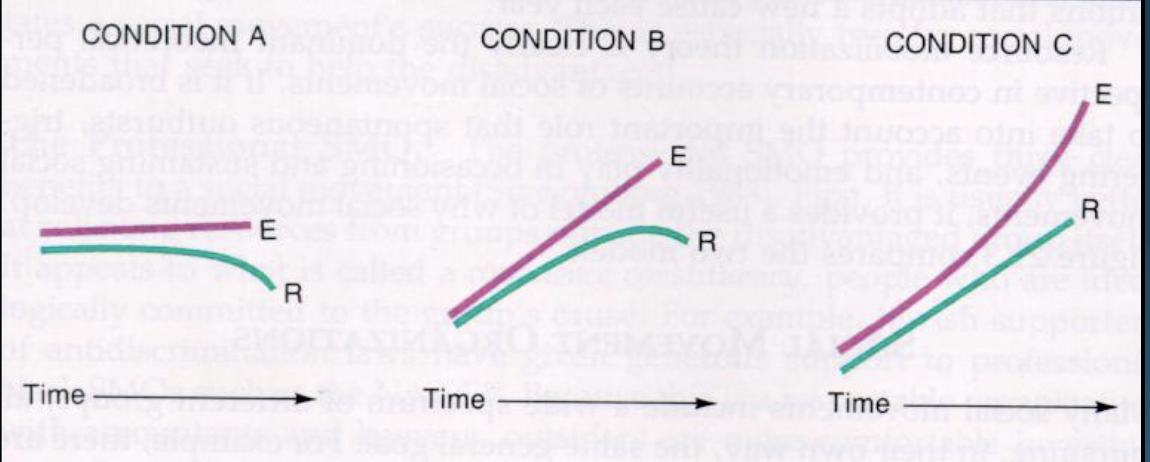
Absolute deprivation - Objective circumstance e.g. abject poverty or total oppression.
Relative deprivation - Subjective sense based on comparison to a reference group or ideal standard
2. Social Networks
Web of relationships in which the individual is embedded.
3. Ideology:
Values and beliefs
Analysis of the problem
Proposed solutions
F. Factors Associated with Movement Success
Demands which match societal values.
Invested third party support.
Concrete and focused demands.
Direct pressure on responsible party.
Using new techniques.
Presence of neutral third parties.
Negotiable demands.
Stating the case positively.
Optimum size of the movement.
Overcoming external opposition.
G. Social Movement Problems
Diverse Organizations that may have conflicting agendas.
Routinization leading to diminished effectiveness over time.
Inability to Achieve Goals with varied success rates.
Achievement of Goals
Problematic People
Slacktivists: Low-risk, low-cost activity via social media, whose purpose is to raise awareness, or grant satisfaction to the person engaged in the activity
Feel-good online activism that has no real political or social impact = “clicktivism”
Often mixed with hipster consumerism - the commodification of social activism: “aWEARness”
Performative activism: Activism done to increase one’s social capital rather than because of one’s devotion to a cause (ex. “posing”)
Social Justice Warriors (SJWs): Engaging in activism to promote social justice but uses for personal reputation gains rather than genuine concern.
Free Riders: Individuals who passively support social movements in order to reap the benefits, but do not actively participate in them.
Inspiring Quotes on Activism
Gandhi: "You must be the change you wish to see in the world."
Sydney Smith: "It is the greatest of all mistakes to do nothing because you can only do little."
Starfish Story: A parable illustrating how individual actions can make a significant difference.
Anita Roddick: "If you think you're too small to have an impact, try going to bed with a mosquito in the room."
Case Study: Mothers of the Plaza de Mayo
Originated during Argentina's military junta in 1976 when children began disappearing.
Mothers protested for their missing children, forming a significant social movement despite facing police brutality.
Achieved recognition and laid groundwork for future human rights advocacy in the country.
By 1983, they were honored at the inauguration of a new president, symbolizing their success.